ALLPCB


Classification of automotive sensors
Automotive sensors are key components of electronic control systems and are the main source of information for vehicle controllers. Their primary function is to use signal conversion devices installed at various vehicle locations to measure or detect working parameters of relevant components under different operating conditions, convert those measurements into electrical signals that the ECU can accept, and provide feedback for the ECU to compute and issue control commands to actuators.
Based on purpose, sensors can be divided into two categories: traditional MEMS sensors that enhance vehicle information and intelligent sensors that support autonomous driving.
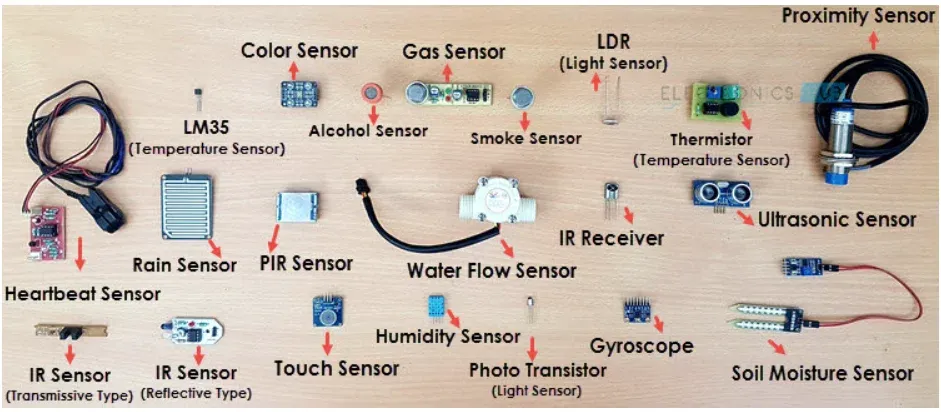
Traditional sensors act like the vehicle's "neurons" and provide feedback for automatic control in various systems. Common types include pressure sensors, position sensors, temperature sensors, acceleration sensors, angular velocity sensors, flow sensors, gas concentration sensors, and liquid level sensors.
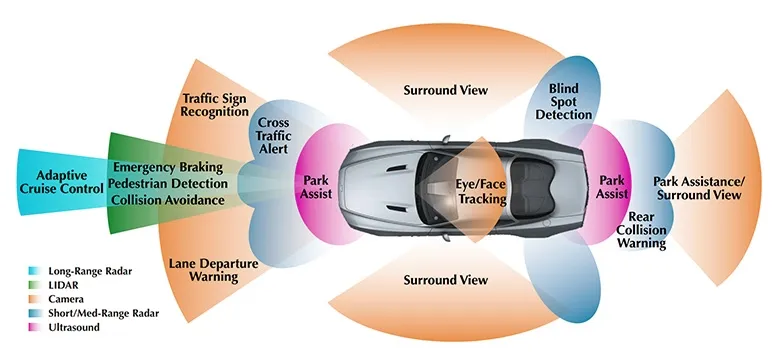
Intelligent sensors perform environmental perception and planning for automated vehicles. Typical types include LiDAR, millimeter-wave radar, ultrasonic sensors, and cameras.
Performance requirements for automotive sensors
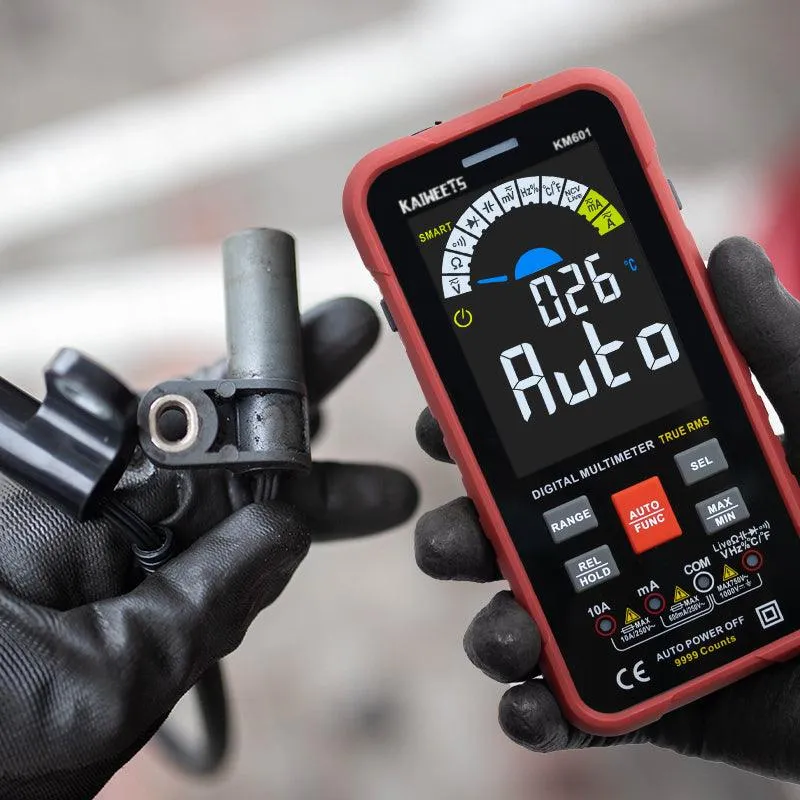
Automotive sensors require multiple rounds of test and measurement to ensure quality and performance. Key performance indicators are typically tested along the following dimensions.
Basic functional characteristics
- Range: measurement span.
- Sensitivity: the ratio of output increment to corresponding input increment.
- Resolution: the smallest input increment detectable by the sensor.
Accuracy characteristics
- Linearity: the deviation between the sensor calibration curve and the best-fit straight line.
- Repeatability: the degree of overlap of multiple characteristic curves obtained when the input varies repeatedly in the same direction under identical operating conditions.
- Hysteresis: the degree of noncoincidence between the actual response curves for increasing and decreasing inputs.
- Drift: changes in the sensor zero output and sensitivity over time and temperature.
- Stability: the ability of the sensor system to maintain performance over long periods.
- Total error: the maximum deviation between the sensor reading and the measured value.
These factors show that precision calibration is a critical testing item for automotive sensors.
Calibration
Calibration establishes the relationship between sensor input and output through experiments and determines error relationships under different use conditions. The basic method is to use a high-precision DC power source as the input, apply it to the sensor under calibration, measure the sensor output, and compare input and output. When the calibration curve meets the required standard, the sensor accuracy is considered acceptable. Calibration is divided into static and dynamic types: static calibration determines static characteristics such as sensitivity, linearity, repeatability, and hysteresis; dynamic calibration determines dynamic parameters such as frequency response, time constant, natural frequency, and damping ratio.
Electrical performance testing
In addition to accuracy calibration, automotive sensors must pass multiple electrical performance tests to ensure stable operation within vehicle electrical environments.