ALLPCB


Overview
In near-field communication (NFC) design, engineers face challenges in optimizing RF performance, hardware design, and software. Single-chip NFC solutions combined with comprehensive software support have changed how NFC is integrated into consumer electronics, wearables, and IoT devices.
These changes allow developers to add many application features with minimal impact on package size, power consumption, or project schedules.
NFC provides a distinctive bidirectional communication capability for simple, inherently secure, low-power short-range wireless connections. Communication occurs only when two devices are brought into close proximity, minimizing the risk of message interception and reducing potential attack paths. Additionally, only one device needs to be powered during communication, keeping average power consumption low.
Use Cases and Benefits
NFC can bring significant benefits to a wide range of smart-home and IoT applications. A user can tap an NFC-enabled smartphone to an NFC-enabled product to complete Bluetooth or Wi-Fi pairing. NFC can serve as an underlying technology for device personalization and simplify smartphone tasks such as configuring settings, transferring data, or registering products.
Embedded NFC
NFC is a subset of RFID that operates at 13.56 MHz and can perform many functions similar to contactless smart cards and RFID tags. NFC supports three communication modes: card emulation, peer-to-peer, and read/write.
In card emulation mode, an NFC device acts as a contactless smart card for applications such as ticketing, access control, transit, toll systems, and contactless payments. Peer-to-peer mode allows two NFC-enabled devices to connect and exchange information, for example to configure Bluetooth or Wi-Fi parameters or to debug devices within a trusted network. In read/write mode, one device can read data from another device or tag, such as reading a URL or coupon embedded in a retail sign with an NFC-enabled smartphone.
An embedded NFC device used as a tag connects to a host processor inside the product and behaves like dual-ported memory. One memory port is accessible wirelessly via the NFC interface, while the other is accessible by the embedded system over an I2C interface. External data sources such as smartphones can supply data to the embedded system, and the host processor can update data stored in the NFC device so that an NFC-enabled external device can access it even when the product is powered off.
This approach is useful for applications that need to transfer data between embedded systems and external systems (for example, an NFC-enabled smartphone). By using the NFC device's wireless link and its onboard storage used during downloads, developers can update embedded system data and even firmware.
Single-chip NFC Controllers
Historically, adding NFC to MCU-based designs posed hardware and software challenges. Hardware engineers had to ensure correct timing between the NFC device and the host, meet low-power targets, and minimize package size and BOM. The software challenge was often greater, as engineers had to implement many low-level tasks to realize a single application-level NFC function.
Advanced NFC devices such as the PN7150 integrate an RF front end with a low-power ARM Cortex-M0 core, memory, and I/O peripherals in a single package. By managing timing between the embedded host and the RF front end, these devices significantly reduce hardware integration problems while supporting higher RF output power. An integrated I2C interface can be compatible with NTAG I2C Plus devices for sensors, lighting, and other smart-home networked devices. The device can also reduce power requirements by automatically switching to low-power modes while keeping the host asleep until RF communication is required.
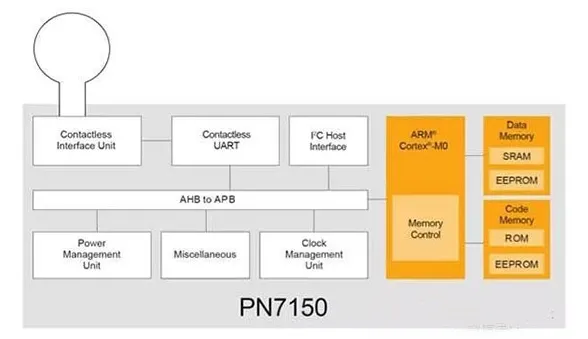
Figure 1: The PN7150 NFC controller combines a complete RF front end, an ARM Cortex-M0 host, and integrated firmware.
Beyond simplifying hardware, embedded NCI firmware in devices like the PN7150 reduces host interactions and provides a higher level of abstraction for NFC application developers, easing the software development burden. By moving low-level code into firmware, the PN7150 reduces the host-side application code footprint.
Direct-replacement Solutions
The PN7150 provides integrated hardware and software aimed at direct-replacement NFC solutions for developers working in Android, Linux, or Windows environments. Developers unfamiliar with NFC can use existing PN7150 demo kits for platforms such as Arduino, BeagleBone Black, and Raspberry Pi. Each kit includes a PN7150 NFC controller board, a dedicated interface board, and an NFC sample tag.
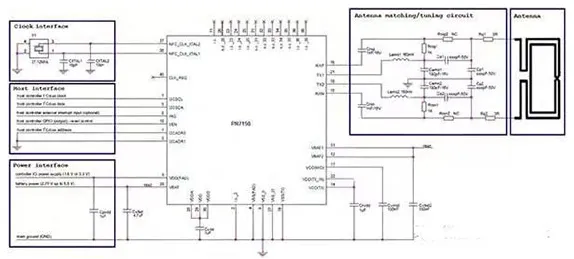
Figure 2: The PN7150 requires few additional components to deliver a complete NFC subsystem. It integrates easily with a host MCU via a simple hardware interface and integrates with host software through the NCI protocol.
Designers need fewer components to create a complete NFC subsystem for existing MCU-based designs. In some cases, engineers can remove or consolidate passive components in the antenna matching network to reduce BOM further.
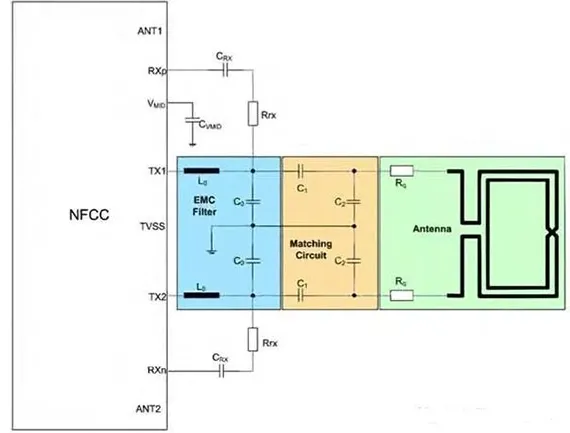
Figure 3: Using the PN7150 as the NFC controller (NFCC) can simplify antenna matching circuits and reduce the BOM for some applications.
In a typical antenna circuit, RQ damping resistors on the antenna feed reduce an excessively high antenna quality factor that would otherwise degrade signal shaping. For designs using a nominal antenna quality factor, these RQ damping resistors can be removed from the antenna end. In the matching network, when the design-specific antenna feed has a very low maximum peak-to-peak voltage, designers can replace paired parallel capacitors with a single capacitor and remove connections to EMC filters. In typical applications with a small antenna connected to the PN7150, the antenna-generated peak-to-peak voltage is relatively low, allowing the removal of the Rx decoupling capacitor and direct connection of the Rrx resistor to the antenna to simplify the Rx path.
Simplified Software
From a software perspective, the PN7150 provides a simple execution model that accelerates product development. The host architecture combines a transport-layer driver, an NCI driver, and middleware consisting of an NFC execution environment (NFCEE) that includes read/write, peer-to-peer, or card-emulation libraries. For NFC operations, the host needs only to send high-level NCI commands to the PN7150 over I2C. The PN7150 firmware then executes the detailed NFC transactions required by the protocol.
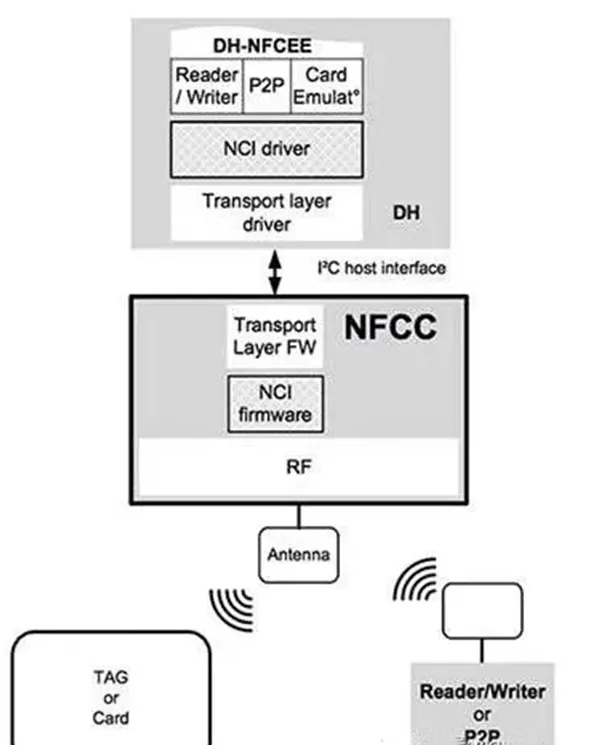
Figure 4: Embedded NCI firmware in the PN7150 reduces the host software stack. The host sends NCI commands over I2C, and the PN7150 NFC controller executes the detailed NFC transactions.
Thanks to vendor-provided software platforms, NFC application development can proceed at a higher level. Common operations for NFC-enabled IoT applications include exchanging NFC Data Exchange Format (NDEF) data. NDEF, managed by the NFC Forum, is a standardized data format for exchanging URIs, plain text, and other information between compatible NFC devices and tags.
For example, the linux_libnfc-nci library provides a simple API that abstracts low-level transactions into higher-level application operations. Developers can write a tag by calling a simple WriteTag routine. The library breaks that application-layer request into the required series of low-level steps to validate, format, and transfer the data.
int WriteTag(nfc_tag_info_t TagInfo, unsigned char* msgToPush, unsigned int len)
{
int res = 0x00;
res = nfcTag_writeNdef(TagInfo.handle, msgToPush, len);
if(0x00 != res)
{
printf(“Write Tag Failed\n”);
res = 0xFF;
}
else
{
res = 0x00;
}
return res;
}
Listing 1: NCI software such as linux_libnfc-nci is a Linux NFC library used with the PN7150. Developers can create NFC applications with simple calls; WriteTag calls low-level routines to handle NFC message protocol details.
The host uses NCI control messages to interact with the NFC controller. One important NCI command sequence provides a mechanism for the NFC controller to discover other cards, readers, or peer devices. This sequence, known as RF Discovery, allows a compliant NFC device to alternate between listening for external RF carriers and transmitting (polling) to find remote cards or tags.
Power Considerations and Low-power Detection
As with any RF technology, transmission requires more power than reception. During the polling phase of an RF Discovery sequence, the PN7150 consumes roughly 30 mA, depending on antenna characteristics. During the listening phase, the PN7150 waits for an externally generated RF carrier; when standby mode is enabled, current consumption drops to around 20 μA.
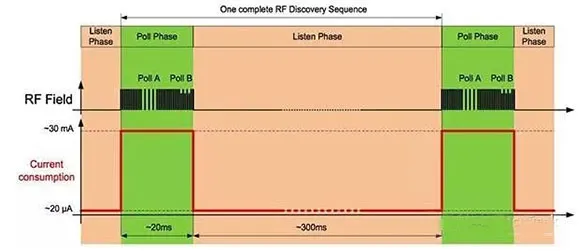
Figure 5: Because the polling phase in a standard NFC Forum RF Discovery sequence is long, power requirements can be relatively high.
Typically, a polling phase lasts about 20 ms, while the listening phase ranges from 300 ms to 500 ms. For a 500 ms listening phase, the average current is:
(30 x 20 + 0.02 x 500) / 520 = 1.17 mA.
To reduce RF Discovery power, the PN7150 offers a proprietary low-power card detection (LPCD) mode. In LPCD mode, the PN7150 monitors antenna impedance changes caused by magnetic coupling when another antenna approaches. If the impedance change exceeds a predefined threshold, the PN7150 automatically enters the standard NFC Forum RF Discovery sequence. This event-driven approach significantly reduces the duration of the power-hungry RF Discovery phase and lowers average power consumption.
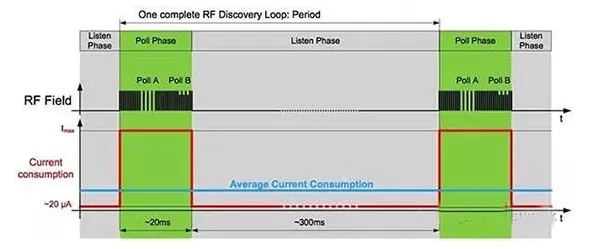
Figure 6: Using a special detection mode, the PN7150 can significantly reduce power consumption in RF Discovery by shortening the energy-intensive polling phase.
Conclusion
NFC provides secure, low-power connectivity that can enhance usability in connected consumer electronics, wearables, and other IoT devices. A simple tap with an NFC-enabled smartphone can configure products, load and access information, and retrieve stored data. Historically, implementing NFC in MCU-based systems introduced hardware and software integration challenges. Integrated NFC devices such as the PN7150 offer near-direct-replacement solutions that simplify hardware and software development for NFC-enabled applications.