ALLPCB


Immersion is a core element for the metaverse concept, and physical immersion remains a key focus for VR and AR. Physical immersion refers to headset weight, size, and wearing comfort. Plastic and metal parts make up most VR/AR structural components, and different structural designs require different forming methods. This article introduces several common manufacturing processes.
1. Injection molding
Injection molding is the preferred method for producing plastic parts. The process melts raw material and, under pressure, injects it into a mold where it cools and solidifies into a formed component.
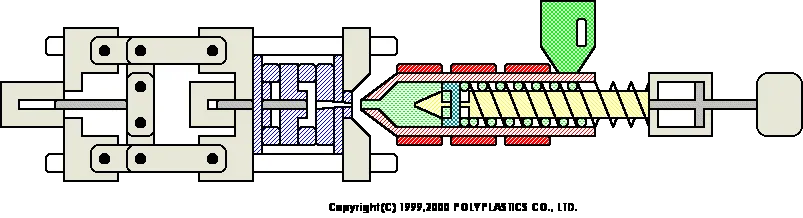
Figure: Injection molding process
The main stages of injection molding are: mold closing, filling, (gas or water assisted) packing, cooling, mold opening, and demolding. Injection molding is commonly used for housings, lens frames, and other plastic components. Typical materials for VR/AR injection molding include PA, PC, PC/ABS, and PP; optical parts may use COC, PMMA, or PC.
Some products combine high-pressure molding with 5-axis CNC finishing to reduce wall thickness (for example from about 1.8 mm to 0.8 mm), maintaining structural strength while significantly lowering device weight.
Advantages:
- Multi-cavity molds allow production of multiple parts per cycle.
- High dimensional accuracy and a wide range of material choices.
- Low labor cost, minimal material waste, and little post-molding finishing required.
Disadvantages: High upfront tooling costs and process limitations. Molded blanks can have high internal stresses and may be affected by uneven cooling during mold changes. Injection-molded optics can have lower transmittance and limited resolution for high-precision lenses.
2. CNC monoblock machining
CNC machining uses numerically controlled tools to process parts. Monoblock CNC machining refers to sculpting a single block of metal into a precise, robust structural component. Common metals for VR/AR are magnesium-lithium alloys and titanium.
Because CNC machining is driven by computer programs, it offers stable machining quality, high accuracy, high repeatability, and the ability to produce complex surfaces at relatively high efficiency. The main drawback is cost.
3. Compression-injection molding (integrated forming)
Compression-injection molding combines injection and compression molding. Plasticized raw material is fed into the injection machine hopper, injected into the mold cavity at controlled pressure, and then a compression mechanism advances the mold cavity to press the material until it fully hardens. The mold is finally opened and the part removed.
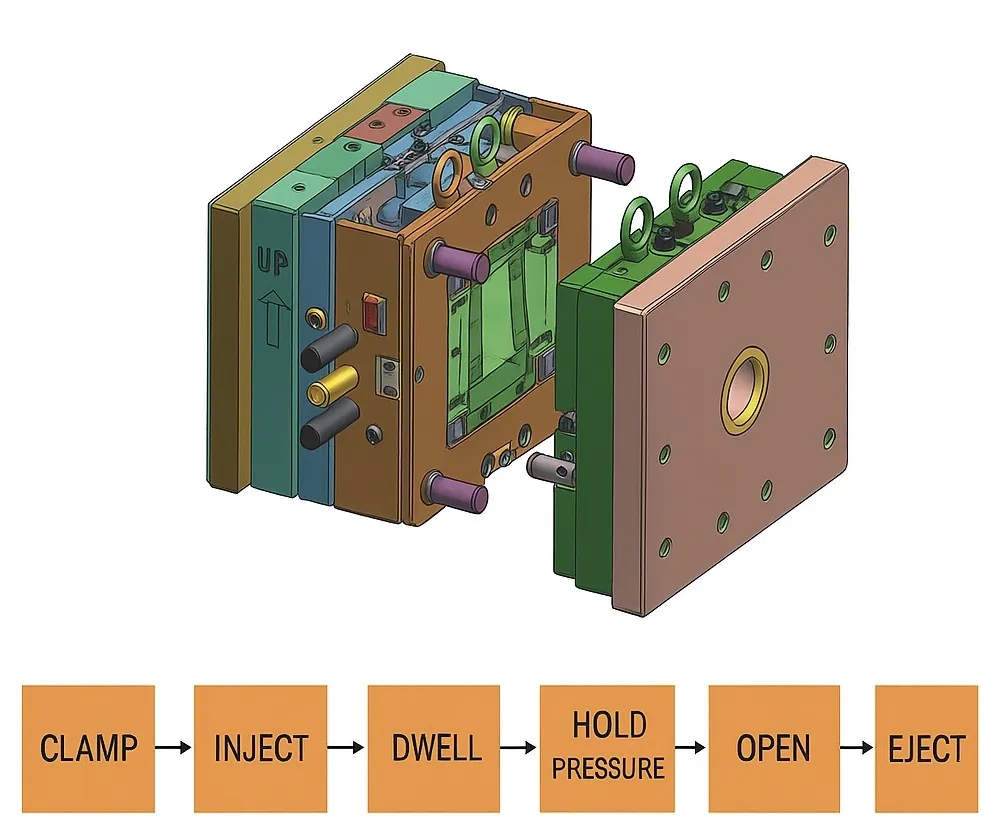
Figure: Compression-injection molding process
Some VR products have used compression-injection molding combined with optical coating and nanoscale engraved optical textures to achieve mirror-like facades and controlled curved surfaces.
Advantages:
- Capable of producing complex shapes, thin walls, large wall-thickness variations, and parts with fine inserts.
- Shorter molding cycles and improved production efficiency; parts can have higher density and strength.
- Because the mold is fully closed before forming, flash at parting lines is minimal and surface roughness is easier to control.
Disadvantages:
- Higher material consumption.
- Increased work to trim gate marks.
- Complex mold structures.
- Higher operational difficulty.