ALLPCB


TMR (tunneling magnetoresistance) sensors use quantum tunneling effects to achieve performance advantages over many existing sensors and can serve as alternatives to mainstream Hall-effect sensors.
What Is a Quantum Sensor?
Sensors collect data about phenomena to measure physical properties of devices and convert those properties into measurable electrical signals. Characteristics relevant to the quantum sensor market include time, motion and gravity, magnetic fields, current, and photons.
Quantum sensors rely on quantum phenomena to deliver substantially increased sensitivity compared with classical alternatives, enabling measurements that were previously inaccessible. In many cases, exploiting quantum effects yields higher sensitivity; in other cases, improvements come from trade-offs in power consumption, size, or remote sensing capability.
Advantages of Quantum Sensors
Quantum sensors can provide much higher sensitivity for certain measurements, enabling new applications. However, some quantum sensing approaches require complex components and infrastructure compared with simpler technologies such as tunneling-based sensors.
What Is a TMR Sensor?
Strictly speaking, TMR sensors are not usually classified as full quantum sensors, but they exploit quantum tunneling. A TMR sensor consists of ferromagnetic thin layers separated by a nanometer-scale insulating barrier and uses quantum tunneling for high-sensitivity magnetic field measurement. The probability of electron tunneling through the barrier depends strongly on magnetic and electric fields. TMR sensors can be integrated into circuits to produce measurable voltage or resistance changes, allowing detection of magnetic fields hundreds of times smaller than those detectable by many existing sensors.
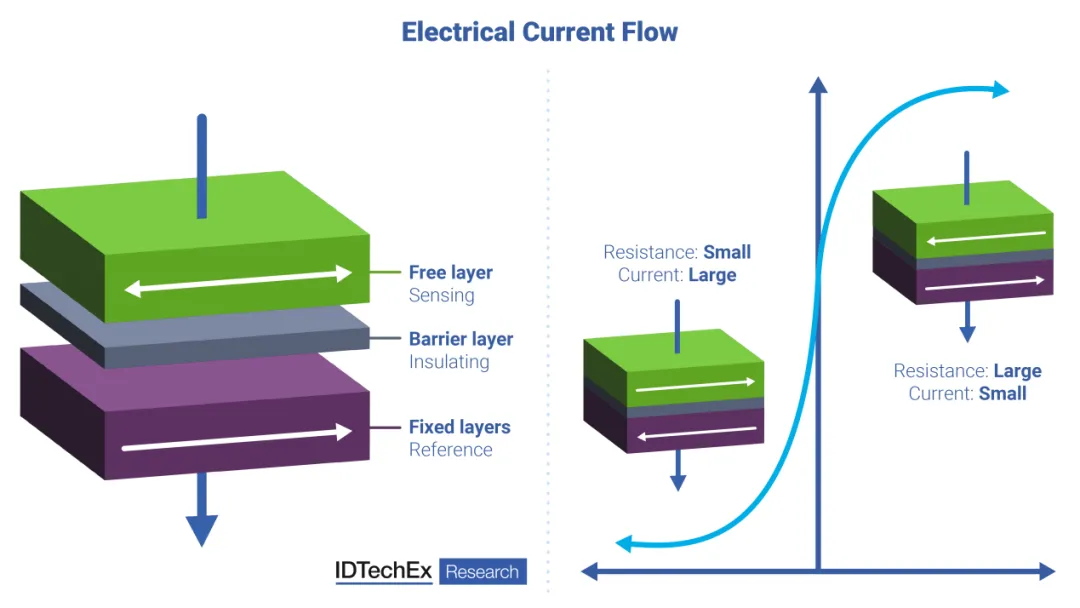
Operating Principle of TMR Sensors
Compared with GMR (giant magnetoresistance) and AMR (anisotropic magnetoresistance) sensors, TMR sensors are more sensitive to the direction of external magnetic fields and provide faster output response. These characteristics make them suitable for applications that require high sensitivity and fast response, such as position and speed detection.
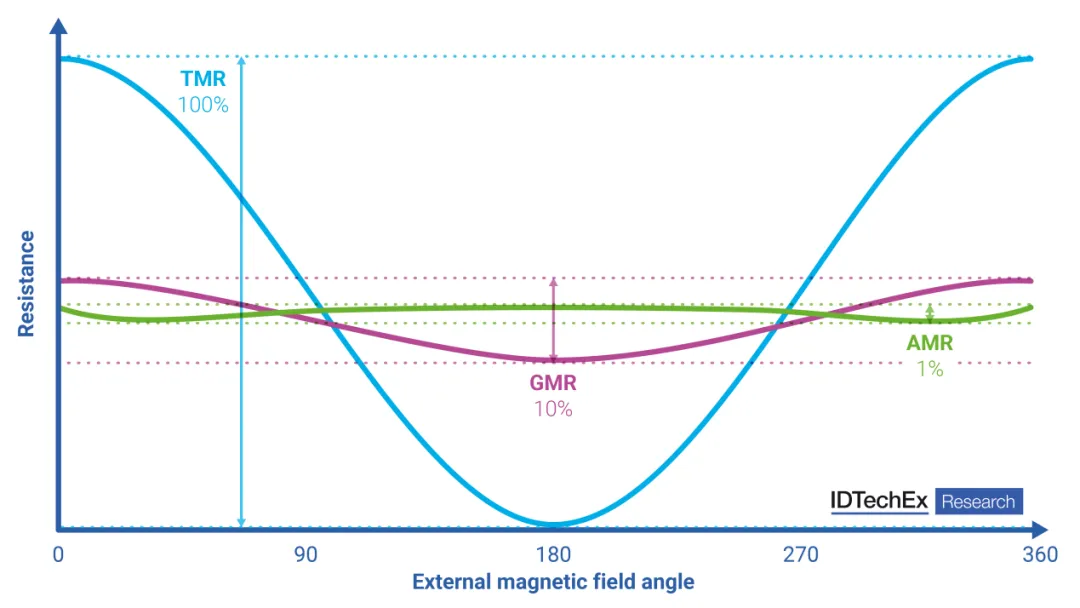
Output Response: TMR Versus GMR and AMR
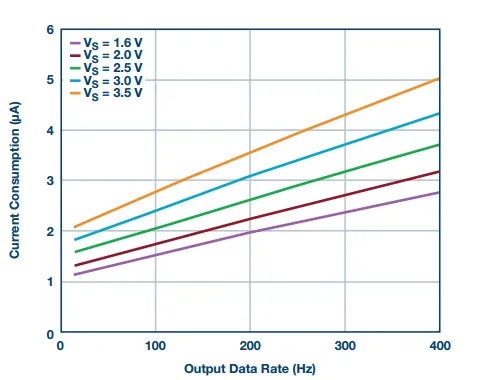
Sensitivity is not the only important parameter in the sensor market. Optimizing size, weight, power, and cost (SWAP-C) is also critical. Compared with Hall sensors, TMR sensors can reduce power consumption, which is a key factor for adoption. Devices in the Internet of Things (IoT) domain, for example, require long operating times and therefore have strict low-power requirements.
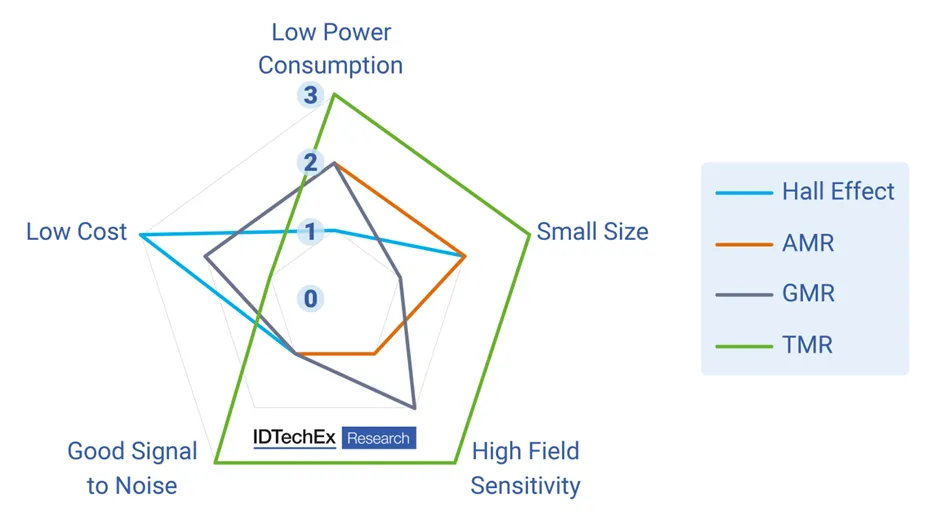
Key Characteristics for Miniaturized Magnetic Field Sensors
TMR sensors have relatively simple structures, which helps achieve optimized SWAP-C. They can be manufactured using CMOS processes at existing semiconductor foundries. Their small form factor enables them to compete with, and in many cases outperform, more mature solutions.
Other quantum sensing techniques are also under development, including magnetic field sensors, clock technologies, gravimeters, gyroscopes, and photodetectors. These technologies could increase sensitivity by orders of magnitude and disrupt existing sensor markets. However, next-generation quantum sensors that rely on entanglement or superposition typically need more complex components and infrastructure than tunneling-based solutions. Technologies such as vapor cells, lasers, and nitrogen-vacancy centers remain high-value technical challenges for the quantum sensing industry.
Application Diversity of TMR Sensors
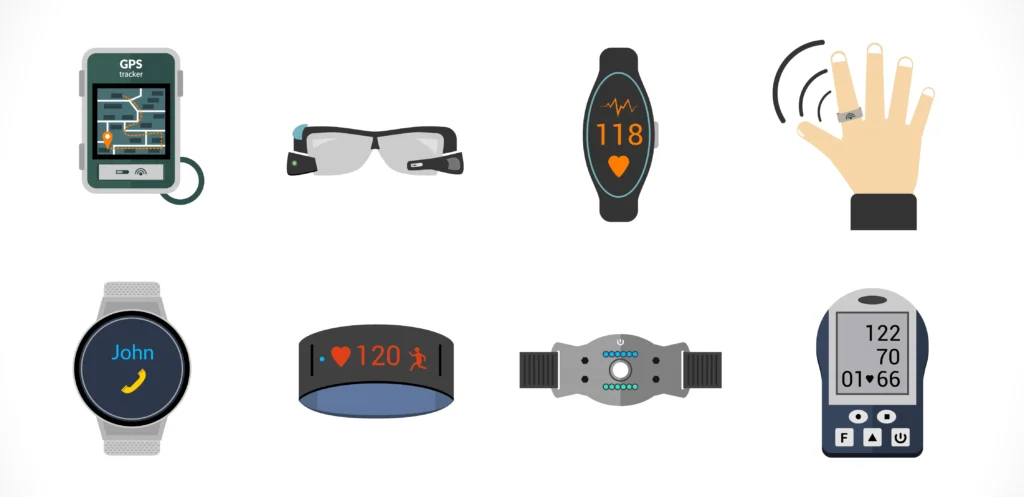
TMR sensors are used for wake-up detection, angle and position sensing, and remote current detection across several vertical markets. Many wearable and medical devices rely on wake-up functions, including continuous glucose monitors and ingestible digital pills. Remote sensing and temperature robustness improve safety monitoring in electric vehicles and solar systems. Position and angle detection have broad uses, with clear value in wind turbine power optimization, robotics, and factory automation.
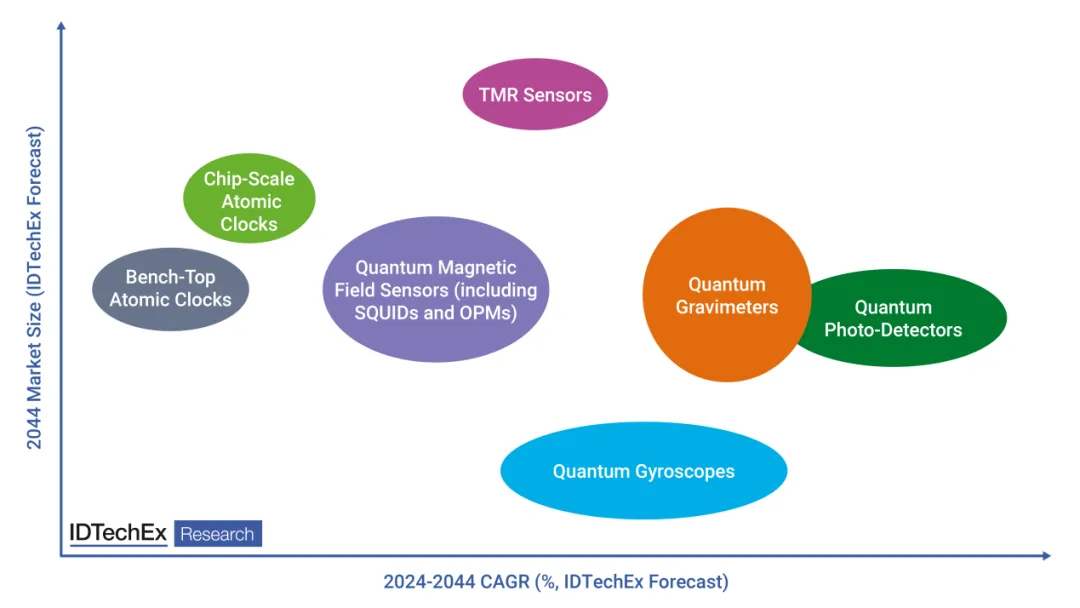
Market Size and Compound Annual Growth Rate
TMR sensors already have large-scale adoption in the automotive industry, for example in remote current detection. The cumulative potential market for TMR in automotive and wearables is large, representing a high-volume market with steady growth.
Other significant potential markets include gyroscopes and atomic clocks for navigation and timing. Gravimeters and imaging sensors have more specialized applications, such as subsurface mapping and quantum computing. Market size for each application depends on price and commercial readiness.
Why Navigation Could Be the Quantum Sensor Mass Market
GNSS systems such as GPS are the common methods for accurate positioning and local time. However, GNSS reception can be limited in some environments, such as mountainous terrain that blocks signals or by deliberate spoofing. Precise navigation systems therefore need reliable performance when GNSS is unavailable.
Autonomous vehicles are a key example where centimeter-level navigation accuracy can be critical. In dense urban environments, GNSS signal loss affects smartphones and wearable device users trying to navigate. Continued navigation without trilateration depends on accurate measurements of distance traveled, heading, speed, and time. Existing motion sensors, gyroscopes, and local oscillators do not provide sufficient precision for high-accuracy navigation; many systems also rely on satellite-derived time information.
Quantum sensors for position and motion (such as gyroscopes and accelerometers) and time (atomic clocks) can enable precise inertial navigation without GNSS. To date, many quantum sensing technologies remain too large or expensive for mass-market navigation. However, as demand grows for autonomous vehicles, smartphones, and wearables, these technologies are expected to become smaller and more optimized over the next decade, making navigation a likely mass-market application for quantum sensors.
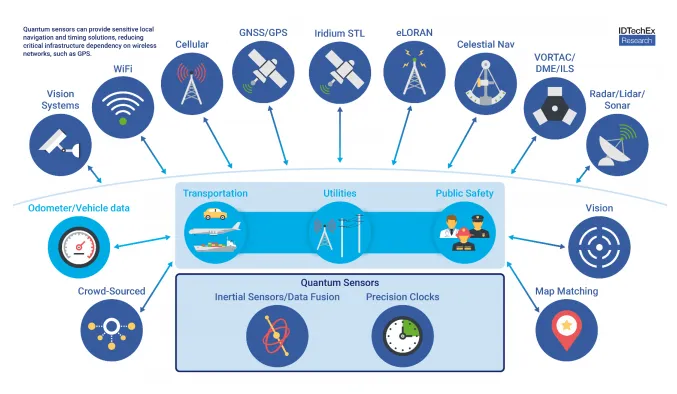
Role of Precise Clocks When GNSS Is Denied
High-precision clocks play an important role in precision navigation and timing when GNSS signals are not available.
Future of Quantum Sensing Technologies
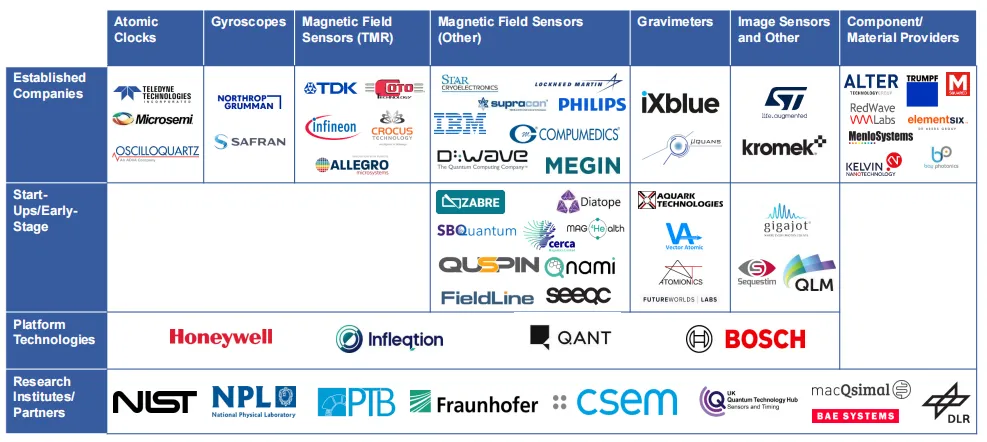
Major quantum sensing technologies under development include atomic clocks, magnetic field sensors, gyroscopes, gravimeters, and imaging sensors. Larger market opportunities generally require sensors that are optimized for SWaP-C.
The primary challenge for the quantum sensing industry is miniaturizing laboratory or benchtop systems so they can compete in mass-market applications. Some chip-scale atomic clocks can already support last-mile navigation in aerospace, but they remain too expensive, large, and unstable for many consumer electronics applications.
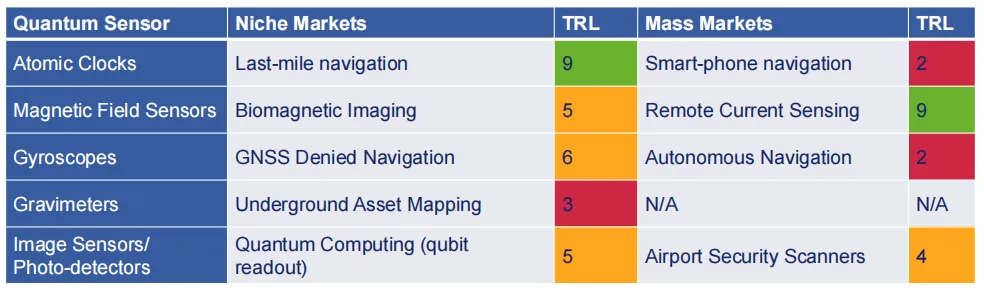
Industry Outlook
Quantum sensing technologies are expected to see broad application. Millions of chip-scale TMR sensors have already been deployed in the automotive sector for remote current detection, while optically pumped magnetometers for biomagnetic imaging remain at an early stage.
There are indications that atomic clocks and quantum gyroscopes will be adopted in aerospace, automotive, finance, and potentially consumer electronics for precise navigation and timing. TMR sensors, with high sensitivity and optimized SWAP-C, will add commercial value across multiple industries and serve as an example of exploiting quantum effects to improve on classical sensors.