ALLPCB


Overview
Researchers at the University of California San Diego (UC San Diego) have developed a wearable photoacoustic sensing patch intended for clinical practice and research.
The wearable photoacoustic patch can assist clinicians in diagnosing tumors, organ dysfunction, and other conditions by noninvasively imaging blood flow and vasculature. It aims to translate multiple biophotonics techniques into clinically useful tools.
Studies indicate that imaging hemoglobin molecules, in particular, could have a major impact by supporting decentralized healthcare and enabling wearable-based patient self-monitoring.
According to Mims Consulting, UC SD researchers developed a wearable electronics patch capable of monitoring biomolecules in deep tissue, including hemoglobin. The results were published in Nature Communications.
Sheng Xu at UC San Diego said, "The amount and location of hemoglobin in the body can provide key information about blood perfusion or localized accumulation. The wearable patch we developed shows significant potential for close monitoring of high-risk populations and can help enable timely intervention in emergencies."
Design and operating principle
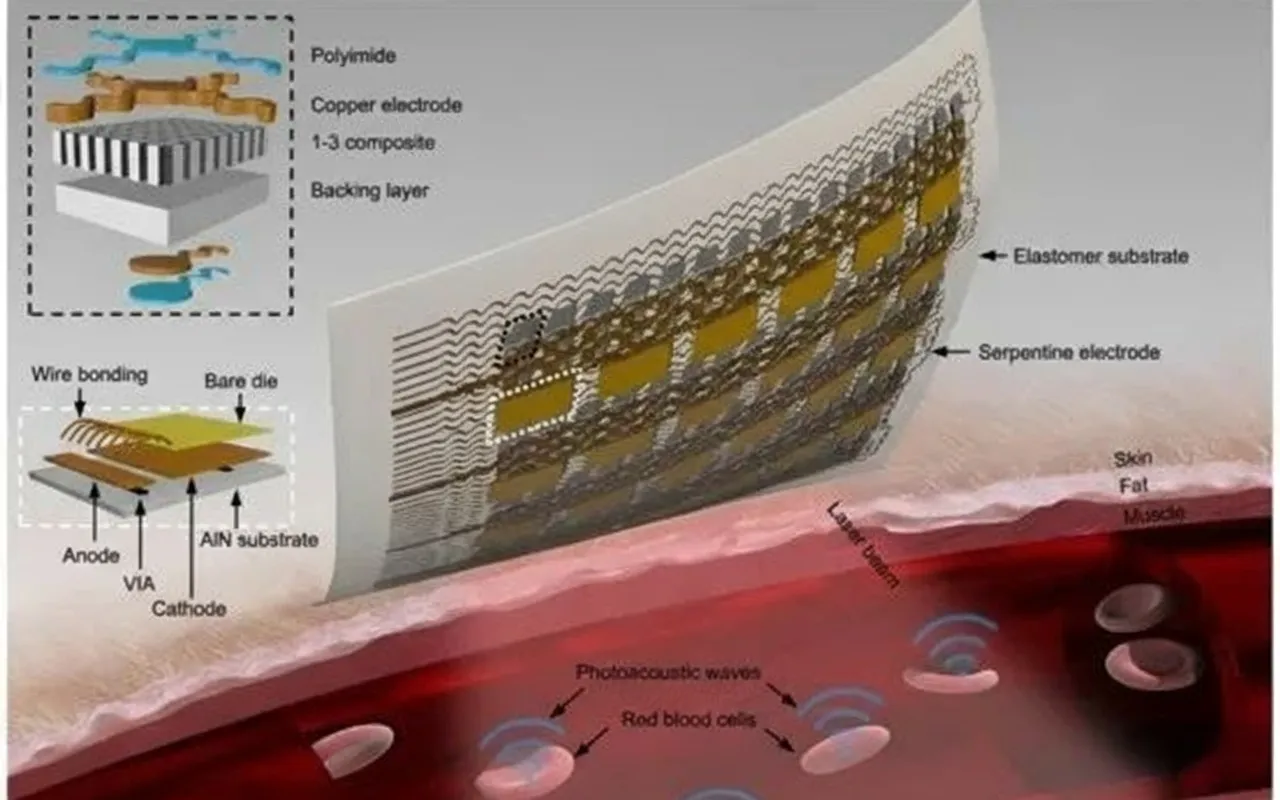
The patch integrates a VCSEL array and a piezoelectric ultrasound transducer array, interconnected by serpentine copper electrodes. After absorbing light, hemoglobin in red blood cells undergoes thermoelastic expansion and radiates acoustic waves into the surrounding medium. The ultrasound transducer array then collects the photoacoustic waves and transmits them to a backend system for data processing.
This device is based on photoacoustic sensing technology, which exposes hemoglobin to rapid laser pulses and images the resulting transient ultrasound pulses. Photoacoustic imaging has been studied for over a decade as a method for hemoglobin-based contrast and as a potential alternative or complement to MRI or X-ray CT in some clinical research contexts.
UC San Diego combined photoacoustic imaging with a flexible wearable patch concept, analogous to existing devices that use electrochemical or optical sensing modes. Notably, the team's goal is to sense molecules in deep tissue that correlate with metabolic processes, rather than only detecting surface molecules accessible to current patch technologies.
Deep tissue reach remains a major challenge
The patch integrates 24 high-power 850 nm vertical-cavity surface-emitting lasers (VCSELs) arranged in four equidistant rows and connected in series, with 240 piezoelectric ultrasound transducers positioned between the VCSEL columns.
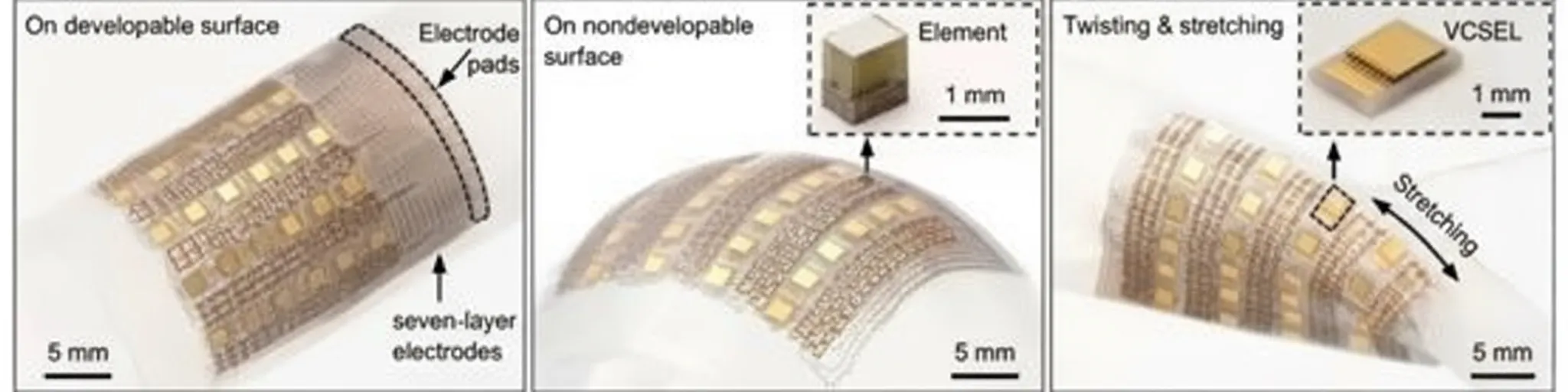
Optical photos show the flexible patch under different deformations. Insets in the central and right images are optical micrographs of a single ultrasound transducer element and a VCSEL diode, respectively.
As the paper describes, "VCSEL diodes and the ultrasound transducer array, interconnected by serpentine metal electrodes, are encapsulated in an elastic substrate. High-power VCSEL diodes can generate laser pulses that penetrate more than 2 cm of biological tissue and excite hemoglobin to produce acoustic waves."
Validation and future work
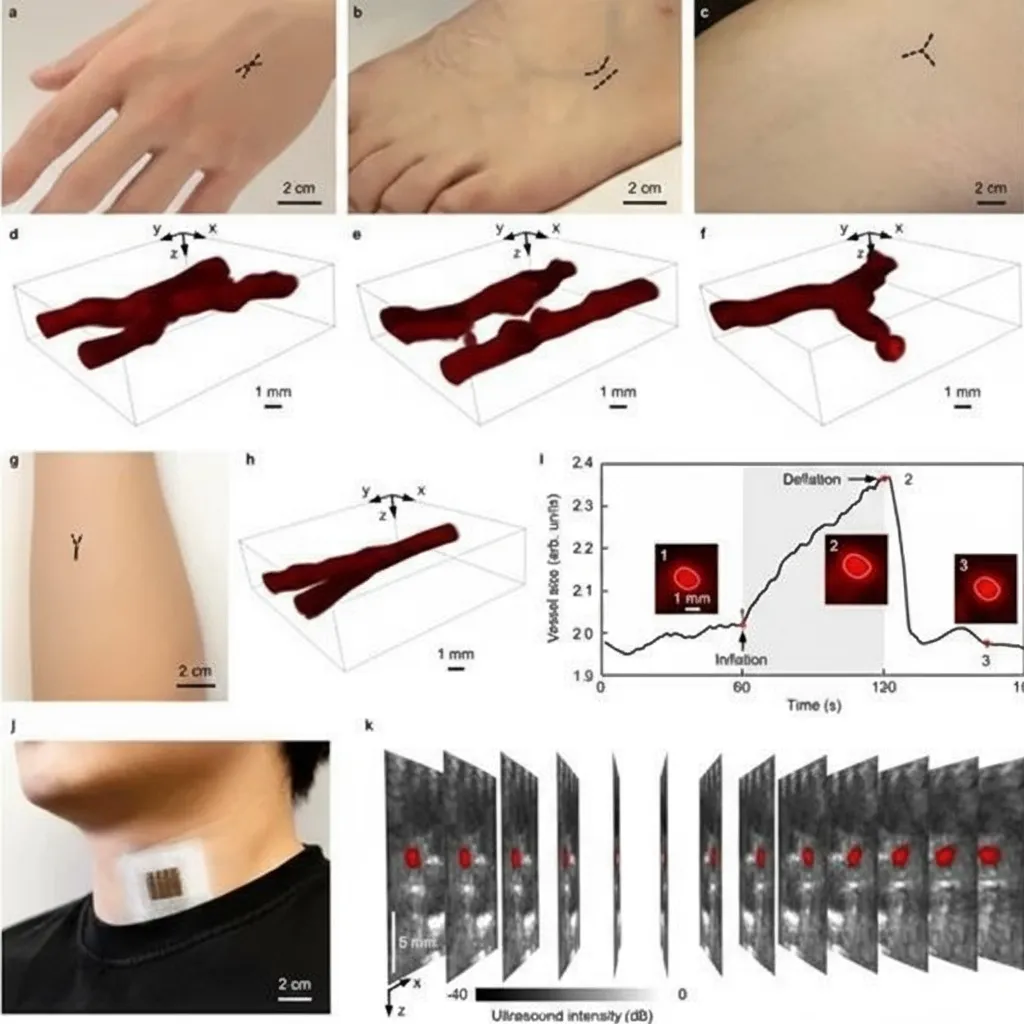
In experiments, the patch was applied to tissue phantoms and ex vivo porcine tissue, followed by tests on human volunteers where the measured penetration depth was 1.1 cm. The team reports achieving three-dimensional hemoglobin mapping with submillimeter spatial resolution within these deep tissues.
Future work will include using higher-power VCSELs, since detection depth depends strongly on illumination intensity. The project notes that photoacoustic imaging of the human heart remains extremely challenging because of the distance between internal organs and the external skin, but higher-power light sources could improve detection depth in visceral regions.
Xiangjun Chen at UC San Diego commented, "Continuous monitoring is critical for timely intervention to prevent life-threatening deterioration. Wearable devices that detect biomolecules using electrochemical methods, not limited to hemoglobin, are a promising approach for long-term wearable monitoring applications."