ALLPCB


Introduction
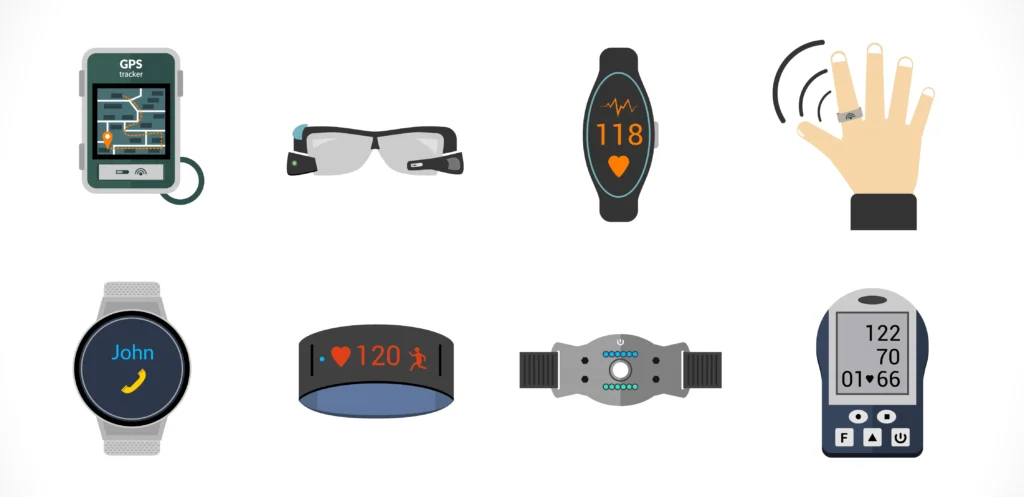
Authorities and health insurers are placing greater emphasis on prevention, health awareness, and lifestyle. The focus has expanded beyond exercising more or better nutrition to include monitoring certain vital physiological parameters. This shift explains the revenue growth in the smart and health watch sector over recent years.
Purchasing a health watch and measuring body parameters does not by itself make a life healthier. Effective health management requires long-term monitoring of selected parameters to become familiar with the data and use it to adapt daily routines, thereby reducing long-term health costs. This process helps users understand how the body works and how to lower health-related risks over time.
This article describes ADI's latest wearable VSM platform and the considerations behind it. The platform is intended to help electronic designers and system architects accelerate development while enabling more refined, accurate wearable designs for professional and medical markets.
What we measure, how, and where
A variety of important physiological parameters can be measured with wearables. Depending on the overall objective, some metrics are more relevant than others. The device location on the body has a large impact on what can and cannot be measured. The wrist is the most common location, which explains the large market for smartwatches and wrist-worn devices. The head is another suitable location: headphones and earbuds are available in styles that embed sensors for heart rate, oxygen saturation, and temperature. A third good location is the chest. First-generation heart rate monitors used chest straps based on bioelectric potential measurement, which remains a highly accurate technique. Today, chest patches are often preferred because straps are less comfortable. Some manufacturers have developed smart patches to monitor key parameters.
Sensor choice also depends on body location. For heart rate, bioelectric potential measurement is one of the oldest techniques. Using two or more electrodes produces a strong signal that is easy to measure from the body; integrating the circuitry into a chest strap or headset is ideal. Single-point bioelectric measurement at locations like the wrist is nearly impossible because the cardiac electrical source must be measured. For single-point measurements, optical techniques are more appropriate. Light is transmitted into tissue and the reflected signal modulated by arterial blood flow is captured and measured. From this optical signal, beat-by-beat information can be retrieved. While the method is straightforward in principle, motion and ambient light introduce challenges that complicate design.
GEN II wearable reference platform
ADI's GEN II wearable reference platform includes most of the technologies described above. It is designed to be worn on the wrist but can be removed from the strap and connected directly to the body to serve as a smart patch. The device integrates technologies supporting bioelectric potential measurement, optical heart rate, bioimpedance, motion tracking, and temperature measurement, all in a miniature battery-powered form factor.
Overall objectives
Why design a system like the GEN II watch? The goal is to measure several important physiological parameters on the body in a simple, integrated way. The device can measure parameters concurrently and store results on an SD card or transmit them via BLE to smart devices. Simultaneous measurement helps assess correlations between signals. Biomedical engineers, algorithm developers, and companies are continually seeking technologies, applications, and use cases for early-stage disease detection to minimize later adverse outcomes.
Single measurements are not enough
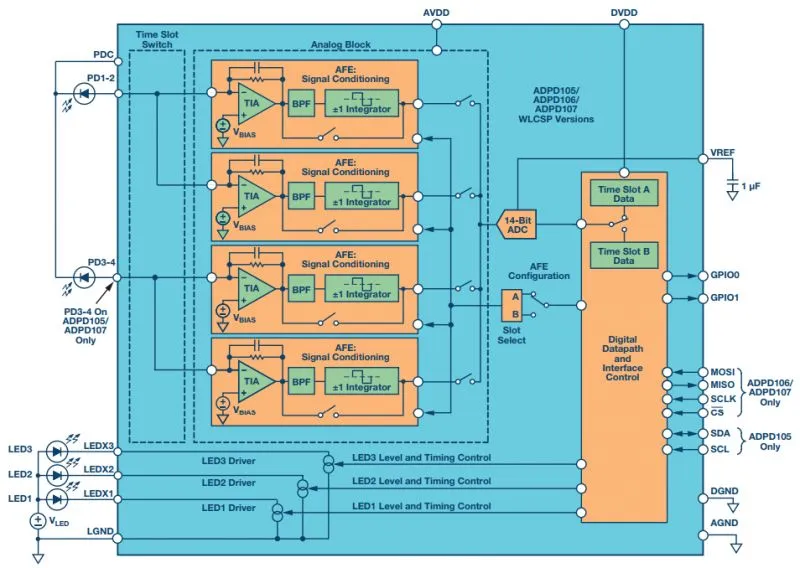
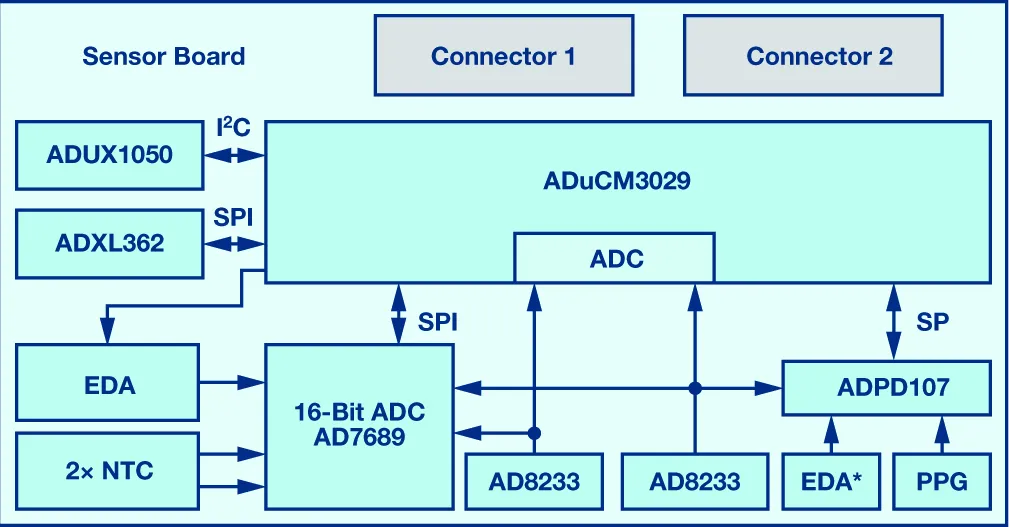
The combination of embedded sensors, processing capability, and wireless communication gives ADI's new wearable system unique potential. The optical system is built around the ADPD107 analog front end. It uses a green LED to measure PPG and heart rate while integrating an infrared LED for proximity detection to determine when the device is in contact with the body. Two independent AD8233 analog front ends support bioelectric ECG measurement. One front end is connected to electrodes embedded in the device. An electrode on the back of the device contacts one limb, and a second electrode on the top can be touched by the other hand to close the loop. A second analog front end can be enabled to use external electrodes for ECG measurement, allowing the device to be used as a patch with external electrodes attached directly to the chest.
The back electrodes serve a dual purpose. In addition to ECG measurement, they are used for electrodermal activity (EDA). EDA, also known as galvanic skin response (GSR), relates to skin conductance, which can change with emotional states or internal and external stimuli. The GEN II watch can detect small changes in skin conductance. The circuit for this measurement includes discrete emitter and receiver signal chains designed for minimal power consumption and high precision. Finally, the device integrates a skin temperature sensor and a 3-axis ultra-low-power MEMS sensor (ADXL362). The MEMS sensor tracks motion, which can be used for activity analysis and to compensate for motion artifacts in other measurements. Motion is a critical aspect because many vital parameters such as heart rate, SpO2, and respiratory rate are activity-dependent and require motion measurement for correct interpretation.
A heart rate of 140 bpm can be normal if you are jogging, but concerning if you are sitting on a couch. Combining various sensor signals enables new applications and contextual interpretation.
The platform integrates an ultra-low-power ADuCM3029 microcontroller to collect sensor data and run algorithms. The diagram below outlines the integrated devices on the sensor board.
Stress and continuous blood pressure
Use cases that require repeated measurements include stress management and continuous blood pressure monitoring. Emotional state can be estimated by monitoring changes in skin conductance. This is only one parameter, but when combined with others such as heart rate and heart rate variability (HRV), the measurements become far more informative. Skin temperature can also serve as an additional input for stress estimation.
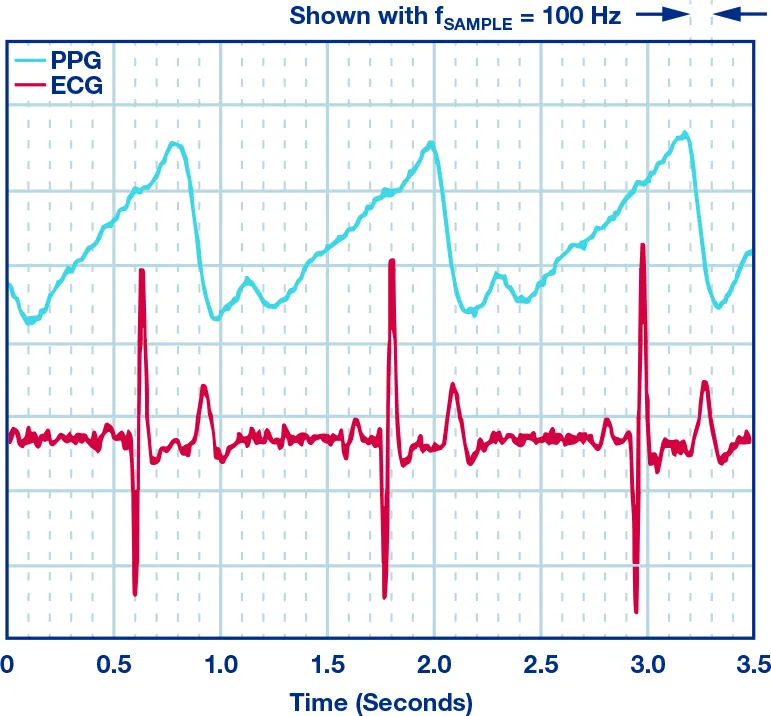
Blood pressure monitoring is another interesting use case. Although most clinical systems are cuff-based and difficult to integrate into continuous wearable systems, some cuffless techniques exist. One technique uses pulse transit time (PTT). PTT is measured as the time between the R-wave of the ECG, marking cardiac contraction, and the arrival of the pulse at a peripheral site such as the finger measured by PPG. This transit time correlates with blood pressure. The watch supports both ECG and PPG measurement, enabling this type of assessment.
Prototype and deployment considerations
The GEN II watch integrates multiple high-performance sensors and functions in a compact wearable. Mechanical considerations were addressed alongside the electronic design, making the platform relevant for developers targeting semi-professional and professional sports markets as well as medical applications. While the device can measure multiple parameters concurrently, algorithms and application software are required to support specific use cases. The platform provides developers and device manufacturers a rapid starting point for development without the initial need to validate algorithms and custom hardware from scratch.
A limited number of GEN II watches are available for collaboration with design companies and algorithm providers to develop systems suitable for professional caregivers and health insurers. Some features already meet medical specifications, while others require further refinement.