ALLPCB


Overview
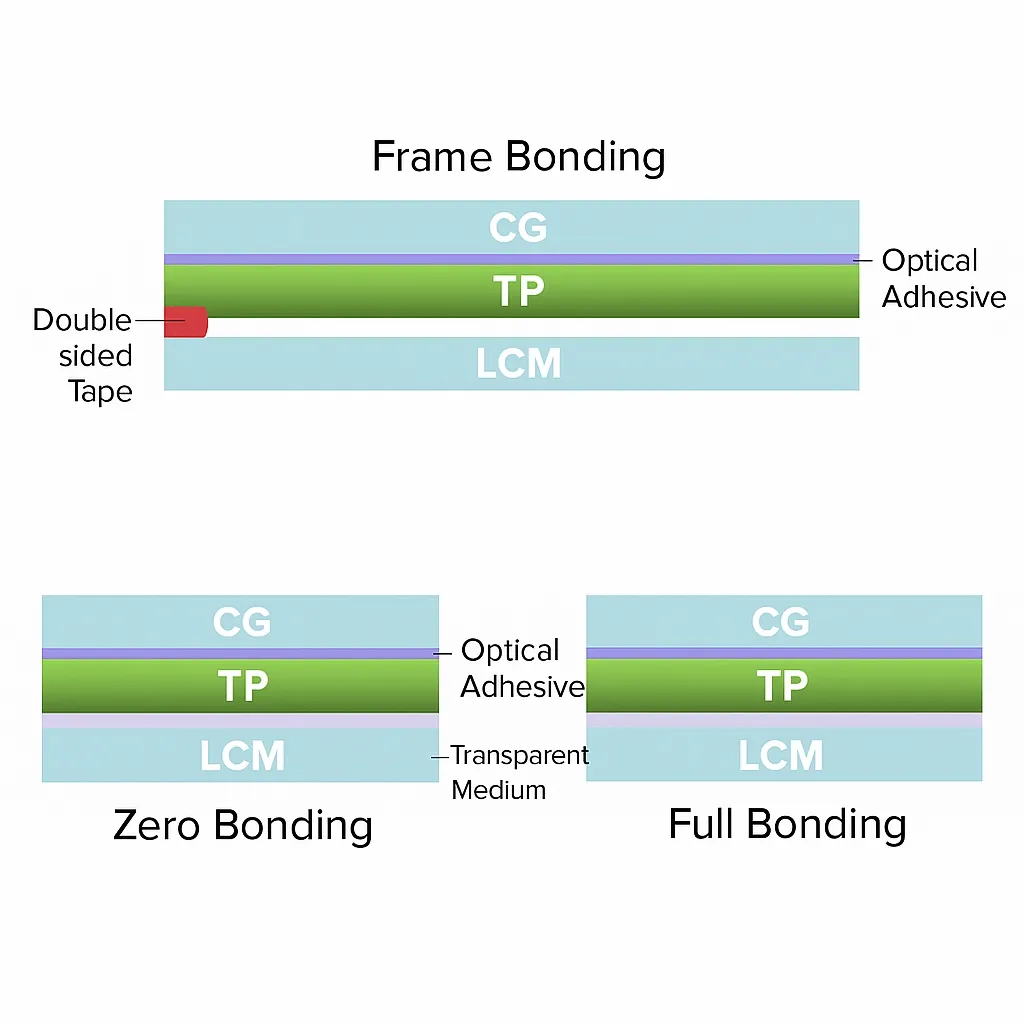
Touchscreen lamination methods are classified as frame lamination, zero lamination, and full lamination. With the widespread adoption of ultra-thin, ultra-narrow-bezel high-resolution displays, full lamination has become the lamination solution used in many high-end phones and tablets.
For details on frame, zero, and full lamination, see the previous article "Screen: frame lamination, zero lamination, full lamination".
Within full lamination technology, the position of the touch circuit in the overall stack determines classifications such as GFF, OGS, Oncell, and Incell.
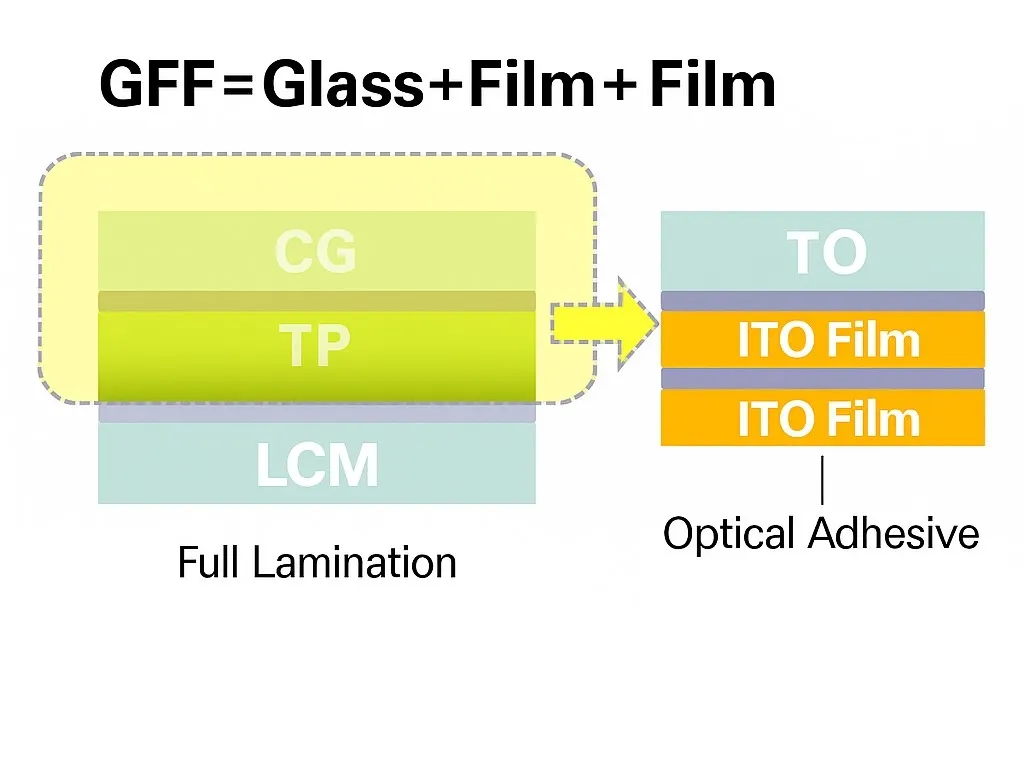
GFF
GFF places the touch sensor on a transparent flexible substrate and then laminates it onto the cover glass. In simple terms, this full lamination process replaces the glass-based touch layer used in non-full-lamination processes with a thin film substrate. Conductive coatings are applied to both sides of the film sensor, for example indium tin oxide film (ITO film), reducing overall thickness.
Process flow:
Large glass sheet -> cut -> film application on front and back -> strong acid edge etch to remove saw marks -> chemical strengthening -> cover glass
Film photolithography / laser (pattern touch traces on PET) -> film sensor
Cover glass + adhesive + film sensor -> attach OCA (optical adhesive) -> attach LCM -> complete
OGS
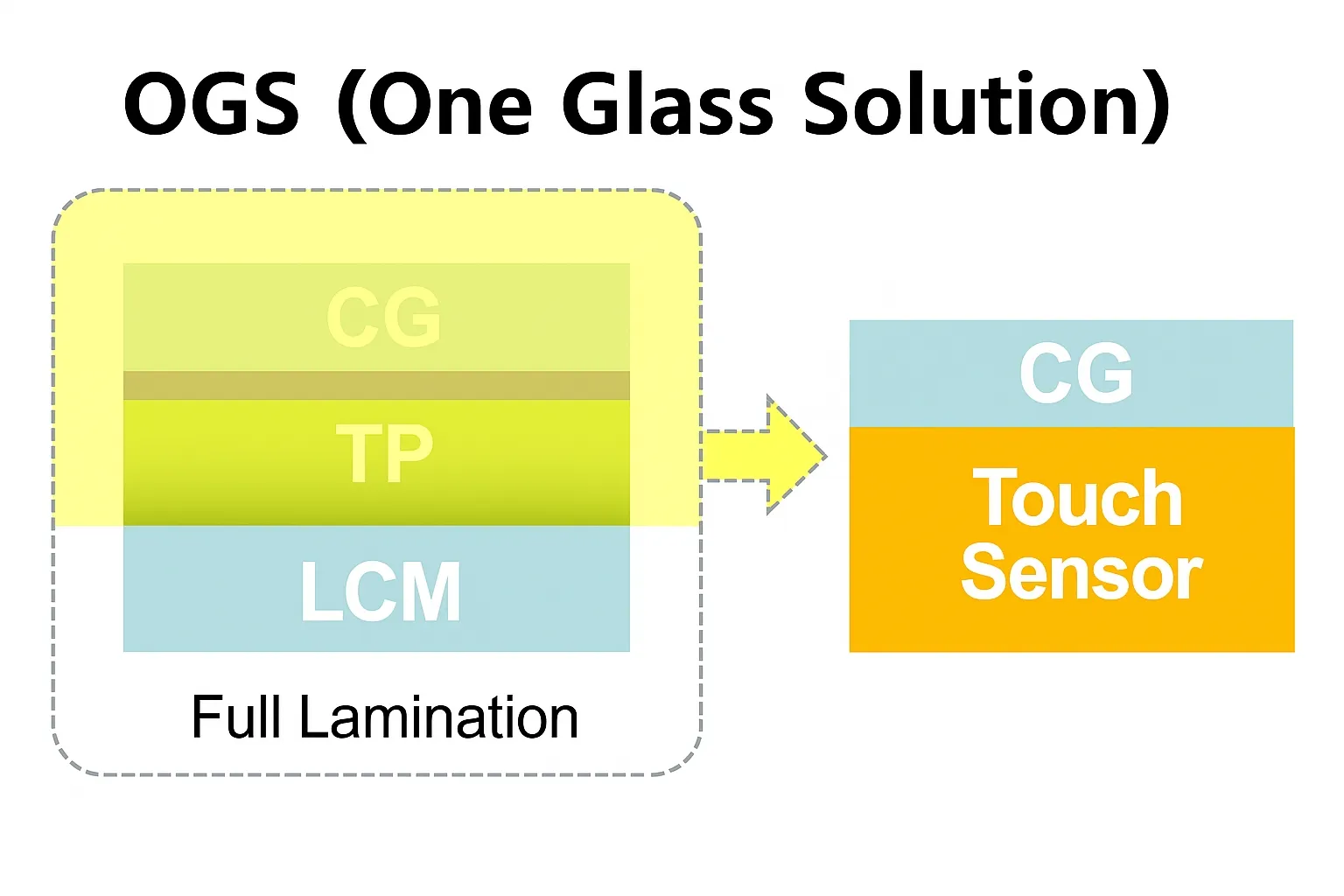
OGS forms the touch sensor directly on the cover glass. This yields a thinner overall assembly with high touch sensitivity and good optical performance. However, because the large glass sheet is patterned with touch traces before cutting, the cutting step can produce many saw-tooth edges and chipping, which can reduce strength.
Process flow:
Large glass sheet -> chemical strengthening -> photolithography (pattern touch traces) -> cutting -> film application on front and back -> strong acid edge etch to remove saw marks -> chemical strengthening -> attach OCA -> attach LCM
Oncell
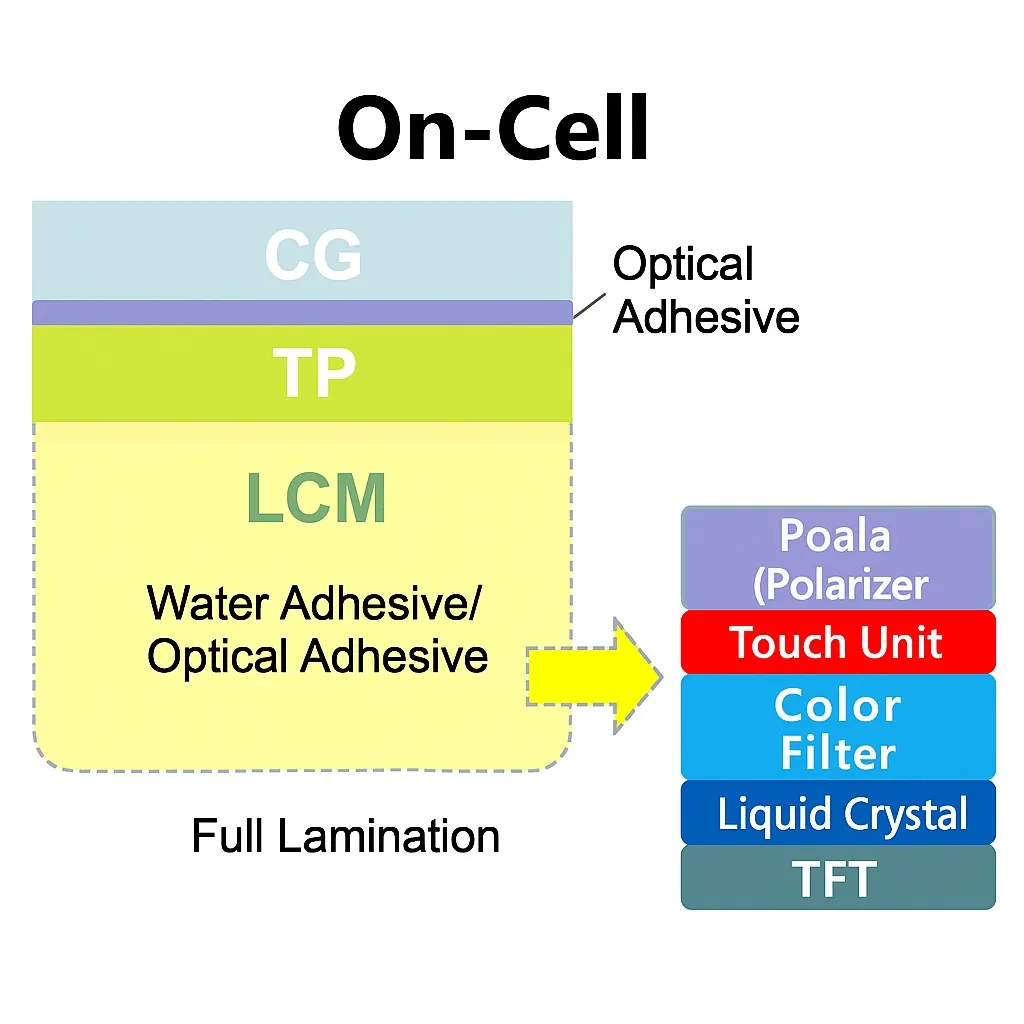
Oncell embeds the touch sensor between the display's polarizer and filter layers.
Incell
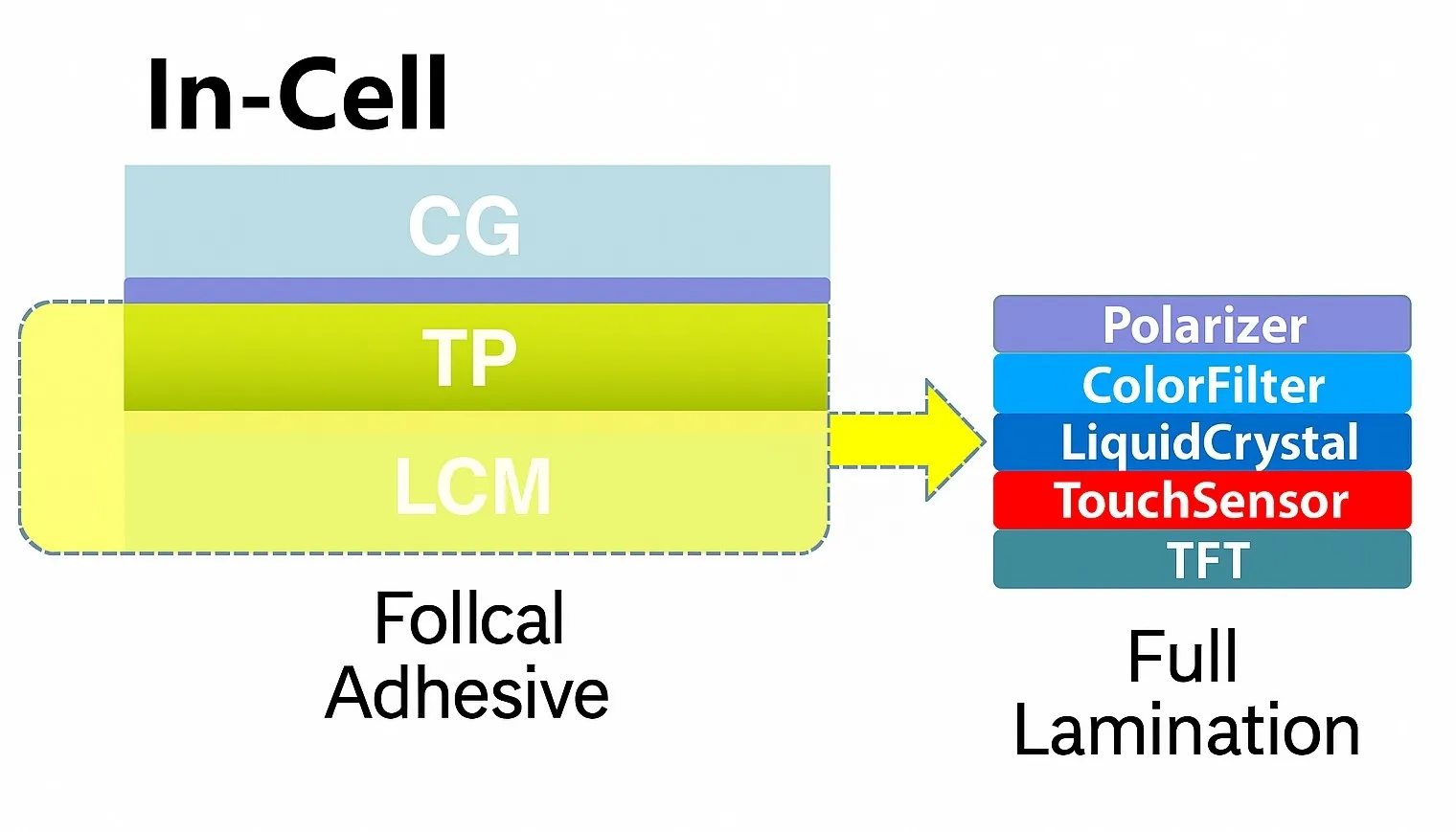
Incell embeds the touch sensor within the liquid crystal display layer itself.
Process similarities and differences
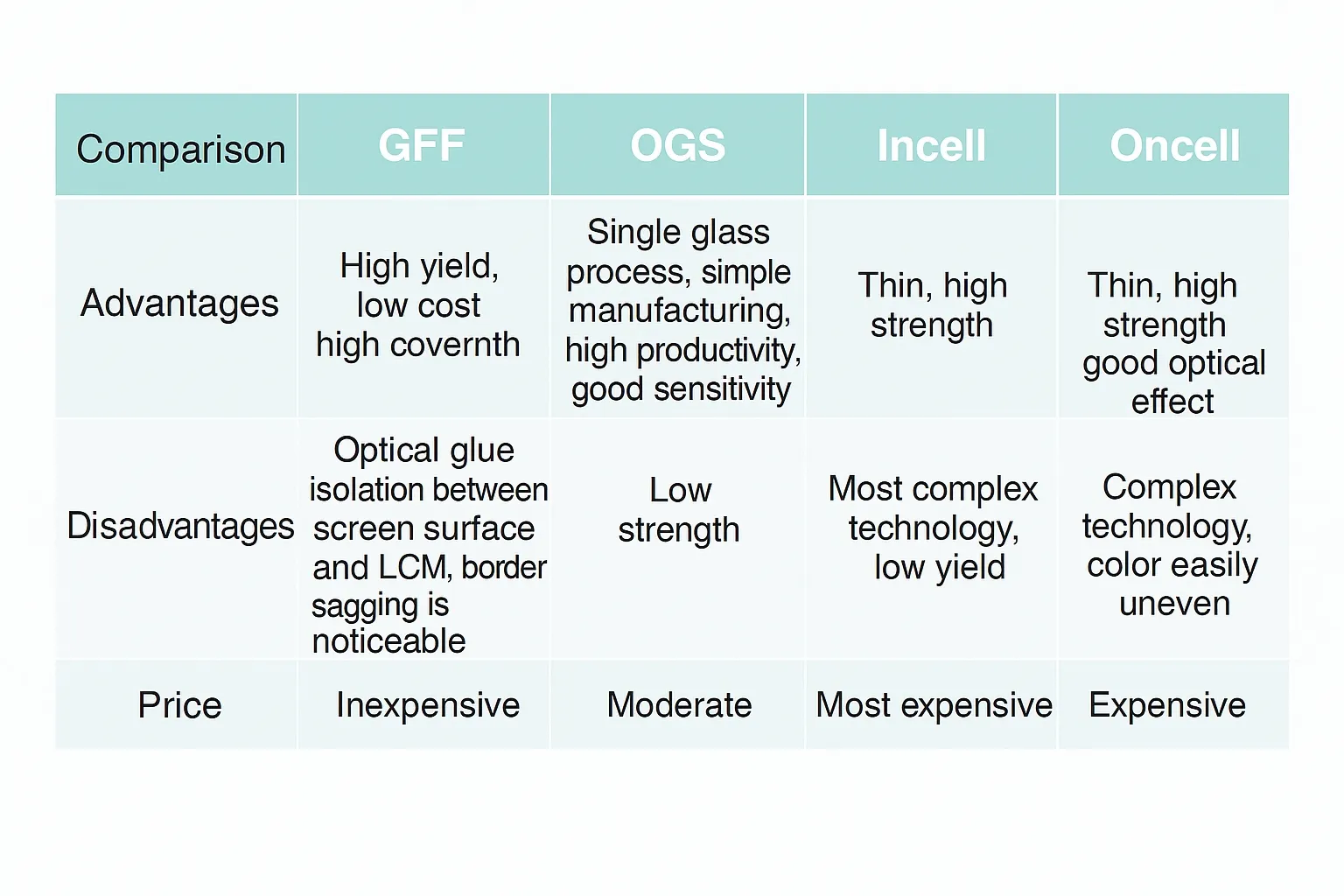
Strictly speaking, GFF is not a true full fusion lamination. True full lamination fuses the touch layer either upward or downward into the stack. GFF uses optical adhesive to bond the ITO film touch layer upward to the cover glass, which is more advanced than non-full-lamination approaches but does not constitute a strict fusion. True full lamination examples include OGS, where the touch unit fuses upward with the protective layer, and Oncell/Incell, where the touch unit fuses downward with the LCM. Based on process integration, touch panel manufacturers typically promote GFF and OGS, while display panel manufacturers typically promote Oncell and Incell.
Due to space constraints, GF, GG, and OTL processes are not covered here. These processes will be compared with GFF, OGS, Oncell, and Incell in a subsequent article.