ALLPCB


Introduction
Electrochemical migration poses a significant threat to PCB reliability in humid or contaminated environments. This phenomenon occurs when conductive filaments form between adjacent conductors under electrical bias, leading to insulation resistance degradation and potential short circuits. Surface finishes play a critical role in mitigating electrochemical migration by protecting exposed copper traces from oxidation and ion mobility. Engineers must select finishes that balance solderability, cost, and long-term performance to ensure PCB reliability. Common finishes like electroless nickel immersion gold provide robust barriers against metal ion transport. Understanding their impact helps in designing circuits that maintain high insulation resistance over time.
As electronic assemblies operate in diverse conditions, surface finishes influence not only assembly processes but also field performance. Poor choices can accelerate conductive filament growth, compromising system integrity. Standards such as IPC-6012 outline performance requirements for finishes to uphold PCB reliability. This article explores the mechanisms of electrochemical migration, evaluates surface finishes, and offers practical guidance for electric engineers focused on durable designs.

What Is Electrochemical Migration and Why It Matters
Electrochemical migration refers to the transport of metal ions from anode to cathode across a moisture layer under applied voltage, resulting in conductive filaments. These filaments, often dendritic in structure, bridge closely spaced conductors and drastically reduce insulation resistance. The process requires four key elements: bias voltage, moisture, ionic contaminants, and susceptible metallization. In high-density PCBs, spacings below 0.1 mm exacerbate risks, leading to premature failures in consumer electronics, automotive, and aerospace applications.
The consequences extend beyond immediate shorts to long-term reliability degradation. Insulation resistance drops from gigaohms to kiloohms within hours under test conditions, signaling catastrophic potential. PCB reliability suffers as field failures increase warranty costs and erode trust. Engineers prioritize preventing electrochemical migration to meet operational lifespans exceeding 10 years in harsh environments. Conductive filaments not only cause intermittent faults but also generate heat, accelerating further damage.
Humidity above 60% relative combined with DC bias above 5 V accelerates the process, common in power supplies or sensors. Contaminants from flux residues or handling amplify ion availability. Addressing electrochemical migration through surface finish selection directly enhances PCB reliability metrics.
Technical Principles Behind Electrochemical Migration
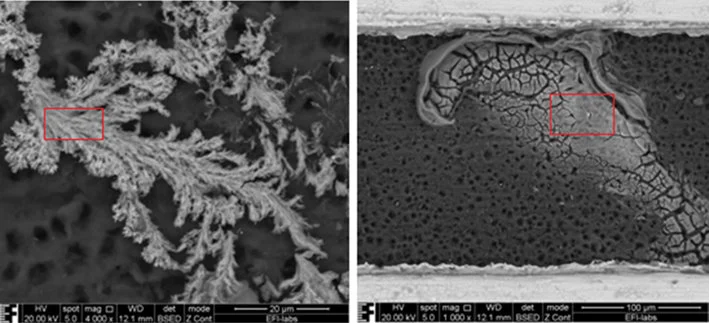
Electrochemical migration initiates at the anode where metal oxidizes into soluble ions under positive bias. These ions migrate through the electrolytic moisture film toward the cathode, driven by the electric field. At the cathode, ions reduce and deposit as metallic dendrites, growing iteratively until contact occurs. Copper, the primary conductor material, readily participates due to its electrochemical potential. The reaction rate follows Faraday's laws, proportional to current density and ion concentration.
Moisture films as thin as 0.1 micrometer suffice, forming from condensation or adsorption in high humidity. Ionic contaminants lower activation energy, promoting faster filament growth. Surface topography influences path length; rough finishes shorten effective distances. Insulation resistance monitoring reveals exponential decline as filaments propagate.
Conductive filaments exhibit tree-like morphologies, branching to minimize resistance paths. Factors like temperature rise kinetics, typically 20-85°C in tests, influence solubility and diffusion. Voltage gradients above 10 V/mm intensify ion drift velocity. Understanding these principles guides surface finish choices to disrupt ion transport or eliminate moisture interfaces.
How Surface Finishes Influence Electrochemical Migration
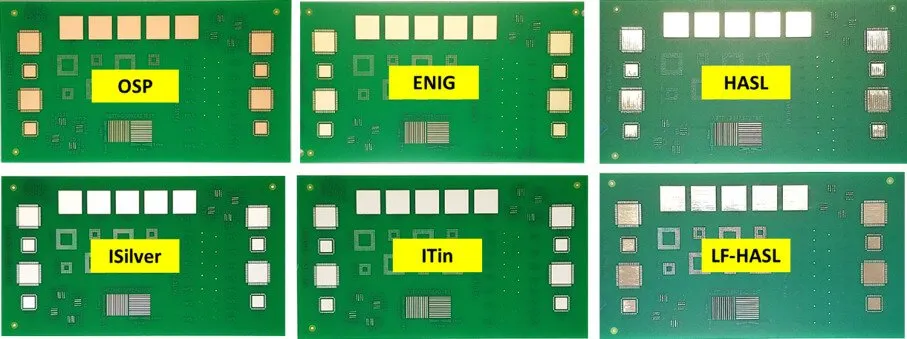
Surface finishes coat exposed copper to prevent oxidation while enabling soldering. They vary in composition, thickness, and barrier properties, directly affecting electrochemical migration susceptibility. Electroless nickel immersion gold deposits a 3-6 micrometer nickel layer topped by 0.05-0.1 micrometer gold. The nickel acts as a diffusion barrier, retarding copper ion release, while gold repels moisture and resists corrosion. This multilayer structure excels in high-reliability applications, minimizing conductive filament formation.
Organic solderability preservative applies a thin organic film, typically 0.2-0.5 micrometer, that protects copper temporarily. However, the organic layer degrades under heat or contamination, exposing copper and heightening electrochemical migration risks. It suits short-shelf-life assemblies but demands stringent cleanliness. Hot air solder leveling coats with molten solder alloy, providing thick protection but uneven topography that traps residues, potentially aiding ion paths.
Immersion silver and tin finishes replace copper surface atoms with noble metals, offering flatness for fine-pitch. Silver's tendency to migrate under bias makes it vulnerable to electrochemical migration, forming silver dendrites faster than copper. Tin provides moderate resistance but suffers whisker growth risks. Engineers compare these based on environmental exposure; barrier-type finishes like ENIG consistently outperform organics in biased humidity tests.
- ENIG — Barrier mechanism: Ni diffusion barrier + Au corrosion shield; ECM susceptibility: Low; Key applications: High-reliability, fine-pitch.
- OSP — Barrier mechanism: Organic film; ECM susceptibility: High; Key applications: Cost-sensitive, quick-turn.
- HASL — Barrier mechanism: Solder alloy thickness; ECM susceptibility: Medium; Key applications: Through-hole, robust.
- Immersion Ag — Barrier mechanism: Ag substitution; ECM susceptibility: High; Key applications: Flatness-critical.
- Immersion Sn — Barrier mechanism: Sn substitution; ECM susceptibility: Medium; Key applications: Lead-free compliance.
Testing Surface Finishes for Electrochemical Migration Resistance
Qualification involves standardized tests simulating accelerated conditions. IPC-TM-650 method 2.6.14.1 uses interdigitated comb patterns with 0.1 mm spacing, applying 10-100 V DC at 85% RH and 40°C. Insulation resistance thresholds below 10^5 ohms indicate failure from filament bridging. Bare copper fails rapidly, while coated samples reveal finish efficacy.
Visual inspection post-test identifies dendrites via microscopy. Time-to-failure metrics, though variable, highlight superior performance of nickel-barriered finishes. Preconditioning with flux simulates assembly residues. IPC-6012 specifies qualification for rigid boards, mandating surface finish conformance to solderability and contamination limits.
Engineers correlate test data to field reliability, adjusting designs for spacing and materials. Solder mask over bare areas complements finishes, further insulating against moisture.
Best Practices for Selecting and Implementing Surface Finishes
Select finishes matching application demands: ENIG for high-density, humid environments prioritizing PCB reliability. OSP fits volume production with controlled storage. Ensure minimum thicknesses per manufacturer specs to sustain barrier integrity. Maintain conductor spacings exceeding 0.15 mm in risk areas, per IPC-2221 design guidelines.
Process controls minimize contamination: ultrasonic cleaning post-finishing, ion chromatography verification. Assembly fluxes with low residues reduce post-reflow ions. Bake boards pre-assembly to desorb moisture. Conformal coatings add redundancy in extreme cases.
Validation through lot sampling via IPC-TM-650 confirms consistency. Collaborate with fabricators on finish thickness uniformity. These practices sustain insulation resistance above 10^8 ohms long-term.
Conclusion
Surface finishes critically prevent electrochemical migration by blocking ion paths and moisture interaction. ENIG stands out for its robust barriers, enhancing PCB reliability against conductive filaments. Testing per industry standards ensures qualification. Engineers applying these insights achieve superior insulation resistance and field performance. Prioritizing finish selection alongside design rules fortifies assemblies for demanding conditions.
FAQs
Q1: What causes electrochemical migration on PCBs?
A1: Electrochemical migration arises from metal ion transport under bias voltage across moisture films with ionic contaminants. It forms conductive filaments that erode insulation resistance, compromising PCB reliability. Surface finishes like ENIG mitigate this by providing barriers. Proper spacing and cleanliness further reduce risks in humid environments.
Q2: Which surface finish best prevents electrochemical migration?
A2: ENIG offers superior resistance due to its nickel barrier layer that limits copper ion diffusion. It outperforms OSP and immersion silver in biased humidity tests. Select based on assembly needs while verifying via standard tests. This choice bolsters long-term PCB reliability.
Q3: How do you test for electrochemical migration risk?
A3: Use IPC-TM-650 2.6.14.1 with comb patterns under high voltage and humidity, monitoring insulation resistance drop. Filament growth indicates vulnerability. Surface finishes influence outcomes; robust ones delay failure. Integrate into qualification for high-reliability designs.
Q4: Can solder mask replace surface finishes for ECM prevention?
A4: Solder mask insulates covered areas but leaves exposed copper reliant on finishes. It complements but does not substitute, as unprotected pads remain prone to electrochemical migration. Combine with appropriate finishes for optimal PCB reliability and insulation resistance.
References
IPC-6012E — Qualification and Performance Specification for Rigid Printed Boards. IPC, 2017
IPC-TM-650 2.6.14.1 — Electrochemical Migration Resistance Test. IPC
IPC-2221B — Generic Standard on Printed Board Design. IPC, 2012
IPC-A-600K — Acceptability of Printed Boards. IPC, 2020