ALLPCB


Overview
Sleepace (Chinese name "Xiangshui") is a brand of Maidijia Technology Development Co., Ltd. Its product RestOn is a portable non-wearable sleep monitor introduced in 2014. The device can monitor physiological signals such as heart rate, respiration, and body movement in real time, and analyze sleep status. It does not use skin-contact electrodes or require attachment to any body part. Instead, it collects data via a sensing strap approximately 80 cm long, 6.4 cm wide, and about 2 mm thick. For use, the strap is placed between the bedsheet and the mattress.
Mechanical Design and User Interaction
The sensing strap is integrated with the main monitor body and can be rolled up for storage or travel. Friction between the strap, bedsheet, and mattress helps keep the main unit suspended on the bed edge without slipping.
The monitor back cover has a curved shape and contains no visible screw holes. The front face includes a removable cover panel that attaches magnetically to the main unit. Removing the cover reveals pictographic operating instructions. The orientation of this cover controls power on/off: placing it in the power-on position lights a green indicator for several seconds, while removing it puts the device into the off state.
The front shell is also free of visible screw holes. During disassembly, the front and back covers were found to be held together by multiple clips rather than separately engaging the frame. Four magnets are embedded in the front cover to align with magnets in the removable cover for positioning.
Internal Layout and Key Components
Internally the enclosure is flat, with the lithium battery and the circuit board each occupying about half of the internal space. The PCB connects to the battery and to the sensing strap via two multi-strand enameled wires. Solder silk markings on the PCB test points indicate an ARM Cortex-M series MCU as the main controller. Most major components are on the other side of the board.
Notable components identified on the PCB include:
- A small PCB module, color-differentiated, likely a TI CC2540 Bluetooth Low Energy solution.
- A central MCU from Freescale (now part of NXP): KL16Z128, an ARM Cortex-M0+ with 128 kB Flash and 16 kB SRAM. This MCU family includes a 16-bit SAR ADC, offering higher ADC resolution than typical MCU ADCs.
- TI TLV2764: low-power, low-voltage quad op amp.
- Microchip MCP41100: 100 kΩ digital potentiometer.
- Holtek HT1381: real-time clock (with an associated crystal).
- Winbond W25Q64: 64 Mbit serial flash.
The TLV2764 and MCP41100 appear configured to amplify the sensor signals with controllable gain, with the amplified analog output feeding the KL16Z ADC input. The HT1381 provides a persistent timekeeping function even when the main unit is powered down, likely for lower standby power than using the MCU's internal RTC. The W25Q64 stores sleep data so monitoring does not depend on a phone or network connection.
Numerous small packaged chips and transistors on the board are assumed to support power management, including lithium battery protection and charging circuitry, and separate regulation for the digital system and analog front end.
Signal Observation from the Analog Front End
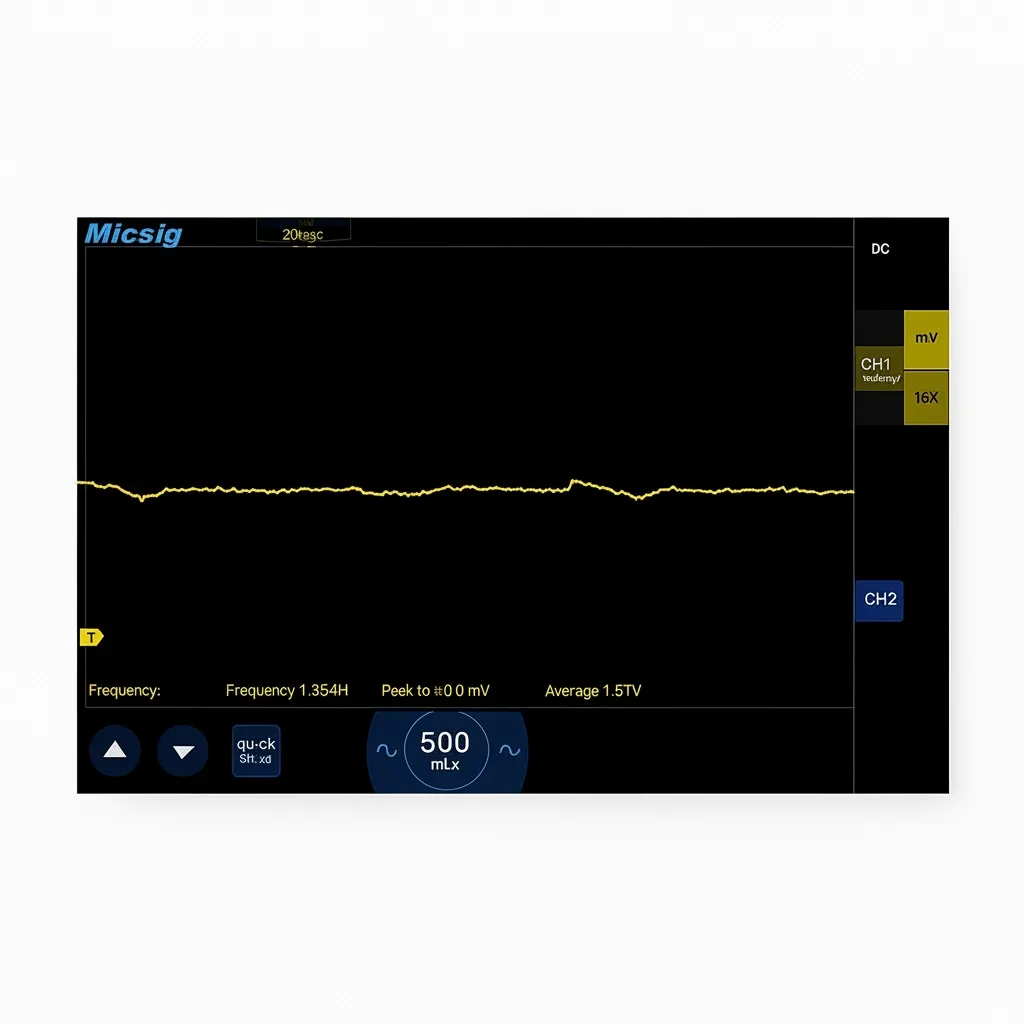
An oscilloscope probe connected to an output of the TLV2764 revealed a waveform that follows respiration when a person lies on the sensing strap. A clear heartbeat waveform was not visually obvious; this may be due to filtering applied to that signal path or because the heartbeat signal amplitude is relatively small and requires algorithmic processing to extract. Large body movements, such as raising an arm, produce large amplitude signals that can drive the op amp output to saturation.
Sensing Strap Disassembly and Structure
To examine how the sensing strap generates signals, the strap was disassembled. The strap edges are tightly stitched, and non-destructive side separation proved impossible. Separating from the head end and desoldering the strap wires allowed the strap to be detached from the main unit. The strap appears to be glued and then die-cut, making disassembly difficult. The outer layer resembles synthetic leather. At the head end, two layers sandwich a foam layer. Peeling revealed at least a three-layer structure with foam segments arranged in strips; full reassembly would not be feasible after this destructive disassembly.
The lead wires from the monitor run into the strap and terminate at solder points embedded in another foam layer. Between foam strips the underlying sensor was exposed: a long thin film sensor. Heating the foam locally with a hot air tool made it easier to separate the sensor connector fastened inside the foam. The foam behaves like a double-sided adhesive, about 1 mm thick per sheet, and in some areas two sheets are mated together.
Under the foam and a semi-transparent film covering, the sensor appears as a thin film strip 13 mm wide, with an opaque conductive region about 9 mm wide. From the connector, the conductive layer is split into two layers. The piezoelectric layer is very thin, so measuring the dielectric thickness was not feasible with available tools.
Sensor Type and Materials
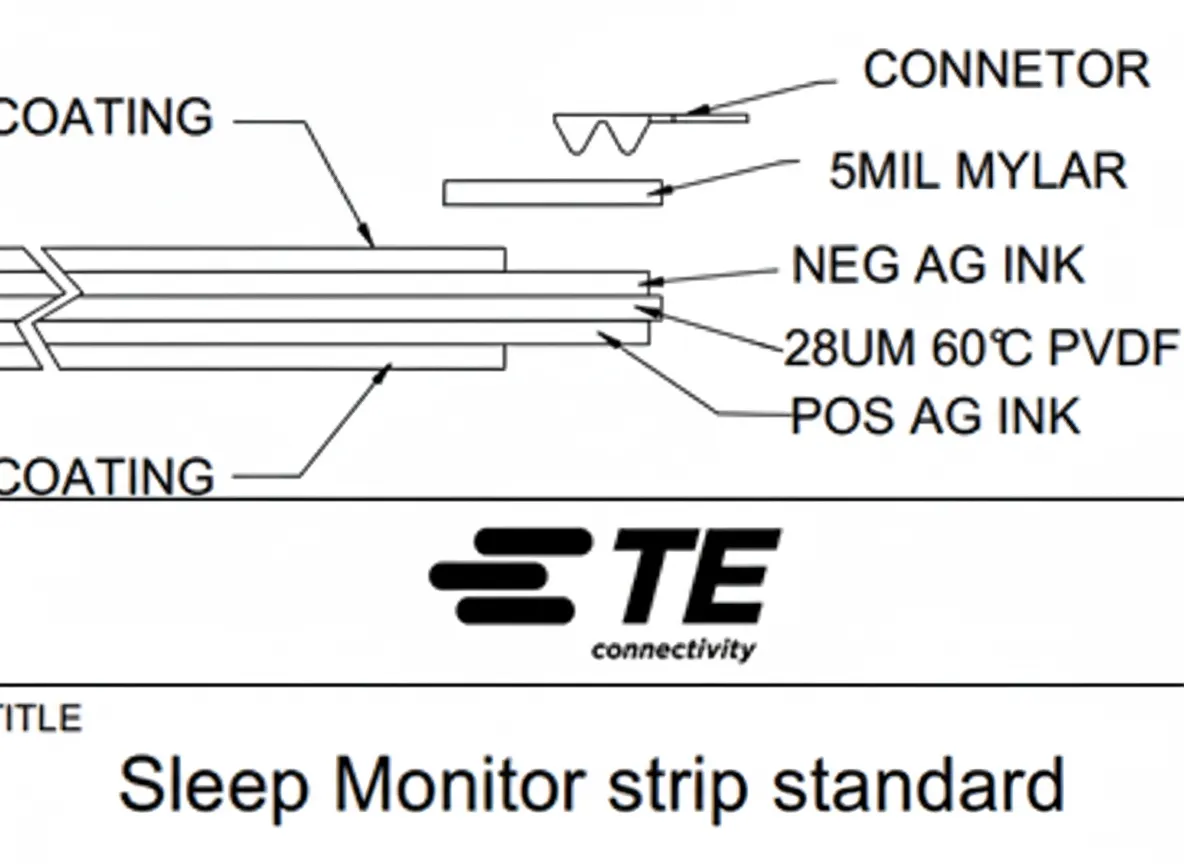
The sensor is reported to be a TE Connectivity product. TE publishes sensor product information for sleep monitoring and provides a drawing for product 10184000-01. Although the RestOn sensor dimensions differ, the operating principle is the same. The central PVDF (polyvinylidene fluoride) layer is estimated at about 28 μm thick; adding conductive electrodes and protective layers yields a measured overall thickness of approximately 0.05 mm. This five-layer film is thinner than ordinary A4 printer paper and is very flexible.
TE describes the piezoelectric film as a thin, transparent PVDF film that is flexible, low density, and lightweight with good mechanical toughness. The film can be produced in various thicknesses and large areas, and can be adhered directly to mechanical surfaces without affecting movement. Piezoelectric PVDF offers a wide frequency band, broad dynamic range, and high voltage sensitivity, and its low acoustic impedance is closer to water, human tissue, and other organic materials, facilitating efficient transmission of acoustic signals in those media (data source).
Direct Sensor Output
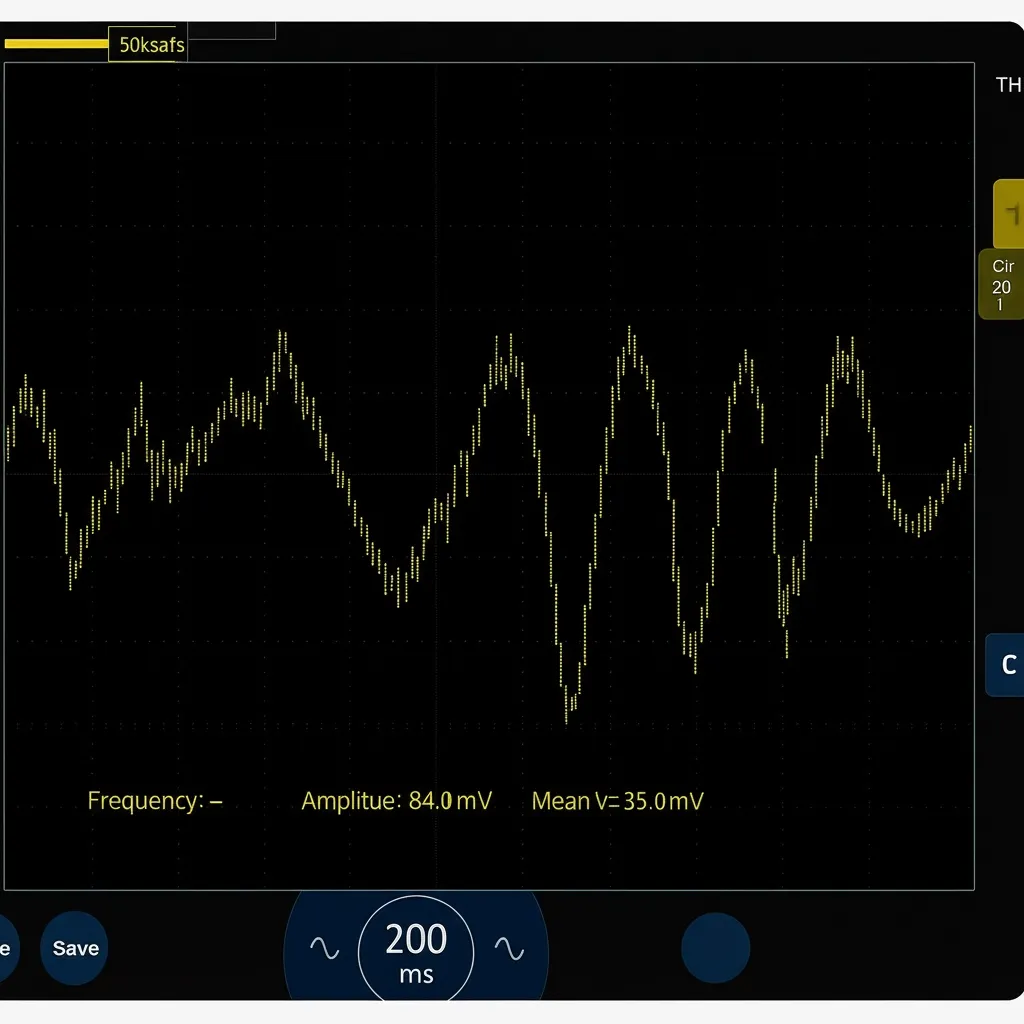
Connecting the oscilloscope probe directly across the sensor terminals after separating it from the monitor showed clear voltage signals when the sensor experienced vibration or instantaneous deformation. This confirms the sensor operates without external power, using the piezoelectric effect to generate voltage changes. Due to the sensor's high output impedance, the oscilloscope also picked up mains interference, visible as a 50 Hz disturbance on the traces.
Design Considerations for the Sensing Strap
The sensing strap's multi-layer, foam-protected design likely serves two purposes: to transmit subtle pressure and vibration from the body to the piezoelectric sensor more effectively, and to protect the sensor from tensile stress and extreme local bending or twisting.
Signal Processing and Data Flow
In summary, the piezoelectric film sensor converts small pressure changes from heartbeats, respiration, and body motion into electrical signals. These analog signals are amplified by the device's analog front end, digitized by the MCU ADC, and then processed for filtering, recording, and analysis. Low-power Bluetooth is used to synchronize and exchange data with a mobile app, which can generate graphical sleep reports. Off-device processing via a phone or remote server enables more advanced health management features.