ALLPCB


Overview
General Movement (GM) assessment is widely used for early clinical evaluation of neonatal brain development disorders such as cerebral palsy, enabling very early intervention and rehabilitation for at-risk infants. Current clinical practice largely depends on subjective evaluation by pediatricians and lacks quantitative methods, requiring substantial clinical expertise and personnel and limiting large-scale screening, especially in regions with limited medical resources. Although video-based motion capture can digitize neonatal movements, privacy and usability issues remain. Wearable physiological sensors for GM assessment could address these limitations.
System Design
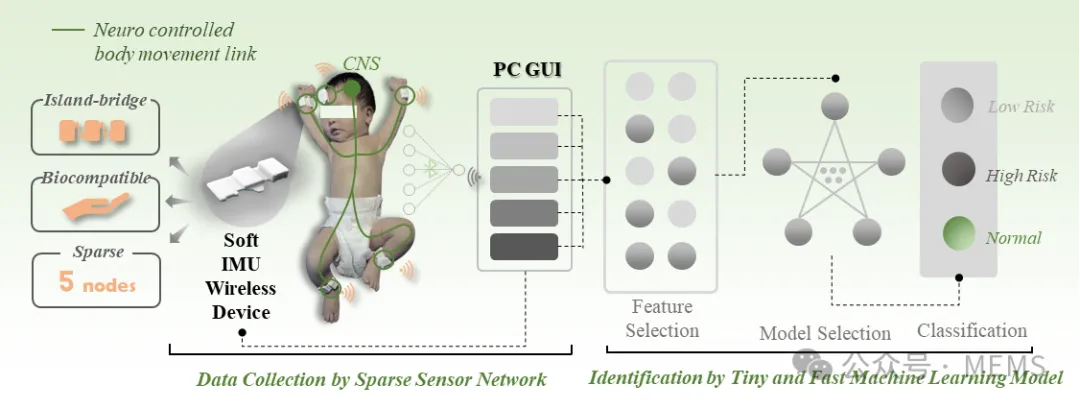
Researchers from the Suzhou Institute of Biomedical Engineering and Technology, Chinese Academy of Sciences, and Penn State University have proposed a sparse sensor network composed of flexible wireless IMU devices (SWD) for rapid automated ultra-early screening of cerebral palsy in infants (figure 1). The system can screen infants up to 20 weeks old within 15 minutes.
Wearable Hardware and Sensing Capabilities
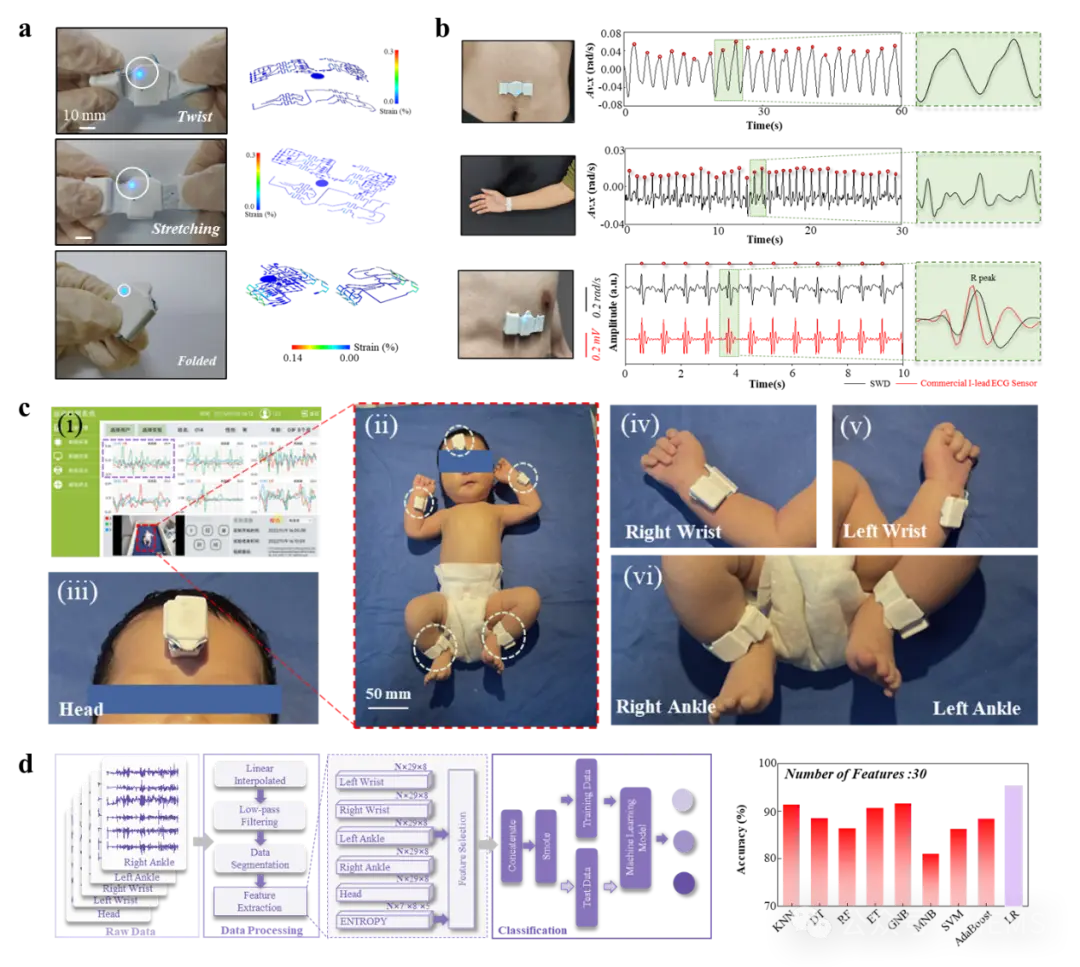
The motion-assessing sparse network uses only five sensor nodes. Each node features an "island-bridge" structure and biocompatible materials, providing mechanical compliance and biocompatibility to ensure infant comfort and safety. The integrated system can continuously and stably acquire acceleration and angular velocity from the infant without skin damage or motion interference (figure 2a). The devices exhibit favorable wearable mechano-electrical properties, enabling potential monitoring of biomechanical and physiological signals such as respiration rate, heart rate, and pulse (figure 2b). The team completed a clinical proof-of-concept validation with 23 infants in collaboration with affiliated hospitals, confirming the system's reliability (figure 2c). Combined with a compact, easily deployable machine-learning algorithm, the system can automatically and reliably identify infants at high risk for brain developmental issues with accuracy greater than 99% (figure 2d).
Conclusions
This work provides a digital and automated approach for large-scale rapid screening of neonatal brain developmental disorders and could support ultra-early intervention and rehabilitation for infants at risk of cerebral palsy.
Publication and Funding
The study, titled "Intelligence Sparse Sensor Network for Automatic Early Evaluation of General Movements in Infants," was published in Advanced Science (IF = 15.1), a journal classified as top-tier by the Chinese Academy of Sciences. The first author is PhD student Bao Benkun; co–corresponding authors include postdoctoral researcher Zhang Senhao, researcher Cheng Xiankai, researcher Yang Hongbo, and professor Cheng Huanyu. The research received funding from the Chinese Academy of Sciences International Partnership Program, the National Key R&D Program of China, the National Natural Science Foundation of China, and the Jiangsu Provincial Key R&D Program.