ALLPCB


In March 2021, with the IPO of Roblox, the metaverse attracted global attention. Facebook, Microsoft, Nvidia, Tencent, ByteDance, Baidu and other companies made moves in related fields. The metaverse is built on new infrastructure and represents a next-generation internet application and social ecosystem that fuses virtual and real-world space and time. By using blockchain, artificial intelligence, extended reality, digital twin and other technologies, the metaverse creates mirror mappings of the real world, extends space and time, and extends value, enabling digital avatars and human–machine interaction methods to blend virtual and real environments.
What Is the Industrial Metaverse?
The industrial metaverse is an important application domain of the metaverse. It is built on core metaverse infrastructure and application concepts to serve the industrial economy through new industrial systems, industrial ecosystems and industrial modes. In the virtual world, the industrial metaverse can present a holographic view and cross-spatiotemporal aggregation of all industrial elements, the entire value chain, and the entire industry chain, while overlaying new social and economic models. Using human–computer interaction and digital avatars, it enables coordinated industrial production and operations, promoting industrial transformation, upgrading and innovation.
Industrial Metaverse: Introductory Series
Q1: What is the metaverse?
There is no universally accepted definition of the metaverse yet. Generally, the metaverse refers to a virtual world created by technology that maps and interacts with the real world and forms a digital living space with a new social and economic system. Synthesizing related definitions, the metaverse can be seen as a digitally networked space that integrates multiple information technologies, is immersive, autonomous, and blends virtual and physical realities. It reconstructs platform value, enables identity assetization, content monetization, and open interoperability, and extends real-world social activities and interpersonal relationships across space and time.
The metaverse uses extended reality, blockchain, artificial intelligence, digital twin and other technologies to digitally extend the real world, achieving spatial extension, temporal extension and value extension.
Q2: What is the industrial metaverse?
Academician Li Bohu defines the industrial metaverse as, under new development concepts and led by a new generation of artificial intelligence, leveraging cross-disciplinary integration of emerging technologies to enable virtual–real mapping, interaction and fusion among "people, virtual space and physical space" in the industrial domain. It aims to promote virtual-driven and virtual-enhanced capabilities across the full element chain, full industry chain and full value chain (the three chains), forming an intelligent, collaborative, open, service-oriented and interconnected complex digital industrial economic system.
The industrial metaverse represents a new industrial ecology formed by deep integration of extended reality, digital twin, content generation and other technologies with the physical industrial economy and next-generation information and communication technologies.
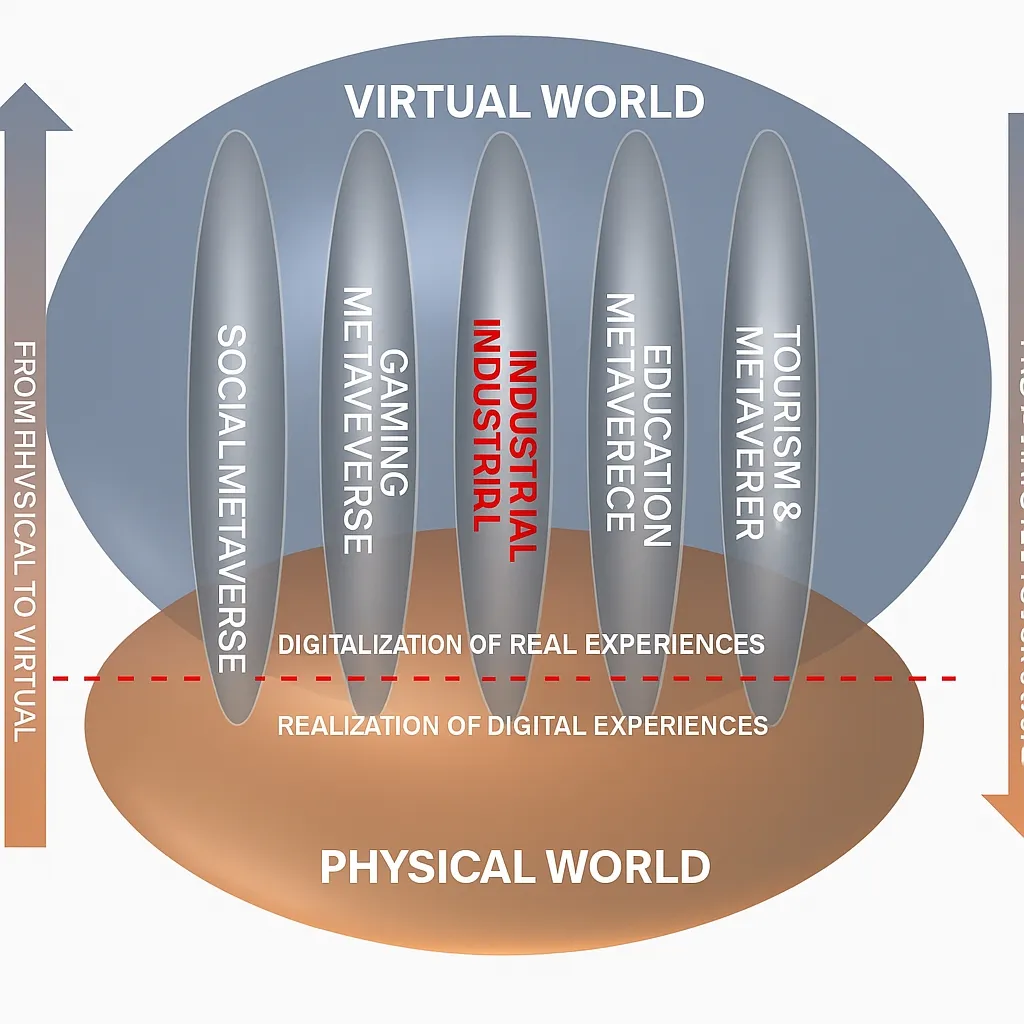
Figure: Industrial Metaverse vs the Metaverse
Compared with surreal content creation and user experience in consumer scenarios, the industrial metaverse constructs scenes and objects that correspond to concrete physical systems, with well-defined problems, organizational relationships and tasks. Given the industrial domain's solid technical foundations and clear application scenarios, the industrial metaverse is likely to be among the first areas where metaverse concepts are applied in practice.