ALLPCB


Background
While browsing Hackaday recently, I found a smartwatch project still under development. The build centers on an ESP32 PICO D4-based Pi-style watch with Wi-Fi, Bluetooth, mesh networking, a vibration motor, an RTC, four buttons, a USB-C connector, and, most notably, 192 LEDs that can be used to create complex lighting effects.
The LEDs are arranged in four concentric rings. The outer ring of 60 LEDs is intended for the seconds hand and will be white. Two middle rings are purple for minutes. The inner ring is yellow for hours.
The LED driver is an IS31FL3733-TQ. The watch draws inspiration from the TokyoFlash style of LED timepieces.
Capabilities
The 603-200 Morphwatch design uses 192 LEDs to produce visual effects. The layout is four rings of 603-size SMD LEDs:
- Outer ring: 60 white 603 LEDs for seconds.
- Two middle rings: purple 603 LEDs for minutes.
- Inner ring: yellow 603 LEDs for hours.
Each LED can be individually controlled via I2C or scripted with Python. This enables a wide range of programmable visual effects.
Beyond lighting, the watch has an ESP32 PICO D4 microcontroller, enabling Bluetooth interaction with a phone, mesh communication between devices, and Wi-Fi connectivity. Features include vibration alerts when a paired phone moves out of Bluetooth range or when the phone is far away and reachable via Wi-Fi.
Four buttons can be programmed to trigger actions such as sending an emergency email or sending a vibration signal to another watch. Using ESP-NOW mesh protocol, watches can communicate directly, potentially reaching hundreds of meters depending on conditions, allowing a private long-range communication network independent of cellular infrastructure.
The watch can also operate as an access point and simple web server, providing a basic information interface. And, of course, it displays the time.
Availability of Files
The project is open source and all related files are available.
Design Concept
The goal is a hybrid design combining a retro LED watch aesthetic with modern networking features. The build uses the ESP32 PICO D4 and classic 603 LEDs. If this version proves successful, the plan is to migrate the LEDs from 603 packages to smaller 402 packages and reduce the watch diameter to better suit smaller wrists.
With 192 LEDs driven by the IS31FL3733-TQ, each LED is addressable over I2C and can form many visual patterns. The ESP32 PICO D4 links the watch to Wi-Fi, Bluetooth, and ESP-NOW, enabling a community mesh network.
The initial concept graphics and simulations were created in SolidWorks to evaluate layout options and test visual patterns.
Main PCB
Core modules include:
- Lithium battery charging module
- ESP32 PICO D4 as the main controller
- DS3231MZ real-time clock
- CP2104 USB-to-UART interface for ESP32
- ME6211C33M 3.3V regulator converting 5V/BAT to 3.3V
- TP4054 charger IC
The system monitors battery state via the ESP32 ADC. This main PCB supplies power and I2C signals to a daughterboard that holds the LEDs and LED driver, enabling interchangeable daughterboard designs.
The main board includes connectors and buttons to select various functions.
LED Daughterboard
The second board in the concept houses the 192 LEDs. Three connectors route power and signals from the main board to the LED daughterboard. This connectorized approach lets makers swap or redesign daughterboards easily—for example, to add a full-color display, different LED patterns, or small motors.
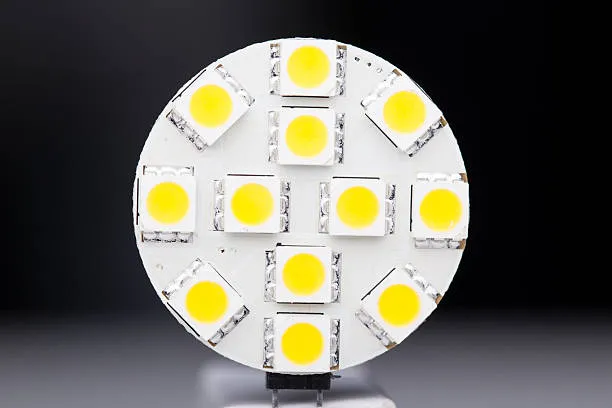
The LED daughterboard uses a single IC, the IS31FL3733-TQ, which accepts I2C and can drive up to 192 LEDs arranged in a matrix. The current prototype uses a 56 mm diameter PCB. After functional testing, the design may move LEDs to 402 packages and reduce diameter to about 40 mm.
Current Status
The project is in prototype stages. All design files are open source and available in the project repository.