ALLPCB


Overview
In March 2021, after Roblox, the first public company associated with the metaverse concept, went public, the metaverse attracted global attention. Facebook, Microsoft, NVIDIA, Tencent, ByteDance, Baidu and other companies began investing in related areas. The metaverse is a new generation of internet applications and social ecology built on next-generation infrastructure to achieve spatiotemporal fusion of virtual and physical worlds. Technologies such as blockchain, artificial intelligence, extended reality, and digital twins enable mirrored mapping, spatiotemporal extension, and value extension of the physical world, allowing people to obtain digital avatars in virtual environments and, via extended reality and other human-computer interaction methods, to merge virtual and physical worlds.
The industrial metaverse is a major application domain of the metaverse. Based on metaverse core infrastructure and application concepts, it forms a new industrial system, industrial ecosystem, and industrial operating model that serve the industrial economy. The industrial metaverse can provide holographic displays and cross-spatiotemporal aggregation of industrial elements, the value chain, and the industry chain within a virtual environment, and overlay new social and economic interaction models. Using human-computer interaction and digital avatars, it can enable coordinated industrial production and operations in virtual environments to support industrial transformation, upgrading, and innovation.
What does the conceptual framework include?
The industrial metaverse aims to map the industrial physical world into the virtual world and to enable new forms of industrial production within the virtual domain. The conceptual framework is shown below.
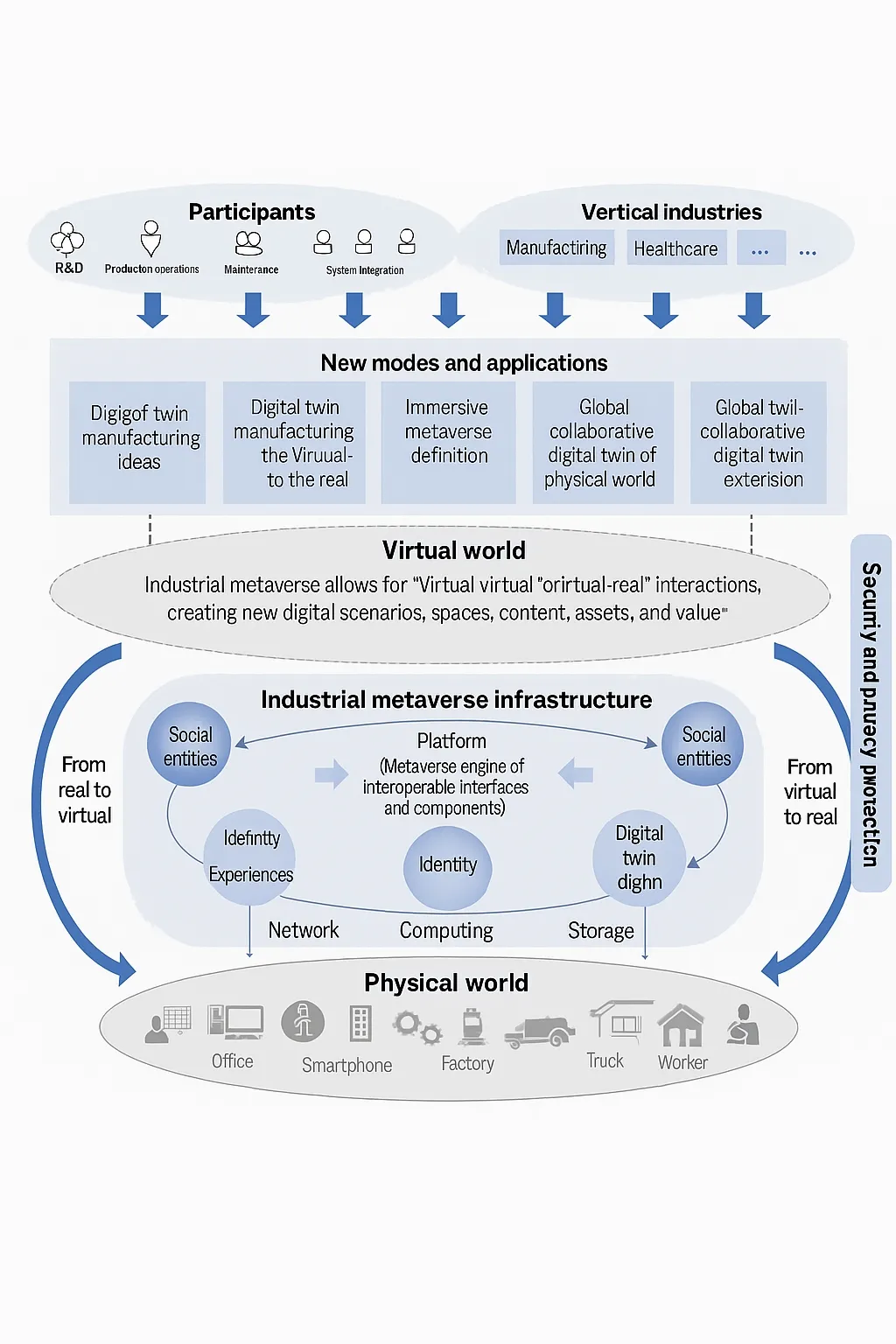
Industrial metaverse conceptual framework
Real World
Beyond industrial production itself, the real world encompasses comprehensive sensing of all industrial elements, the full industry chain, and the full value chain. "All elements" include people, machines, materials, methods, environment, and quality. The full industry chain covers procurement, production, logistics, sales, and other stages that make up the complete supply chain. The full value chain includes all participants, organizations involved in production and sales, and their value and profit distribution. Digitalizing these elements and chains establishes the data foundation for the industrial metaverse.
Infrastructure
Supported by key information infrastructure such as networks, computing power, and storage, the industrial metaverse builds experience, identity, asset, and platform infrastructure with industrial characteristics, forming four major systems: social, spatiotemporal, economic, and governance.
Experience infrastructure focuses on virtual-physical interaction and on content and rendering engines. It is the gateway for virtual-physical interaction and a key entry point for users into the virtual world. Identity infrastructure represents virtual and physical identities and maps them. It supports digital avatars and the internal social relationships within the industrial metaverse. Asset infrastructure turns industrial elements into assets, enabling representation of industrial elements and supporting transactions of industrial digital assets under those representations.
Platform infrastructure supports coordination of virtual and physical resources across the industrial metaverse, providing data-driven industrial intelligence and services for the entire system. It links experience, identity, and assets, and enables the construction of new social, economic, spatiotemporal, and governance systems for industrial production and operations. It supports virtual world construction and various industrial-metaverse innovation applications.
The industrial metaverse is built on underlying metaverse social, economic, spatiotemporal, and governance foundations, adapts to new industrialization needs, and evolves iteratively. The spatiotemporal and social systems extend the physical world digitally through virtual environments. Distributed identifiers and digital avatars give users greater identity autonomy. Digital twins of the physical world and virtual-native constructs create richer virtual environments that can transcend physical time and space. The economic system can encompass and extend the real-world economy, and may establish new virtual economic models that interact with existing economies, such as the creator economy. The governance system establishes the rules and institutions needed for a secure and stable metaverse.
Virtual World
Based on mirrored mappings from the physical world and supported by industrial metaverse infrastructure, the virtual world builds digital elements under social, spatiotemporal, economic, and governance systems. These elements include virtual objects, virtual humans, virtual organizations, and virtual environments. Virtual objects map physical production resources and include digitalized materials, equipment, and products. Virtual humans map participants in industrial production and include digitalized producers, designers, operators, managers, and consumers. Virtual organizations map production entities and include digitalized factories, workshops, enterprises, and industrial parks. Virtual environments map production surroundings and include digitalized spatiotemporal settings, sites, and buildings. In the future, the virtual world will become an important carrier for industrial production, operations, and management in the industrial metaverse era.
Emerging Models and Applications
By combining virtual and physical spaces, the industrial metaverse greatly expands the physical world, removes spatiotemporal constraints, and enables integrated scheduling of physical and digital resources over a wider scope. The metaverse introduces new interaction methods, presentation modes, and collaboration patterns, and fosters changes in social, economic, and governance systems. This promotes innovation in six representative application patterns: platformized design, intelligent manufacturing, personalized customization, networked collaboration, servitization extension, and digitalized management, improving design, production, manufacturing, service, and management comprehensively.
Participants such as users, content creators, operators, platform builders, infrastructure providers, and platform regulators can explore innovations around shared industrial metaverse foundations and across sectors including manufacturing, energy, healthcare, and transportation, advancing new industrialization systems and development.