ALLPCB


Overview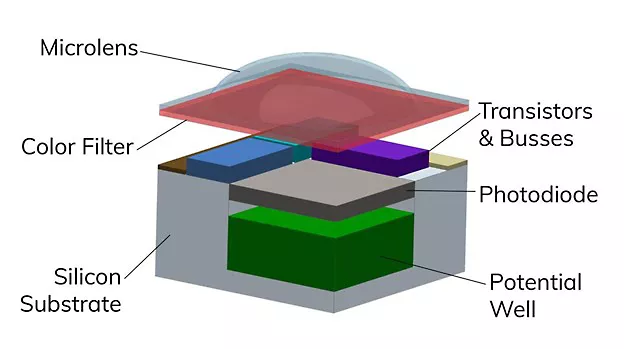
CMOS image sensors are common image-capture devices that use complementary metal-oxide-semiconductor technology to sense light and capture images.
They are used in many applications, including digital cameras, smartphones, surveillance cameras, medical imaging, and industrial inspection. The following are technical terms commonly associated with CMOS image sensors:
Key Terms
-
Pixel: The smallest image element on the sensor; each pixel corresponds to a tiny area in the image and records light intensity and color.
-
Resolution: The level of image detail the sensor can produce, typically expressed as horizontal by vertical pixel count.
-
Photosite: The light-sensitive element associated with each pixel; it converts incoming photons into an electrical signal.
-
Image Noise: Unwanted random variations in pixel values, usually caused by manufacturing process variations, environmental conditions, or electronic noise.
-
Dynamic Range: The span of brightness levels the sensor can capture, commonly represented as the ratio between the darkest and brightest detectable signals.
-
Frame Rate: The number of image frames the sensor captures per second, typically measured in frames per second (fps).
-
Pixel Size: The physical dimension of each pixel, usually given in micrometers.
-
Sensitivity: The sensor's responsiveness to light, often described in terms of the number of photons required to generate a detectable signal at each pixel.
Functions of CMOS Image Sensors
The primary function of a CMOS image sensor is to convert light into electrical signals and then process and convert those signals into digital images. A sensor is typically composed of many small light-sensitive elements (pixels), each responsible for detecting and recording light intensity and color.
Main functions include:
- Image capture: Converting the intensity and color of incident light into electrical signals to record images.
- Digitization: After converting light to electrical signals, the sensor uses on-chip analog-to-digital converters to produce digital image data for subsequent processing.
- Image processing: On-chip circuits can perform enhancements such as filtering, cropping, and color correction to improve image quality.
- Real-time transmission: The sensor can transmit digital images in real time to displays, storage devices, or network interfaces for viewing or storage.
- Special features: Some sensors provide functions like high dynamic range (HDR), low-light enhancement, and high-speed burst capture to meet different application requirements.
CMOS vs CCD: Key Differences
CMOS (complementary metal-oxide-semiconductor) and CCD (charge-coupled device) are two common image capture technologies. They differ in operating principle, structure, and characteristics.
-
Structure:
- CMOS sensors include amplifiers and signal-processing circuitry at each pixel, integrating many converters and control elements on the same chip. This high integration typically yields lower power consumption and lower manufacturing cost.
- CCD sensors use one or more shift registers to transfer charge from all pixels to output stages, requiring external circuitry for amplification and processing. CCD structures are relatively simple but depend on external support circuits.
-
Pixel design:
- CMOS pixels are more independent, often including the photodiode, amplifier, and sometimes ADC at each pixel, which increases on-chip complexity.
- CCD pixels transfer charge between cells and share output circuitry, which can provide certain advantages in uniformity and image quality.
-
Circuit complexity:
- CMOS sensors are comparatively complex on-chip due to per-pixel control and signal processing, but they offer greater design flexibility.
- CCD sensors have simpler on-chip circuitry but require additional external signal-processing components.
-
Power and speed:
- CMOS sensors generally consume less power because of per-pixel amplification and on-chip conversion.
- CCD sensors often offer advantages in high-speed operation and low noise, making them suitable for applications with very stringent image-quality requirements.
Choosing between CMOS and CCD depends on application requirements and cost considerations, given their differences in structure, pixel design, circuit complexity, power consumption, and performance.