ALLPCB


Overview
A wireless tilt sensor that uses low-power wireless communication technologies such as NB-IoT to provide high-precision, all-weather monitoring for storage rack safety. This article examines how wireless tilt sensors address core requirements for rack structural safety management and their effectiveness in detecting and preventing rack deformation and tilt incidents.
1. Industry pain points and technical requirements for rack safety monitoring
Storage racks are core facilities in logistics and are subjected to sustained loads, forklift impacts, and environmental vibrations. Structural deformations such as column tilt or beam bending are often difficult to detect visually. Manual inspection has clear limitations: subjectivity and limited accuracy from tools like plumb bobs, long inspection intervals that prevent continuous dynamic monitoring, and delayed warnings that usually occur only after a noticeable tilt. For high racks or automated warehouses, cumulative micrometer-level displacements can trigger chain reactions that lead to structural failure or collapse, creating safety and economic risks.
Wireless tilt sensors address these issues by continuously collecting tilt-angle data at key rack nodes such as column tops and beam connections and transmitting the data wirelessly. Key benefits include:
- Real-time continuous monitoring: Sensors sample at minute-level intervals, automatically recording and transmitting data to cloud platforms to eliminate periodic gaps associated with manual inspections.
- Multi-point synchronized data: Deployments at rack corners or critical load-bearing points create a three-dimensional monitoring network that captures deformation trends across positions.
2. Technical characteristics and operational adaptation of wireless tilt sensors
High-precision measurement and environmental robustness
The sensor uses MEMS technology with dual-axis accuracy within 0.05°, allowing detection of tilt changes caused by micrometer-level displacements. For warehouse environments with high humidity, dust, or temperature variations, the device employs an IP67 enclosure and a wide operating temperature range (-40°C to 85°C) for long-term stable operation. Internal temperature-compensation algorithms suppress thermal drift and reduce measurement error caused by environmental fluctuation.
Wireless communication and low-power design
Depending on site conditions, the sensor supports multiple communication modes:
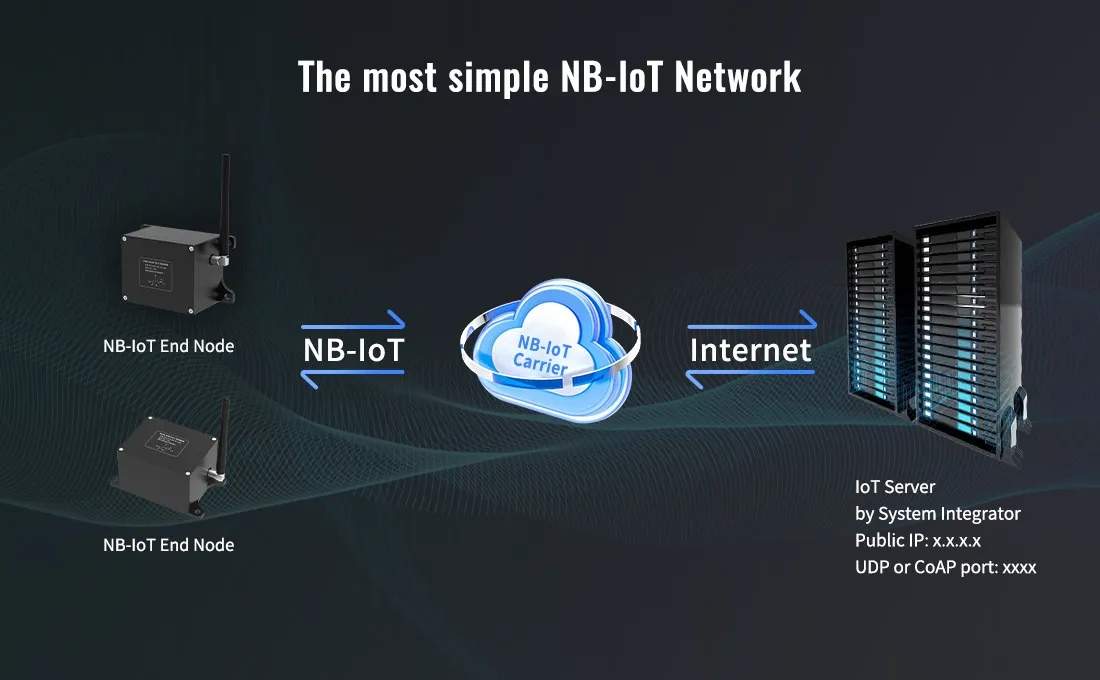
- NB-IoT: Uses cellular networks for direct transmission, avoiding relay-device failure risks. Built-in storage supports data retransmission after network outages to ensure data integrity.
- Low-power optimization: With intelligent power management, when reporting data hourly the battery life can reach 3–5 years, suitable for racks without external power.
Intelligent diagnostics and system integration
Onboard algorithms filter short-term vibration disturbances such as forklift passages and focus on long-term deformation trends. Multi-level thresholds can be defined, for example, a tilt rate exceeding 0.03‰ triggers an alert. The system can send alarms to a mobile app and provide specific location information including latitude and longitude. Data can be integrated into warehouse management platforms using lightweight protocols such as MQTT. Combining real-time and historical data enables rack health modeling and risk prediction.
3. Application scenarios and validation
Verticality monitoring for high-rise rack columns
In automated warehouse projects, sensors are mounted at column tops to monitor verticality in real time. Industry standards typically limit verticality deviation to 1/120 for conventional beam racks and 1/1000 for automated storage systems. In one case, sensors detected a 15% week-on-week increase in column tilt rate. After the system issued a timely alert, an inspection found uneven floor settlement. Adjustments were made to prevent further structural damage.
Deformation alerts in intelligent warehousing
In a dairy industry example, a dairy company deployed ZCT330E-SWP-N sensors at the four corners of racks for full-angle monitoring. When a rack tilted more than 1.2°, the mobile app immediately triggered an alarm and backend software provided traceable data over a 5–10 minute window. This approach identified hidden deformations caused by forklift impacts and enabled a shift from reactive maintenance to predictive maintenance.
Adaptation to special environments
In cold-chain or chemical storage environments, sensors maintain a data loss rate below 0.1% through waterproofing and interference-resistant algorithms. For dense racking areas, flexible networking allows a single gateway to cover multiple monitoring points, reducing deployment cost.
4. Conclusion
The wireless tilt sensor combines high-precision measurement, multi-mode communication, and industrial-grade reliability to offer an end-to-end solution from data acquisition to intelligent alerting. Field use in smart warehousing and high-rise racking indicates that the technology can improve the accuracy and efficiency of rack safety management and support long-term maintenance operations for logistics facilities.