ALLPCB


Notice from China’s Ministry
Recently, China’s Ministry of Industry and Information Technology published a notice soliciting comments on a draft titled "On Strengthening End-to-Network Coordination to Support the Scale Development of 5G Messaging". The notice states that newly activated mobile phones must support 5G messaging, and it encourages device manufacturers that can do so to enable 5G messaging via system upgrades.
What "5G Messaging" Actually Is
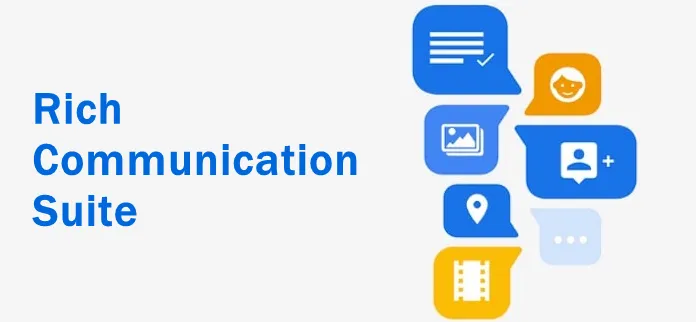
"5G messaging" is not inherently a 5G feature and it is not a brand-new service developed for the 5G era. Its true identity is the RCS service, first introduced in 2008. RCS stands for Rich Communication Suite, a specification for rich-media communication.
What Is Rich Media
Traditional voice calls carry only audio and traditional SMS carries only text. Rich media includes text, voice, images, video, animations, emojis, location, and other media types. Popular messaging apps are examples of rich-media communication. RCS is also referred to as converged communication, meaning a convergence of multiple media types and of IP-based services with traditional telephony services.
Origins and Standards
RCS emerged more than 15 years ago as PC-era instant messaging demonstrated the appeal of multimedia communication. As mobile networks evolved, 3G and later 4G shifted the focus of mobile devices toward data services to meet growing multimedia demand.
In the evolution from 3G to 4G, the 3GPP introduced the IP Multimedia Subsystem (IMS) in Release 5 (2002) to enable multimedia voice and messaging services over packet networks. IMS enables voice over LTE (VoLTE) and provides the foundations for RCS. IMS can be considered a modular component that allows LTE networks to support and enhance voice and SMS functionality by delivering multimedia capabilities.
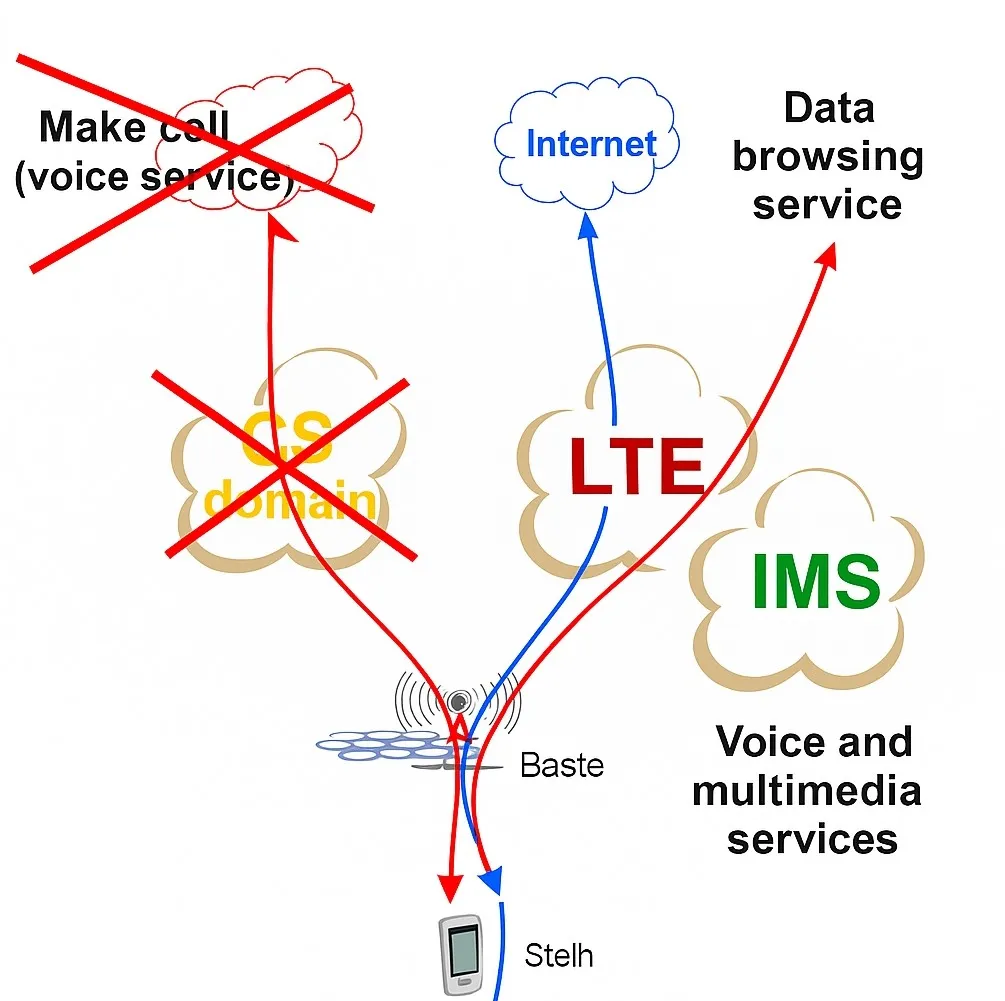
RCS was proposed by a subset of GSMA members in 2007 to enable multimedia message interoperability between operators. GSMA formally launched the RCS project in February 2008 and published successive RCS and RCS-e (enhanced) specifications. After the introduction of 4G LTE, RCS became a standard part of operators' 4G deployments. GSMA later introduced the RCS Universal Profile (UP) to accelerate product development and deployment; the latest UP version was Version 2.4, released in October 2019.
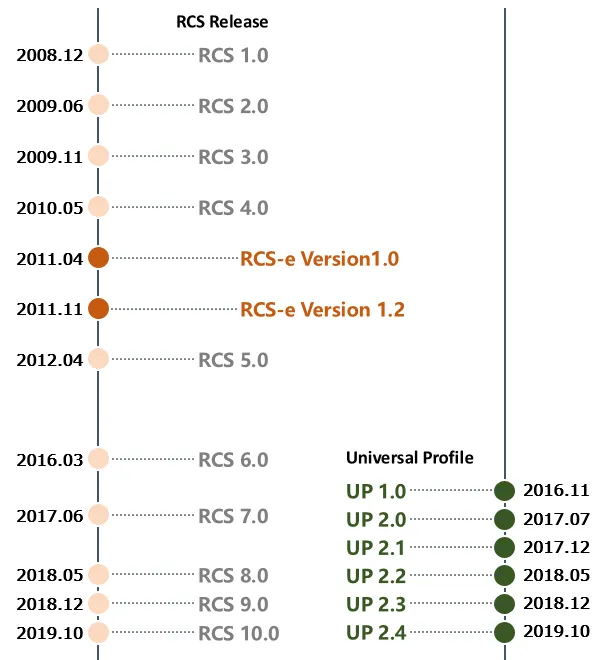
RCS Development in China
China's 3G and 4G rollouts lagged behind those in Europe, Japan, and the U.S. China Mobile prioritized IMS, VoLTE, and RCS in its LTE deployments starting in 2014. To free spectrum for 5G, operators accelerated the retirement of 2G/3G networks and migrated legacy voice and SMS services to LTE and IMS, creating an opportunity to introduce RCS. The "5G messaging" label leverages the 5G brand to emphasize the difference between RCS and traditional messaging.
RCS Functionality
China Mobile previously described three target areas for RCS: new voice, new messaging, and new contacts—corresponding to phone calls, SMS, and address book entry points. "New voice" centers on VoLTE to improve call quality; "new messaging" integrates multiple media formats while maintaining compatibility with SMS/MMS; "new contacts" uses verified mobile numbers as the basis for social and public service access. Overall, RCS supports two broad application scenarios: person-to-person messaging and application-to-person (enterprise-to-consumer) messaging.
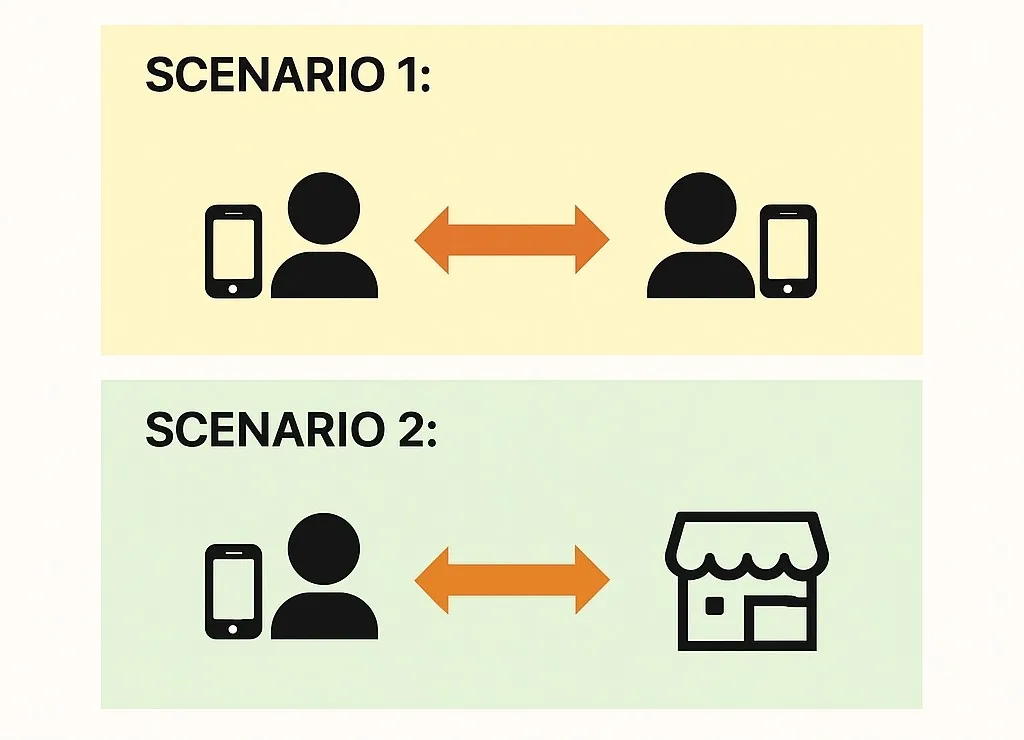
For person-to-person scenarios, RCS supports one-to-one messaging, group messages and chats, multimedia messages (voice, images, video), location and contact cards, cloud message backup, and ephemeral messages. These features are similar to mainstream messaging apps, so RCS is unlikely to displace dominant apps for social use and may serve a supplementary role.
Enterprise Messaging and MaaP
GSMA introduced Messaging as a Platform (MaaP) in UP 2.0 and published a MaaP white paper to standardize RCS Business Messaging for A2P (Application-to-Person) use cases. MaaP provides APIs enabling enterprises to interact with users using rich media and interactive elements, supporting light-service functions such as flight and hotel booking queries, parcel tracking, and order notifications.
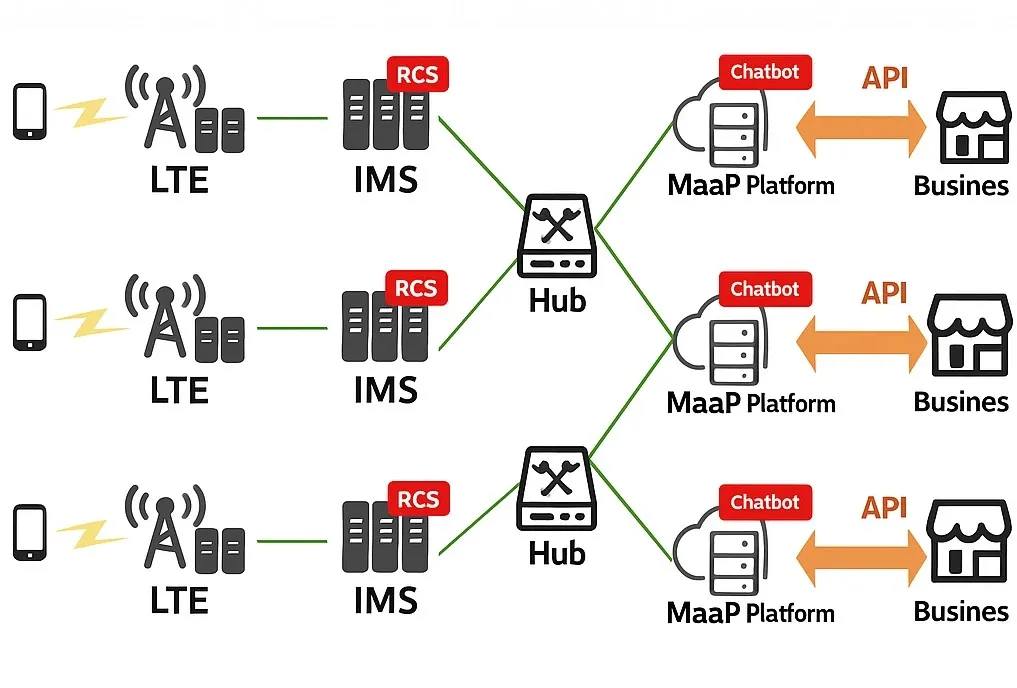
To support RCS Business Messaging, operators deploy MaaP-enhanced open platforms and chatbot services, offering APIs to enterprises. This creates a new communications channel for businesses to reach users and for users to access services, analogous to mini-apps, public service accounts, or automated call center flows.
RCS Advantages
RCS has several notable advantages:
- Native support: No separate third-party app installation is required; native handset support lowers user barriers and reduces promotion costs. Devices can often be enabled by software updates to support RCS UP 2.4, including many 4G phones.
- Phone number as identity: RCS is directly tied to the user’s mobile number, eliminating the need for separate account registration and reducing friction while addressing identity verification and platform fragmentation.
- Access to address book: RCS can leverage the phone’s contact list to enable immediate social connections without manual friend requests.
Challenges and Ecosystem Considerations
Despite these advantages, the success of RCS depends primarily on its ecosystem and business model. The value chain includes operators, equipment vendors, device manufacturers, platform service providers, and content providers. Key open questions include whether platform and content providers will invest, how platforms and applications will be developed, whether developers can achieve returns, how merchants will be attracted and charged, and whether merchants will be willing to pay.
If the ecosystem cannot scale and strengthen, it will be difficult to incubate diverse 5G messaging applications and realize commercial returns.
Conclusion
According to GSMA, by October 2020, 136 operators had launched RCS commercially. By January 2022, global monthly active users of RCS had reached 421 million, with more than 1.2 billion supported devices.
With broader 5G and LTE deployments, RCS is likely to become a standard native feature on many phones. Whether the feature achieves widespread commercial success remains to be seen over time.