ALLPCB


Overview
Wireless charging has a wide range of applications. By power level, it ranges from under 5 W (for wearable devices) to several watts (for mobile phones, tablets, laptops, power tools, and kitchen appliances) and up to kilowatt levels for electric vehicles. With Chinese manufacturers such as Huawei and Xiaomi adopting wireless charging as standard on some phones, the mobile segment will drive significant change. In particular, 7.5 W and 10 W are expected to be key power levels.
Before the Lunar New Year this year, many 5 W solutions appeared on the market. Those implementations are relatively primitive and are likely to remain in the gift-market segment for now. Market expectations for wireless charging are rising, and heat dissipation is a major technical issue that needs to be addressed.
Remarks from a Technical Forum
At a recent technical forum organized by ASPENCORE titles, Dai Xingke, general manager of Micro Source Semiconductor, spoke on "Existing Wireless Charging Solutions and Future Considerations." He summarized current issues and outlined five future considerations for wireless charging. One notable product he mentioned is a protocol "emulation" chip.
Current Understanding of the Wireless Charging Market
Key points from Dai's presentation:
- Wireless charging technology has existed for many years and saw rapid growth after Apple released the iPhone X.
- Products using wireless charging cover a broad spectrum, including IoT devices, mobile phones, laptops, and power tools.
- Use scenarios are diverse: home consumer, office, automotive, public spaces, and shared environments.
- Standards are not unified; examples include WPC Qi, PMA, and A4WP.
- Demand is large: an individual may need chargers in multiple different usage scenarios.
There are two main implementation methods today: electromagnetic induction and magnetic resonance, with electromagnetic induction being the mainstream. Apple uses electromagnetic induction with fixed-frequency voltage regulation. That approach requires changes across both the circuit and firmware, which has implications for SoC or system-level developers.
One market research firm predicted more than 600 million wireless charging shipments in 2018. In practice, the figure could be much higher: Shenzhen alone hosts thousands of wireless charging manufacturers, and many companies are expanding. The proliferation of transmitters is likely, and wireless charging could become a common consumer convenience despite perceived drawbacks such as slower speeds, heat, and lower efficiency. User habits influence those perceptions; after adoption, many users find the convenience outweighs the drawbacks.
Principles and Integration Trends
The basic structure of a wireless charging system uses magnetic-field coupling. Early implementations resembled a simple induction heater controlled by a microcontroller, appearing as an opportunity for system vendors rather than power-management specialists. With the rise of fast charging, wireless charging temporarily lost attention, but it has regained traction with renewed smartphone support.
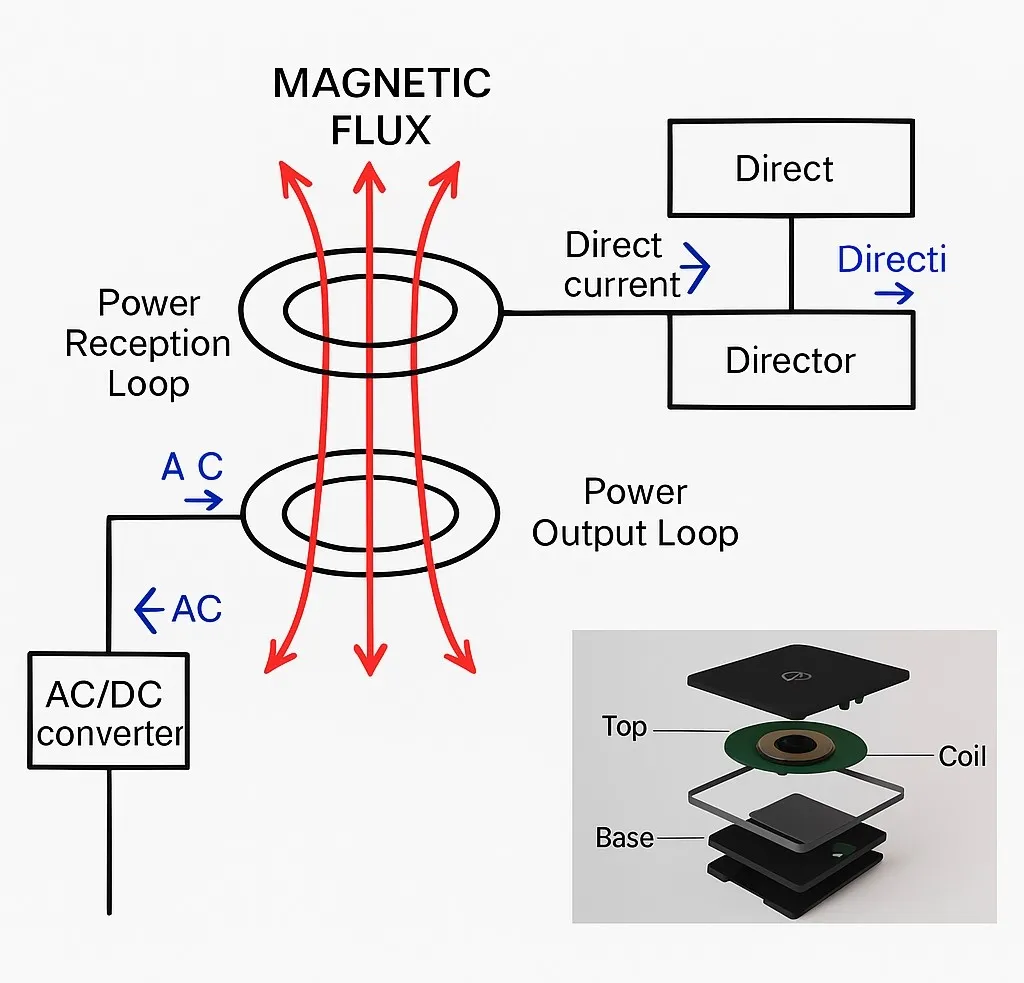
From a circuit-design perspective, the transmitter (Tx) and receiver (Rx) are relatively simple. On the Tx side, an MCU controls a driver, which in turn drives MOSFETs and couples energy to the coil via a capacitor. Feedback sampling informs the MCU of delivered power, and adjustments are made accordingly. However, this architecture has limitations. Power measurements can vary greatly depending on coil placement and distance, so final delivered power is affected not only by electronics but also by mechanical structure, coil size, and coil placement.
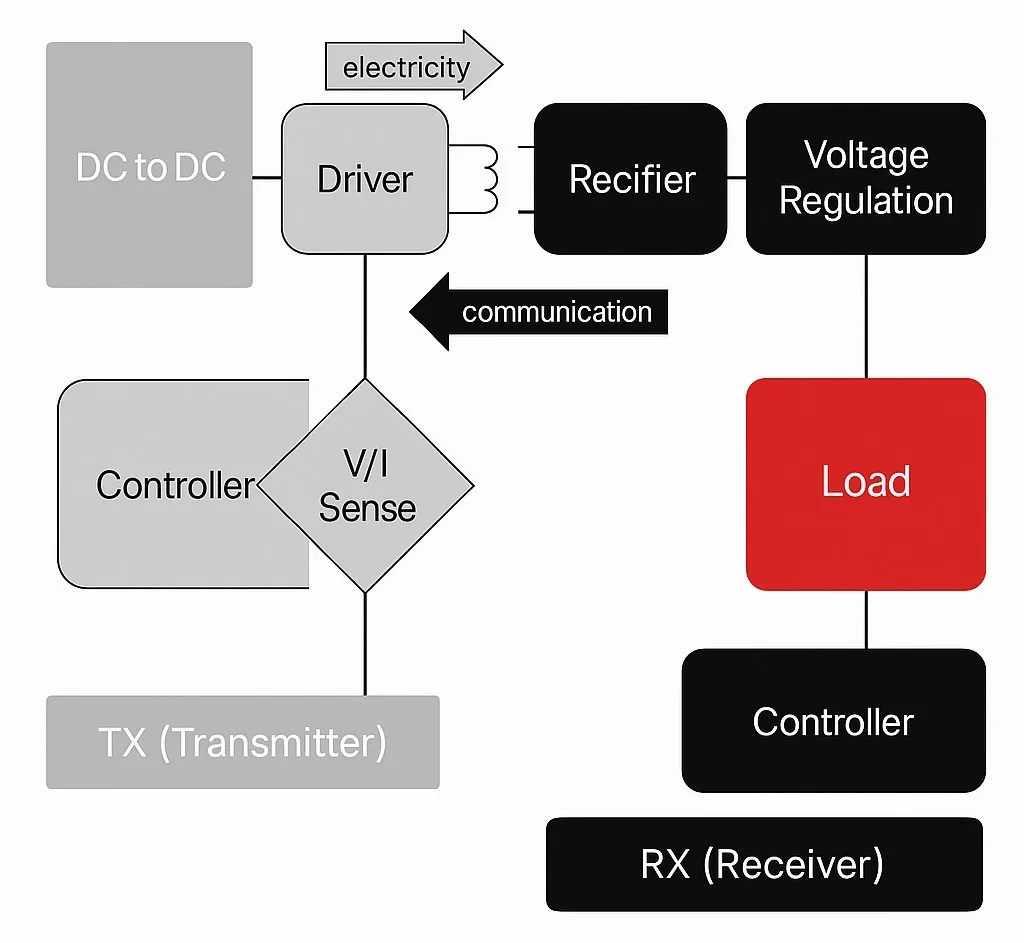
The maturity of an SoC or MCU solution is mainly judged by the accuracy of its sampling and control, since the other hardware components are similar across designs.
Micro Source's approach focuses on companion components around MCUs/SoCs, including the LP1111 driver and half-bridge MOSFETs. The company expects the wireless charging market to become highly price-competitive as functionality converges.
Current printed circuit boards for wireless charging contain many components, which increases the likelihood of assembly and placement issues at volume. To simplify production and reduce parts count, the industry is moving toward higher integration. For example, a dual-driver chip LP1120 reduces an H-bridge implementation to one driver plus two MOSFETs. The LP1130 combines a driver and MOSFETs in SO8 packaging, enabling a complete main-loop design with an SoC and two LP1130 devices. A higher-integrated device, the LP1140 in SOP16, integrates two drivers, two MOSFETs, and voltage/current sensing, allowing an SoC plus one LP1140 to complete the design and simplify manufacturing while lowering cost.
With this approach, a future transmitter could consist of a single MCU for protocol handling, one ASIC for power-stage integration, a capacitor, and a coil. That architecture would aid adoption and allow smaller PCB footprints.
Automotive is a particularly demanding application. Automotive environments require robust protection and validation for high temperature, high voltage, and shock. Micro Source offers products ranging from 1 A to 6 A to meet automotive protection requirements. Consumer vendors face nontrivial barriers when entering the automotive market due to those environmental constraints.
One specific product Dai described is a protocol "emulation" chip. Many manufacturers aiming for 7.5 W or 10 W use low-cost MCUs that struggle with protocol compatibility and accurate handshake voltages. The protocol emulation ASIC, used together with an MCU, can "emulate" the expected fast-charge handshake signals from a large portion of existing fast chargers, enabling fast charging. Because the emulation chip is implemented as an ASIC, its handshake timing edges are precise, improving compatibility.
Five Future Considerations
1. Integrated driver in SoC versus discrete driver solutions
Some vendors are introducing SoCs with integrated drivers to simplify BOM and supply chains. However, drivers and SoCs require different process technologies: drivers need high-voltage analog processes while SoCs use 5 V or digital processes where smaller nodes reduce cost. Integrating both tends to raise costs significantly and may not be meaningful long-term. For 5 W applications, an MCU with an integrated driver can have advantages because it does not require high voltage. For applications above 5 W, integration offers no clear advantage if driver costs decline.
2. Single-chip half-bridge/full-bridge versus discrete solutions
Some domestic suppliers have released SoC H-bridge solutions. Questions remain about whether customers need such single-chip solutions, how they ensure power compatibility across devices, and the optimal MOSFET sizing for cost control. The wireless charging supply chain still contains cost margins; when margins shrink, SoC-based solutions may disappear. Discrete or modular approaches, such as drivers in SO8 combined with external MOSFETs, remain flexible and avoid capacity and cost issues. SoC solutions may be advantageous during certain stages, but long-term benefits vary with target power levels.
3. Size versus cost trade-offs
Cost considerations currently outweigh size for most wireless charging use cases. Users prioritize a stable placement for their phones on the charger. Smaller form factors are relevant for products such as wearable-device chargers, but for phones and general use, cost remains the dominant constraint.
4. SoC versus simple MCU prospects
Many vendors claim SoC-based solutions. Whether SoC or MCU becomes dominant depends on cost. MCUs are already very inexpensive and mature; SoCs still have room to mature and reduce price. Cost competitiveness will determine the mainstream choice.
5. Improving efficiency and reducing heat
Measured efficiencies typically fall in the 85% to 86% range, with 88% approaching practical limits for current methods. Raising efficiency toward 95% is a key technical challenge for the industry. This raises the question of whether capacitive coupling is the only feasible approach or if alternative topologies should be explored to improve efficiency and reduce thermal issues.