ALLPCB


Overview
Wearable devices introduce new requirements for system designers while sharing the key needs of traditional low-power wireless sensor nodes: low energy consumption and high functionality. By harvesting ambient energy such as body heat and motion, engineers can create wearable systems that run for extended periods with minimal need to recharge internal batteries. Designing energy-efficient wearables relies on the combination of energy-harvesting techniques, low-power microcontrollers, radios, and energy-storage devices, including products from Energizer, Linear Technology, Maxim Integrated, Panasonic, Renesas, Seiko Instruments, STMicroelectronics, Taiyo Yuden, and Texas Instruments.
Design Challenges for Wearables
Wearable devices bring new challenges to the design of effective electronic systems. Users expect feature-rich wearables that also appear fashionable. Where traditional designs were function-driven, form factor and fit have become critical attributes for wearables. Designers must balance enhanced performance with low power consumption, since users expect good functionality and extended operation without frequent removal for battery charging.
Energy Harvesting
Energy harvesting can play a key role in extending operation with little or no battery replacement. In wearables, the user's body temperature, motion, or nearby RF transmitters can serve as useful energy sources. Efficient energy-harvesting techniques can extract tens of microwatts from body heat, motion, or nearby RF sources.
Even a continuous trickle of energy from environmental sources may be insufficient to meet active power requirements. At the core of a wearable design, a typical MCU-based wireless sensor system alternates between very low-power sleep states and relatively high-power active states for sensor data acquisition, processing, and final transmission to a receiver (Figure 1).
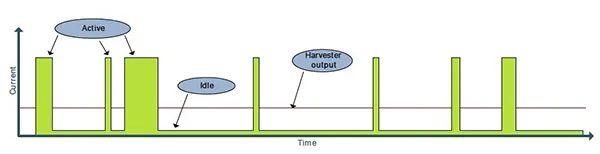
Figure 1: Energy available from environmental sources may be insufficient to meet the active power demands of wireless sensor designs such as wearables, requiring the use of secondary batteries or other energy-storage devices. (Courtesy of Silicon Labs)
High-Efficiency MCUs
MCUs designed for low-power applications consume little power in active modes and only tiny amounts in sleep modes. For example, an ultra-low-power 16-bit MCU like Renesas RL78/G13 1.6V consumes about 66 μA/MHz in run mode and only 0.23 μA in stop mode. For applications requiring 32-bit performance, engineers can choose from a variety of ultra-low-power MCUs based on energy-optimized 32-bit cores such as ARM Cortex-M0+. For example, STMicroelectronics' STM32 L0 series based on Cortex-M0+ requires only 87 μA/MHz in run mode and 250 nA in its lowest-power mode.
In conventional wireless applications, the radio transceiver can consume a disproportionate share of the system power budget during long or frequent message exchanges. By contrast, wireless sensor applications typically generate small amounts of data at low frequency. Short active periods combined with long sleep intervals translate into relatively low average power. In low-power radio devices, such as the Texas Instruments CC2500, these short, infrequent communication bursts result in modest current consumption (Figure 2).
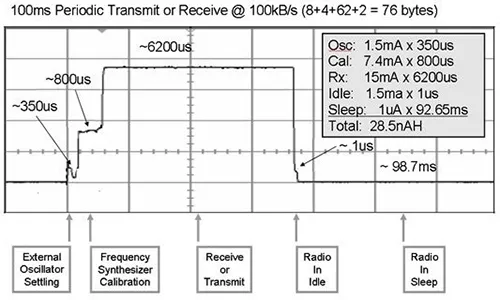
Figure 2: Power requirements for wireless communication in wearable devices can be minimized by using short, low-frequency data bursts and low-power transceivers such as the Texas Instruments CC2500. (Courtesy of Texas Instruments)
Energy Storage
Even with ultra-low-power MCUs and transceivers, supplementary power may be needed if an environmental source weakens or is removed entirely. Designers can choose from a range of batteries and other energy-storage devices to make up for intermittency in energy harvesting.
For wearable battery selection, space constraints commonly favor small coin cells. Small primary (non-rechargeable) coin cells such as Panasonic BSG CR-1025/BN or Energizer AZ10DP-8 can provide relatively high capacity for operation across varied conditions. These cells maintain nominal voltage at relatively high discharge rates. The low discharge rates and duty cycles associated with sensor applications further extend battery life.
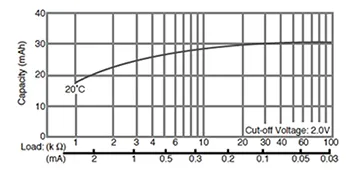
Figure 3: For designs less constrained by size, standard primary coin cells such as the Panasonic CR-1025/BN offer high capacity across a range of discharge currents. (Courtesy of Panasonic)
The CR-1025 has a diameter of 10 mm and a height of 2.5 mm. It is a lithium/manganese dioxide (Li/MnO2) primary cell with a nominal 3 V output and roughly 30 mAh capacity at a continuous 100 μA load. The AZ10DP-8, typically used in hearing aids, is a zinc-air (Zn/O2) primary cell in a 5.8 mm diameter × 3.6 mm height package that can deliver 91 mAh at 1.4 V. Rechargeable coin cells used in energy-harvesting designs eliminate the need for battery replacement; however, rechargeable coin cells typically offer lower capacity than primary cells of the same size. For example, Seiko Instruments MS518SE provides 3.4 mAh with a maximum discharge current of 150 μA. The MS518SE measures 5.8 mm in diameter and 1.8 mm in height and is a rechargeable lithium cell with a silicon anode and lithium-manganese composite cathode, offering long cycle life and stable characteristics.
Other compact storage options include lithium-polymer cells, thin-film storage devices, and supercapacitors. Among the smallest options, supercapacitors such as Taiyo Yuden PAS3225P3R3113 offer an effective solution for designs that require fast discharge bursts. The PAS3225P3R3113 0.011 F supercapacitor, measuring 3.20 mm × 2.50 mm × 1.0 mm, can provide about 3.2 μAh at 3.3 V with a maximum discharge current of 10 μA.
When using rechargeable lithium-ion cells or supercapacitors, engineers must protect storage devices from overcharge and overdischarge. Failing to stay within tight voltage and current windows can reduce effective capacity or damage the device. Although many battery management devices are available, ICs designed specifically for energy harvesting often provide a more complete solution.
Dedicated ICs such as Linear Technology's LTC3331, Maxim Integrated's MAX17710GB, and Texas Instruments' bq25504 integrate battery charging and a complete energy-harvesting subsystem into a single device. For example, TI's bq25504 integrates a boost converter/charger that can extract energy from sources as low as 80 mV during operation.
On-chip battery management and related features in devices like the bq25504 allow engineers to program undervoltage and overvoltage protection levels, typically setting thresholds that enable a "power good" output signal to notify the load when the supply voltage has reached usable levels. Because these devices are highly integrated, engineers usually need only a small number of external components to implement energy harvesting and battery management in a design (Figure 4).
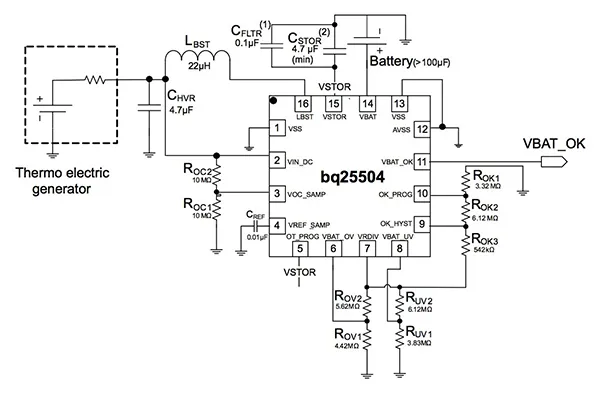
Figure 4: Dedicated devices such as TI's bq25504 integrate efficient energy extraction circuitry with advanced battery management features, offering a complete energy-harvesting solution with minimal external components. (Courtesy of Texas Instruments)
Conclusion
Wearable devices require careful consideration of the underlying electronics' features, functionality, and size to meet consumer expectations. By combining energy harvesting technologies with ultra-low-power ICs, engineers can extend battery life in wearable electronics and, in some cases, eliminate the need for replaceable batteries altogether.