ALLPCB


Introduction
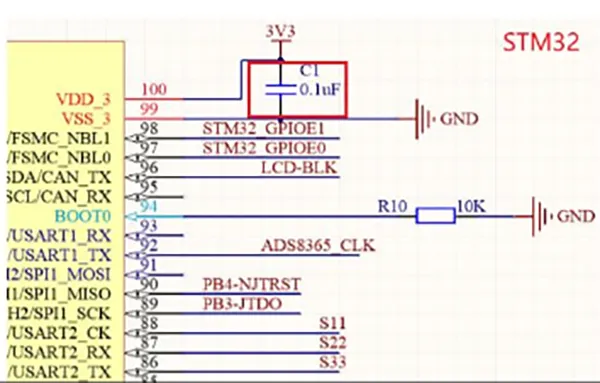
Is using a 100 nF capacitor to decouple a 72 MHz clock signal appropriate? Capacitors seem simple; anyone who has done hardware development knows their common uses. However, the deeper principles behind those uses are worth examining.
Interview question
Why are one or several capacitors typically placed on a chip's power pins? What are they used for and why?
Some people respond: "Of course for energy storage, filtering, and decoupling." While this is not wrong, it is a high-level reply that does not explain the underlying mechanisms or differences. Below we analyze the functions from several technical perspectives.
Perspective 1: EMS — provide a high-frequency noise return path
From the EMS (electromagnetic susceptibility) perspective, if no capacitor is placed at a chip power pin the power return path is long. Power rails often carry high-frequency noise, which can easily enter the chip's functional loop and affect operation.
Placing a capacitor at the chip power pin helps because a capacitor passes high frequencies while blocking low frequencies. The capacitor provides a low-impedance return path for high-frequency noise, allowing that noise to return quickly to ground and reducing interference coupled into the chip. This improves the system's EMS immunity.
Modeling and simulation — time and frequency domain analysis
To validate this, consider a simple simulation model. Treat the power source as VG1 with an internal resistance; use R1 = 100 mΩ. Typical PCB traces have parasitic inductance; using 10 nH/cm as a rule of thumb, set L1 = 20 nH for a 2 cm trace. At the chip side, set C1 as a parasitic capacitance of 1 nF. Use R2 = 1 MΩ as an input resistance. VF1 is the output test point.
Set VG1 to a 50 Hz square wave with a DC bias of 1 V and an AC amplitude of 1 V. In the time-domain simulation, VF1 shows large overshoot in both the positive and negative directions.
Frequency-domain analysis reveals a resonance at 35.9 MHz with a gain of 30.72 dB. A square wave contains rich high-frequency components, including frequencies near 35.9 MHz; the resonance amplifies those components, producing the observed overshoot.
Adding decoupling capacitors, for example 4.7 μF and 0.1 μF, changes the response. In the time domain, the VF1 overshoot disappears. In the frequency domain, the resonance vanishes and the response becomes that of a low-pass filter with a cutoff near 460 kHz.
This confirms the previous statement: the capacitor network provides a low-impedance path for high-frequency noise, acting as a low-pass filter that shunts high-frequency energy to ground and prevents it from entering the chip, thereby improving EMS performance.
Perspective 2: EMI — reduce RF loop area and spatial radiation
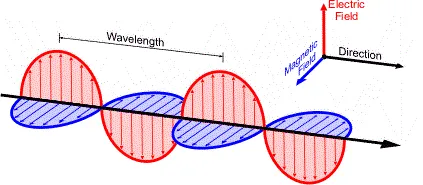
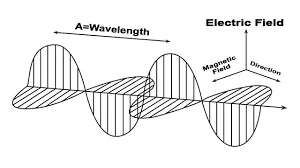
From the EMI (electromagnetic interference) perspective, loop area is critical for far-field radiation. Using the right-hand rule shows how current direction produces magnetic fields, but more practically, a larger current loop area increases radiated field strength. The radiated field strength depends on loop area S, current I, frequency f, and distance D; increasing S generally increases radiation.
Without a capacitor at the chip pin, the current return loop is large. Adding a decoupling capacitor near the pin reduces the loop area. Reducing loop area lowers spatial radiation and diminishes noise propagation. This is the core of the decoupling function: minimizing RF loop area to reduce radiated EMI.
Perspective 3: PI — stabilize supply voltage
From the power integrity (PI) perspective, capacitors help stabilize the chip supply voltage by providing local charge during transient events. This is the energy storage function of capacitors and directly improves power integrity.
Summary
Viewed together, the three perspectives clarify the distinct but related roles of capacitors on chip power pins:
- Perspective 1: Provide an AC return path for high-frequency noise and suppress high-frequency interference. This is the filtering or bypass function.
- Perspective 2: Reduce RF loop area and lower spatial radiation, which is the decoupling function.
- Perspective 3: Stabilize supply voltage and improve power integrity, which is the energy storage function.
Understanding these mechanisms, allows for more effective and flexible application of decoupling and bypass capacitors.