ALLPCB


Overview
Startup MICLEDI Microdisplays, spun out from Belgium's IMEC, was founded in response to growing interest in augmented reality (AR) glasses display systems. To address technical challenges of the emerging technology, MICLEDI focuses on microdisplay modules, a critical component for AR.
Like OLED displays used in mobile computing and televisions, combining the light source and pixels into a compact display subsystem can address form factor, design, and wearability issues for AR glasses.
Brightness Advantage
One of the most important values of MicroLED solutions is brightness. Other approaches such as OLED, LCOS, and DLP provide insufficient brightness for transparent-lens displays used outdoors in natural sunlight. MicroLED displays can produce 1 million to 10 million nits, which enables vibrant, clearly visible full-color images on transparent optics in bright sunlight.
Design and Wearability
Consumers do not want to look like Darth Vader wearing a futuristic digital "headset." They want stylish, attractive, and comfortable glasses that can be worn all day while functioning as both everyday eyewear and a digital display. They expect AR glasses to act as a combined digital display for many mobile consumer computing, communication, and imaging devices, including phones, watches, tablets, cameras, drones, and other portable devices. AR glasses are shifting from bulky, expensive products aimed at industrial, enterprise, and military markets toward lightweight, low-power, price-sensitive consumer products.
System Topology
Visual performance is critical to this evolution. Industry advances cover the front-end and back-end topologies of AR glasses systems. The front end covers power, wireless, and video pipeline. The back end includes the optics that receive light from the display module and project the image to the retina using combiners and waveguides. The middle component, the display module itself, still faces significant challenges.
Technology Choice
Many companies are betting on microLED displays to solve the middle-module challenge. Impressive microLED prototypes have been demonstrated in recent years, but target specifications and large-scale production remain challenging. MICLEDI has announced a MicroLED process flow with integrated backplanes using standard high-volume tools on a 300 mm CMOS production line. The proof of concept uses an integrated approach similar to today's high-volume 3D-stacked backside-illumination imagers.
Compared with other microdisplay technologies, the main difference of MicroLED display modules is resolution and brightness. Other parameters, such as power budget, image quality, yield, and cost, also affect integration choices.
Brightness Targets for Waveguide AR
Brightness targets for MicroLED modules in waveguide-based AR stem from the fact that only about 3% or less of photons produced by the display module reach the eye, due to attenuation in projection optics and combiners/waveguides or loss to accommodate interpupillary distance and other factors. This implies that for outdoor use with transparent lenses, the module must produce 1 million to 10 million nits of white light, while keeping power budgets comparable to phone displays (<1 W). Non-MicroLED light sources lack the brightness to meet true transparent-lens consumer AR requirements.
Manufacturability
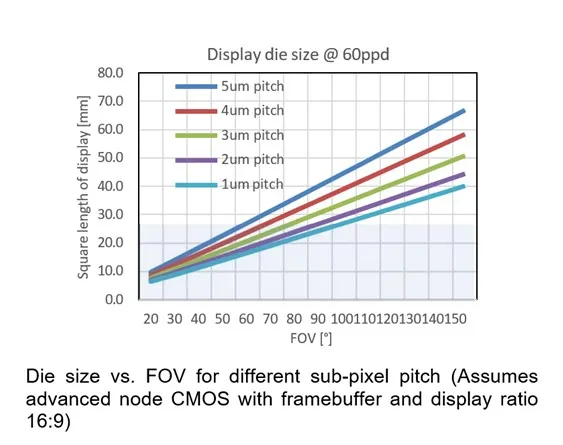
One of the biggest obstacles for MicroLED microdisplays is manufacturability of the display module. 300 mm wafer manufacturing is one enabler for this approach. The figure in the original presentation illustrated display sizes at different pixel pitches, including driver and interface circuitry beyond the active pixel area, and applied basic assumptions about backplane ASIC performance at advanced nodes (<45 nm).
For an FHD display with only 5 μm pixel pitch, practical limits on reticle size for lithography tools in advanced fabs are being reached. This strongly affects manufacturability and yield. To find an appropriate compromise, MICLEDI designs and optimizes a MicroLED panel for each color: red, green, and blue.
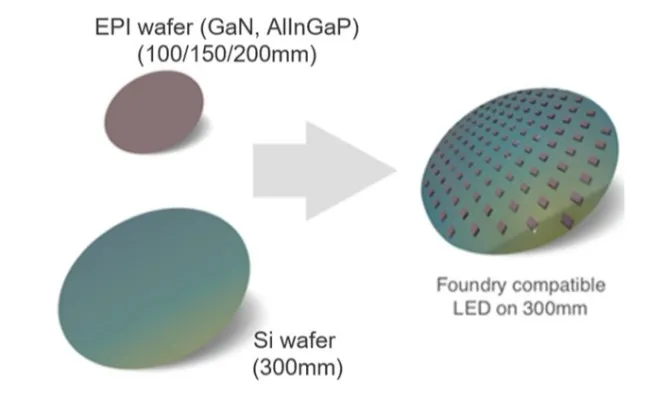
Another challenge is integrating the MicroLED display module onto an ASIC backplane. Multiple approaches exist and are currently used for different display types, including OLED and LCOS. MICLEDI argues that front-panel and backplane integration can be best achieved in separate 300 mm manufacturing flows, using verified proprietary hybrid wafer-to-wafer bonding methods and equipment available today for demonstrations.
Because LED starting materials are not available on 300 mm wafers, wafer stress, bow, and planarity for bonding to a backplane ASIC wafer would face major challenges. It is therefore necessary to reconstitute high-quality epi material onto 300 mm silicon carrier wafers, which can then be processed with world-class CMOS fab tools. The approach shown involves dicing epitaxial chips from 100 to 200 mm wafers and redeploying them onto 300 mm silicon wafers, producing MicroLED wafers ready for proprietary bonding to CMOS ASIC backplanes. The spacing of epi microchips is a function of the chosen backplane design and wafer map alignment requirements.
Business Models
In the display-module space, MicroLED manufacturers can design, fabricate, and sell integrated front-panel and backplane modules. For large OEMs with unique market needs, an alternative is for the OEM to design the backplane ASIC and port the design to a compatible foundry for integration with a MicroLED front panel. A third option for very large OEMs may be licensing unique elements of MicroLED manufacturing so they can produce display modules in-house.
Currently, AR headsets for military, industrial, and enterprise use cost between $1,000 and $5,000 or more, limiting adoption to niche applications. As MicroLED-based display modules improve in cost, size, resolution, and power to meet consumer specifications, demand could surge to volumes comparable with phones and tablets.
Business models for the three elements of the AR glasses system topology are similar. At this stage of market development, specialists provide highly optimized components for the front end, back end, and middle module, and OEMs purchase and integrate these components into their AR products. Specialist suppliers design, manufacture, and sell ICs for the front end (wireless, GPU, power). Other specialists design, manufacture, and sell optical engines and waveguides for the back end. A third group of specialists, such as MICLEDI, design, manufacture, and sell display modules. Some OEMs attempt vertical integration by acquiring specialist companies, but the prevailing dynamic is a supply chain of specialized vendors delivering best-in-class solutions.
As the market evolves and high-yield, low-cost methods mature, all three business models are likely to coexist to match appropriate market segments and commercial entities.