ALLPCB


Overview
Smart light poles are a new type of information infrastructure that integrate lighting, video surveillance, traffic management, environment monitoring, and communications. They serve as an important carrier for next-generation smart city deployments.
The proliferation of 5G has created new opportunities for smart light poles. As next-generation urban information infrastructure, smart light poles are related to many areas of new infrastructure, such as 5G base stations, new energy vehicle charging stations, and vehicle-to-everything applications.
As an important component and entry point of smart cities, smart light poles are a natural platform for deploying urban information systems. In smart city construction, 5G plays an indispensable role, and light poles act as peripheral nodes.
User Requirements
The IoT domain for smart light poles involves complex technologies, including network communications, cloud computing, power systems, and artificial intelligence. Typical deployments include multiple subsystems such as communications, video surveillance, lighting, environment monitoring, traffic management, information display, energy, and operations and maintenance.
Product design must consider compatibility and coordination among subsystems, scalable expansion of poles, and service upgrade, rollback, and capacity expansion. The overall complexity and professional requirements are high.
A traffic signal systems supplier in the Chinese market planned to develop a smart light pole that integrates streetlight control, LED displays, WiFi hotspots, video surveillance, advertising screens, environment monitoring, emergency call, electric vehicle charging stations, and 4G/5G micro base stations.
Solution
Smart light poles are a composite of various devices and technologies. Functionally, they integrate communication poles, streetlights, traffic monitoring, security surveillance, environment monitoring, and roadside advertising panels.
These functions require interconnectivity, with communication control equipment at the core. Therefore, the main controller carrier board must provide high computing power and robust performance, support multiple network ports and UART, and be compatible with 5G and OpenWrt systems.
Following evaluation, the vendor recommended using the FET1046A-C carrier board for product development.
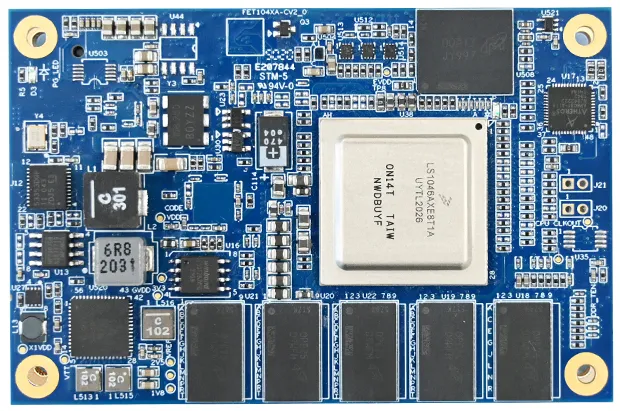
FET1046A-C carrier board
The carrier board provides abundant interfaces, including eight native Ethernet ports (with support for up to two 10GbE ports), four UARTs, and three USB 3.0 ports. Communication control devices developed on this board can use fiber interfaces to enable 4G/5G micro base stations and high-speed wireless WiFi coverage.
RJ45 Ethernet ports facilitate rapid connection of pole-mounted devices such as LED information displays, high-definition cameras, and WiFi. RS485 can be used for serial communication with environmental sensors, monitoring units, and single-lamp controllers.
The FET1046A-C carrier board is powered by a quad-core ARM Cortex-A72 processor at 1.8 GHz and includes 2 GB DDR4 RAM. It offers a data throughput of up to 2.1 GT/s and performance up to 45,000 CoreMark, sufficient for handling multiple communication types, rates, and network protocols. It supports selection among different smart light pole communication methods and enables one-stop system deployment.
FET1046A-C Carrier Board - Basic Specifications
| CPU & Architecture | LS1046A & Cortex-A72 |
| Frequency | 1.8 GHz |
| Memory | 2 GB DDR4 |
| Storage | 16 MB QSPI NorFlash, 8 GB eMMC |
| OS | Ubuntu 18.04.1, OpenWrt v18.06.0-rc2 |