ALLPCB


Background
As a core component of the smart grid, the communications management system functions as a scheduling hub between field devices and supervisory systems. Traditional x86-based communications management units have drawbacks such as high cost, high power consumption, limited compatibility, and heavy dependence on manual operation. This article presents a new communications management unit solution.
In the power sector, the smart grid covers generation, transmission, distribution, and end use. As smart grid deployments expand, upgrades to communication systems yield significant system benefits. Communication systems are a key technology for distribution automation: they deliver control center commands to actuators and endpoints, and their performance strongly influences the overall quality of a distribution automation system. Effective management of power communications is therefore essential.
Distribution management system communication requirements include:
- High stability and reliability, with redundancy for transmission failures.
- Bidirectional communication capability.
- Flexible network topology and strong scalability.
- Unified network management.
- Industrial-grade robustness, including environmental tolerance (temperature and humidity), electromagnetic compatibility, vibration resistance, and lightning protection.
Communications Management Unit Overview
The communications management unit, also referred to as a DPU, provides multiple downstream communication interfaces and one or more upstream network interfaces. Acting as a front-end or gateway device, it aggregates communication data from intelligent monitoring and protection devices within a substation and transmits the consolidated data in real time to higher-level master stations (monitoring center backends and DCS), supporting telemetry and remote signaling functions. It also receives commands from backend systems or DCS and forwards them to intelligent units in the substation to control switchgear operations and adjust device parameters, enabling remote control and remote configuration. Multiple serial interfaces are typically provided to facilitate communications with other intelligent devices at the site.
Beyond data aggregation and forwarding, a communications management unit can perform information synthesis, editing, management, and equipment monitoring between automation devices, intelligent instruments, and the host computer. It can be deployed as a central substation controller or front-end unit in comprehensive automation, dispatch automation, and distribution automation systems. Typical application areas include demand-side management, industrial energy management, building energy management, photovoltaic monitoring, and power operations and maintenance, where it serves as the data hub connecting field devices with supervisory centers.
Traditional Approaches
Traditional power communications management units often use x86-based industrial PCs and must operate 24/7. This leads to high product cost, high power consumption, and substantial installation and maintenance labor. Unexpected system crashes also create operational risk. When designing hardware and software for communications management units, several factors must be considered:
- Protocol compatibility: As an intermediary device, the unit must support a variety of automation device protocols to interconnect with different intelligent instruments and auxiliary equipment.
- Interface count: The number of I/O interfaces and expansion capability determine whether the device can meet current connection requirements and accommodate future updates.
- Performance and budget balance: As the core data conversion and transmission device, the unit's performance-to-cost ratio significantly affects overall solution performance.
- Multiple network functions: Users should be able to configure different communication interface cards to build the required network topologies.
- Application development and system integration effort: Integrators face significant investment in time and resources when developing or adapting application software, drivers, and integration for a new platform.
ZLG System-Level Solution
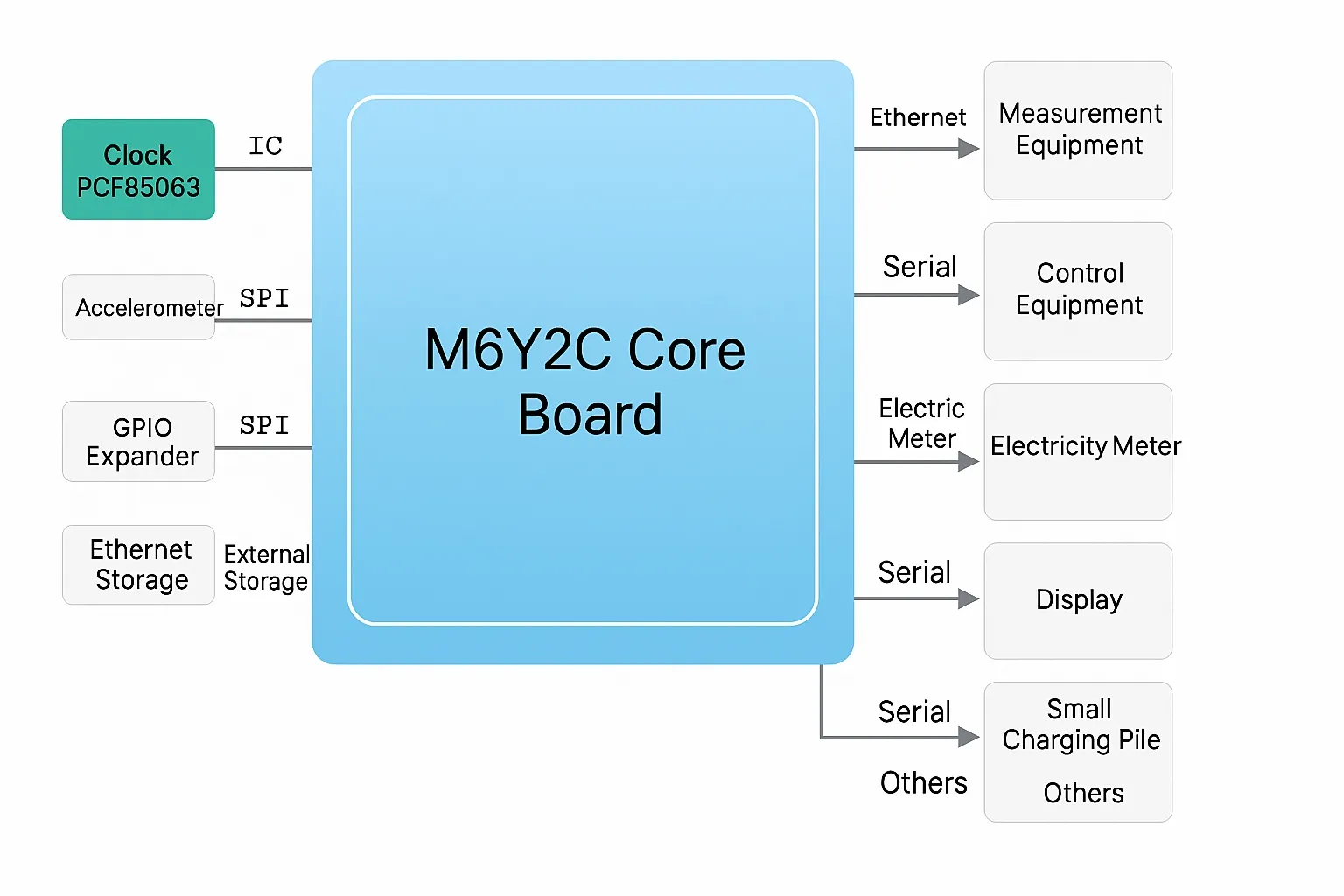
ZLG offers a system-level communications management unit solution tailored for power systems. Compared with traditional x86-based systems, this approach improves integration and cost-effectiveness. The solution's main control platform is based on ZLG's M6Y2C core board, an industrial control module built around an NXP Cortex-A7 processor running at 800 MHz and an optimized power management architecture to reduce power consumption.
The M6Y2C core board provides standard interfaces including 8 UARTs, 2 USB OTG ports, 2 CAN-bus channels, and 2 Ethernet ports. Memory options include 128/256/512 MB DDR3 and 128/256/512 MB or 4 GB eMMC, and a hardware watchdog is included. The board undergoes EMC and high/low temperature testing to ensure stable operation in harsh field environments.
ZLG leverages embedded systems experience and integrates IoT communication technologies and edge computing, combining wired and wireless communication methods. The presented communications management unit solution aims to reduce system cost and improve system integration. It supports scenarios such as distribution substations, transformer areas, and distributed renewable generation (solar, wind) for power monitoring, environmental monitoring, video surveillance, and coordinated control, enabling intelligent and unattended operation.