ALLPCB


Introduction
Positioning measurements have been very successful for outdoor navigation systems, and there is strong demand to reproduce that capability indoors. Being able to locate a person inside a building can help in many ways, from finding the right office in a tower to locating the correct department or a specific product in a store, or delivering highly targeted offers while walking through a supermarket. Unfortunately, satellite positioning via GPS, GLONASS, or the forthcoming Galileo cannot meet indoor positioning requirements, even with advertised enhanced measurement accuracy down to 1 m, because receivers struggle with multipath signals and often cannot see the satellites.
GNSS Performance in Urban and Indoor Environments
Tests by the European GNSS Agency (GSA) and Rx Networks used multi-constellation GNSS to measure Galileo's performance in combination with GPS and GLONASS in real environments including urban canyons and indoor locations. While using Galileo or multiple constellations helps in outdoor urban canyon scenarios, the results show that indoor performance remains poor.
Single-Chip GNSS Receivers for Wearables
Satellite coverage remains a key technology. Maxim's MAX2769 supports GPS, GLONASS, and Galileo on a single chip and can be integrated into wearable and portable designs. This single-conversion, low-IF GNSS receiver is implemented in a low-power SiGe BiCMOS process to provide integration and performance at low cost.
The chip integrates a complete receiver chain, including a dual-input LNA and mixer, followed by an image-suppression filter, PGA, VCO, fractional-N frequency synthesizer, crystal oscillator, and multi-bit ADC. The receiver's overall cascaded noise figure is as low as 1.4 dB, which helps improve sensitivity for indoor use.
The MAX2769 also implements on-chip single-package IF filtering, eliminating the need for external IF filters and forming a complete low-cost GPS receiver solution in a small footprint suitable for wearable designs. The integrated delta-sigma fractional-N frequency synthesizer allows IF frequency programming with ±40 Hz resolution while operating from any reference or crystal frequency available in the host system. Data is presented at CMOS logic levels or limited differential logic levels.
Combining Sensors and Radio Sources
To improve indoor positioning performance, additional techniques can be added. One approach uses surface-mount 3-axis accelerometers already present in many smartphones, for example Freescale Semiconductor's MMA8653, to determine device orientation. Starting from a satellite-derived position, inertial measurements can detect turns and deviations to update the location estimate. However, this approach requires periodic satellite fixes, which can drain battery and still exhibit limited accuracy. It also typically requires an indoor map, which may not always be available.
Another approach uses local Wi-Fi signals for localization. This poses challenges for antenna designers because GPS and Wi?Fi have different sensitivity and antenna requirements. Some modules, such as Antenova's Radionova M10478, are designed to suppress interference in the 2.4 GHz band to avoid degrading GPS reception and improve positioning accuracy.
Radionova M10478 GPS Module
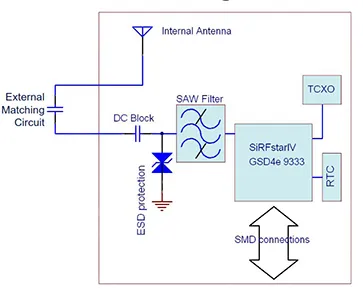
The Radionova M10478 RF antenna module is an ultra-compact single package that combines RF front-end components and an antenna for the L1 GPS band and assisted GPS in the same module.
It is based on CSR's SiRFstarIV GPS architecture and combines Antenova's antenna design to provide an optimized radiation pattern for GPS reception. All front-end and receiver components are included in a single laminated substrate module, delivering a full GPS receiver optimized for performance. The M10478 operates from a 1.8 V supply, offers low-power modes to reduce consumption, and uses a precise 0.5 ppm TCXO to ensure short time-to-first-fix, which is important when combining GNSS with inertial navigation. The module is supported by SiRF software and interfaces to a host controller via UART, SPI, or I2C.
Cellular Assistance and Hybrid Solutions
Telit's JF2 is a 1.8 V module based on the SiRF IV GPS chip. It provides UART, SPI, or I2C host interfaces and is also optimized for connection to Telit cellular modules. This enables assisted GPS functionality, where some satellite data is combined with information from the cellular network to obtain faster fixes. However, indoors this approach can be limited by the lack of penetration for cellular signals, particularly at 1800 MHz. Several companies are pursuing alternative methods to provide location information, each with different trade-offs and with the additional challenge of meeting real-time location system standards such as ISO/IEC 24730.
Server-Based Wi?Fi Localization
After acquiring WiFiSlam, Apple filed a patent application for a system that combines GPS, Wi?Fi access points, and a device-location database to provide indoor positioning. The approach uses multiple Wi?Fi access points to narrow the device's location by querying a server-based positioning system. The server estimates a "presence area" for other devices within the range of an access point, and nearby access points are then used to refine the position, especially within the presence area.
Low-Frequency and Phase-Based Techniques
Q-Track from Alabama takes a different approach, using 1 MHz radio signals to provide location information. Low-frequency signals penetrate floors and walls more effectively and are less affected by multipath. Rather than using signal strength or time-of-flight like GPS, Q-Track measures the signal phase and uses near-field properties to determine the receiver's position and distance from transmitters. The company reports outdoor accuracy on the order of 15 cm and indoor accuracy of a few meters; by mapping a building's RF environment, accuracy can improve to approximately 40 cm for tag localization.
UWB and IEEE 802.15.4-Based Systems
As the Internet of Things increases the number of wireless connections, additional opportunities arise for indoor localization without relying on GPS.
Dublin-based Decawave uses low-power, pulsed UWB time-of-flight measurements to provide indoor accuracy down to 10 cm. This approach is mainly used for locating devices rather than wearables, although it has been applied to health monitoring equipment.
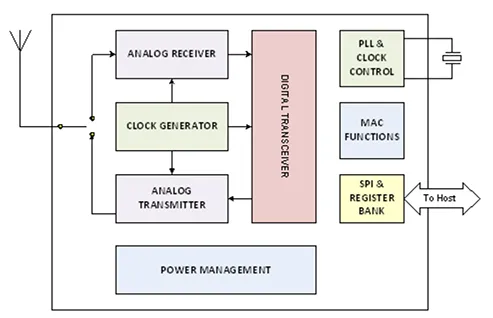
The DW1000 ScenSor (Seek Control Execute Network Sense Obey Respond) uses the same ultra-wideband technology defined in IEEE 802.15.4-2011. It supports data rates up to 6.8 Mbit/s in a coherent receiver design with ranges up to 300 m. Because UWB is resilient to multipath fading, it enables reliable communication and positioning in high-fade indoor environments.
Conclusion
Adding accurate indoor positioning to wearable devices remains an open technical challenge. Combining wireless technologies such as GNSS, cellular, and Wi?Fi provides a viable path forward for many, but not all, devices. These hybrid solutions introduce additional constraints on form factor and power consumption. Integrating multiple technologies while ensuring interoperability and avoiding mutual interference are key challenges designers must address.