ALLPCB


Background
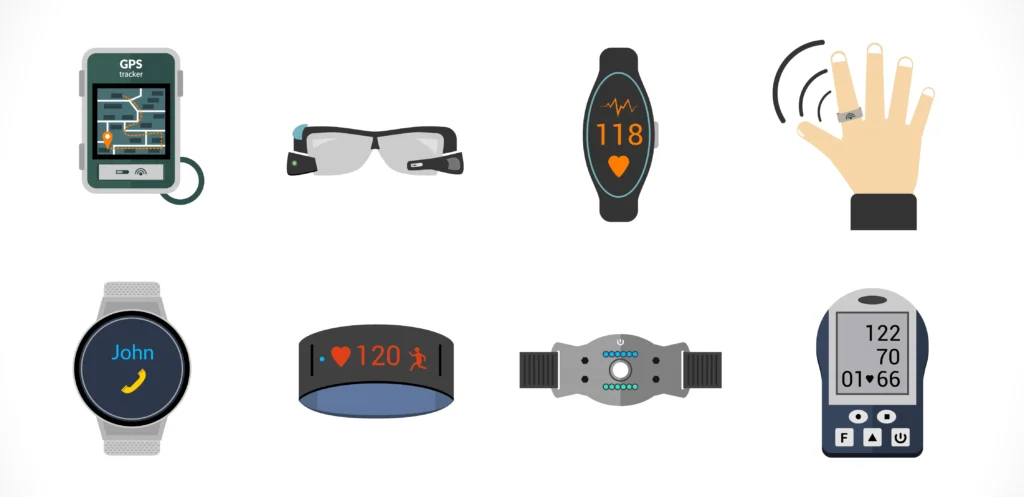
For makers and the manufacturer community, wearable technology is not new. Platforms such as Arduino Lilypad have enabled makers to develop a wide range of wearable systems, from electronic textile art integrated into shirts and dresses to T-shirts that indicate unread email counts. Many of these projects focus on fun or self-expression, but a growing number of engineers are being asked to develop electronics for commercial wearable products. The first wave of consumer devices has been dominated by smartwatches, where vendors have had to balance design, display and battery life. Crowdfunded projects also highlight significant innovation in wearable sensors. For example, in health applications, a Kickstarter project called Violet is a wearable sensor that measures UVA and UVB exposure so users can balance vitamin D intake with the risk of overexposure. Another project, promoted on Indiegogo by LEO, is a sensor system worn around the calf that uses 3D motion, heart rate and muscle activity sensors to help users improve workouts and reduce injury risk.
Both products rely on similar core technologies to collect data efficiently and share information over a wireless link. By using a user’s smartphone and appropriate apps for display, devices can avoid the power cost of onboard displays. Close inspection of product photos on the Violet Kickstarter page shows Bluetooth Low Energy as the likely wireless link used by these new devices.
Bluetooth Low Energy Overview
Originally introduced as Wibree by Nokia, Bluetooth SIG incorporated this low-power wireless technology into the Bluetooth core specification in version 4.0. Marketed to consumers as Bluetooth Smart, BLE is not backward compatible with pre-4.0 Bluetooth devices. However, many Bluetooth chipsets have programmable components, so some existing products may only need a firmware update to add BLE support. BLE uses the same radio and baseband technology as Bluetooth Basic Rate (BR) and Enhanced Data Rate (EDR), though with different modulation schemes. Adding BLE to the specification made it easier to launch low-power accessories that build on the smartphone market, rather than requiring a fresh approach to achieving battery life suitable for wearables.
Key Parameters: BLE vs BR/EDR
| Technology | Channel width | Number of channels | PHY rate | Air data throughput | Connection latency |
|---|---|---|---|---|---|
| BLE (from unconnected) | 2 MHz | 40 | 1 Mbps | 0.27 Mbps | 6 ms |
| Bluetooth BR/EDR | 1 MHz | 79 | 1–3 Mbps | 0.7–2.1 Mbps | ~100 ms |
Table 1: Brief comparison of key Bluetooth BR/EDR and Bluetooth Low Energy parameters.
GATT, Roles and Profiles
BLE provides a low-power wireless link suitable for exchanging small packets with other devices, mainly smartphones. Short connection latency also saves energy. The Generic Attribute Profile, or GATT, allows a smartphone to query a BLE device and discover the services it provides. BLE devices typically act as servers, offering small data packets described by GATT. These can be standard data types such as temperature, pressure or heart rate, which simplifies interoperability. The smartphone acts as a client, regularly querying BLE servers for new data. Packets transmitted over the link are called characteristics. For example, the Health Thermometer Profile defines "Temperature Measurement" and "Measurement Interval" characteristics, enabling both sides to agree on basic wireless temperature-sensor behavior.
Reference Designs and Module Options
Texas Instruments provides radio design guidance in application report SWRA420. Developers have many options for BLE-enabled designs and partitioning of functionality.
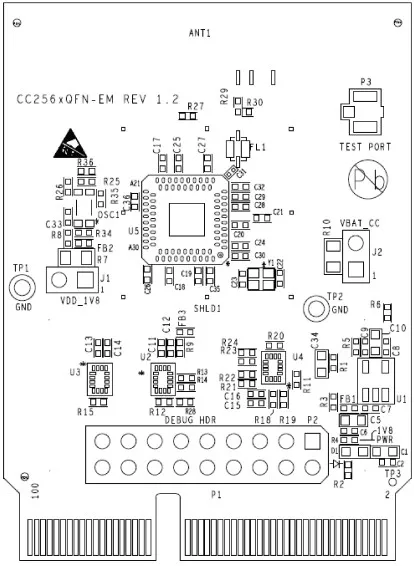
TI CC256x Dual-Mode Controller
TI's CC256x evaluation modules follow the vendor's reference design based on the CC256x Bluetooth and dual-mode controller family. These devices implement the Bluetooth 4.0-compliant radio, link controller, baseband and link manager on chip, exposing a standard Bluetooth Host Controller Interface layer. Configuration is typically done via a UART interface using the standard HCI protocol. The remaining parts of the Bluetooth stack and required profiles must be linked into the host controller's application code. For initial development, the evaluation board can be paired with an MSP430 device, for example the MSP430F5438 board. TI provides a royalty-free Bluetooth stack. Because the CC256x devices use a UART host interface, they can be paired with any microcontroller that supports UART and an appropriate Bluetooth stack. The reference design requires relatively few external components: 13 capacitors, a 26 MHz crystal, a band-pass filter and a copper-trace antenna. With a 500 ms connection interval as a BLE master, these devices draw under 200 μA from a 3.6 V supply.
TI also offers audio application assist modes that let CC256x use a hardware audio codec to handle audio data transport without continuous host MCU intervention. The host sets up the audio connection and the Bluetooth stack processing can be deprioritized, allowing use of a simple microcontroller without an I2S interface.
Nordic Semiconductor nRF51822
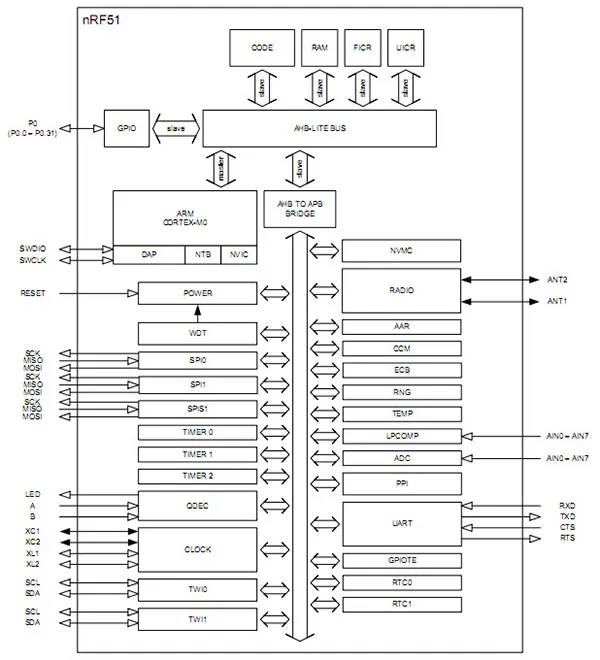
Nordic Semiconductor's nRF51822 uses a single-chip approach, integrating the radio, baseband and a low-power MCU in a 6 x 6 mm QFN or 3.5 x 3.8 mm WLCSP package. The BLE stack is provided as a precompiled binary, allowing independent compilation of the application code that uses it. Depending on the variant, the device provides 256 kB or 128 kB of flash, with between roughly 40 kB and 180 kB available to the application after stack usage. There is also 16 kB of RAM connected to a low-power 32-bit ARM Cortex-M0 MCU. Standard serial interfaces (SPI/UART/TWI), a 10-bit ADC and a 128-bit AES accelerator are available to ease integration with sensors and other subsystems. Low-power features include EasyDMA for RAM-mapped FIFO and a Programmable Peripheral Interconnect (PPI) that lets on-chip modules trigger each other automatically. These features reduce CPU overhead for routine tasks.
The nRF51822-DK evaluation kit is a strong starting point. It includes two evaluation boards, one with a chip antenna and another with an SMA connector for RF measurements. The kit also includes a J-Link Lite debugger, compatible with Keil MDK-ARM Lite, and a wireless development dongle for peer-device testing during development.
CSR1010 μEnergy Module
For a different fully integrated approach, CSR's CSR1010 μEnergy device is worth considering. It is available in a 5 x 5 x 0.6 mm, 32-pin QFN package and provides 64 kB ROM and 64 kB RAM. On boot, it can load code from an external SPI or I2C serial EEPROM via a DMA-capable SPI interface. The CSR1010 integrates the balanced-to-unbalanced converter internally. The DK-CSR1010 development kit includes a compact board with a reference design module and a printed PCB antenna. A complete BLE module can be as small as 25.5 x 18.0 mm and, besides the serial EEPROM, requires only 19 capacitors, 3 inductors, 1 resistor and 16 MHz/32 kHz crystals. If needed, the module offers 12 digital I/O and access to a 10-bit ADC and DAC. The kit includes CSR's μEnergy SDK with a GCC toolchain and the xIDE development environment.
Where to Start
If you already have an established low-power MCU vendor and toolchain, pairing TI's CC256x with a Bluetooth stack is a practical starting point. For fully integrated single-chip solutions, the Nordic Semiconductor nRF51822 should be a primary option. CSR's μEnergy approach provides high wireless integration but has fewer interfaces expected by traditional MCU vendors; pairing μEnergy devices with a small low-power MCU can be a sensible compromise. If you are considering BLE applications for wearables, evaluating one of these solutions early in your design process is recommended.