ALLPCB


Overview
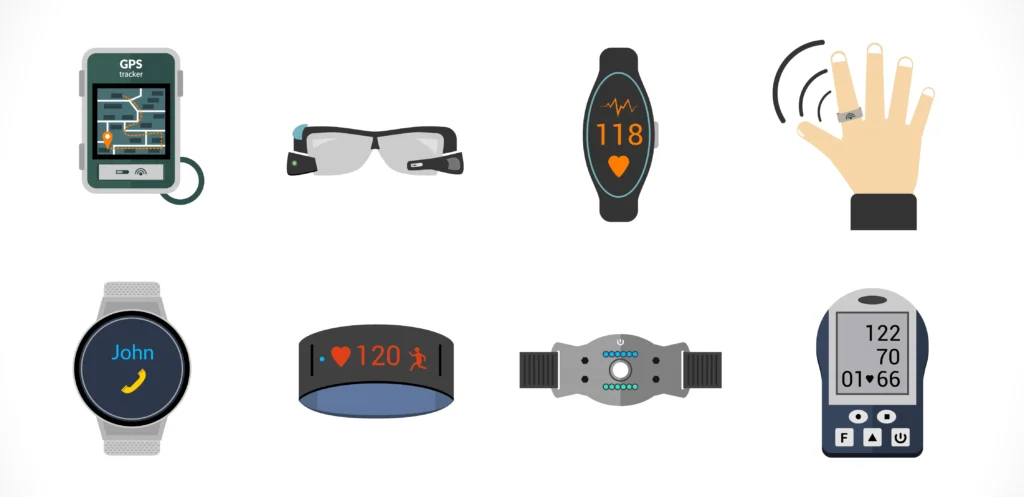
Driven by technical advances and expanding applications, gesture sensing and recognition is a growing market, particularly within the Internet of Things (IoT). Gesture recognition is especially prominent in gaming, healthcare, automation, automotive, and portable and wearable consumer electronics.
In its simplest form, a gesture-sensing circuit may include IR LEDs, IR photodiodes, an ambient light sensor, and a proximity sensor. To shorten development time, more highly integrated devices, subsystems, and modules have appeared that combine multiple optical sensors with control circuitry.
This article examines a recently introduced solution: the ams TMG4903 optical sensor module. The associated evaluation board, TMG4903 EVM-ND, helps designers integrate gesture-recognition functions into next-generation products more quickly and with a lower bill of materials (BOM) than assembling equivalent functionality from discrete components. For engineers and hobbyists who want a lower-cost starting point, the SparkFun SEN12787 gesture-sensor breakout based on the Avago APDS9960 is an accessible option.
Market growth
Market research firm Global Industry Analysts projects the global gesture-recognition market will exceed $12.7 billion by 2020. Demand is driven by the need for simple, intuitive interfaces to control the expanding feature sets of handheld and wearable devices such as smartphones, health monitors, and fitness trackers. Significant improvements in sensor and control-circuit technologies for portable and wearable devices have also driven interest in new human-machine interfaces. Further growth is expected from innovations in areas such as 3D vision, eye tracking, and machine control.
Interpreting gestures requires mathematical algorithms that allow more creative, natural, and intuitive methods of communicating with electronic devices. In wearable devices, gesture sensing can eliminate the need for mechanical buttons, enabling control via whole-body motion, hand movements, or facial expressions.
Components such as sensors and control circuitry for wearables must be robust, compact, and highly energy-efficient to preserve battery life. Recent improvements in accuracy, speed, and simplicity have raised quality levels, making wearables viable for a broader range of medical applications. Early consumer wearables succeeded due to novelty, but they now benefit from more accurate and reliable sensors; gesture recognition is viewed as a differentiating feature for the next generation of products.
Design challenges
ams, headquartered in Europe, combines intelligent sensors such as IR LEDs with integrated control circuitry. Typically, gestures are recognized by analyzing IR light reflected back to photodiodes when a user's hand passes near the LEDs.
Design is challenging because wearable devices are exposed to ambient light sources, such as sunlight, that contain IR components. Sensor openings on device surfaces may be obscured by sweat, dust, or dirt. Very sensitive photodiodes are needed to reliably separate ambient IR (background noise) from IR reflected from LEDs. Advanced analog semiconductor technology is therefore required.
In operation, gesture-recognition systems typically wake periodically to scan for gestures. To minimize battery drain, efficient power-down and sleep modes plus low-power wake routines are required, preferably without driving the IR LEDs during idle sensing.
With suitable hardware, application software must interpret raw IR measurements. Software calculates the user's hand movement speed and direction, estimates hand-to-device distance, distinguishes ambient IR from LED reflections, and classifies movements into distinct gestures. System performance—how quickly and reliably gestures are recognized—depends heavily on both application software and sensor hardware.
Wearable manufacturers increasingly prefer ready-made sensor systems over discrete sensor and processing components. Integrated systems save development time and can deliver the performance and reliability expected in next-generation wearable electronics. Key advantages of integration include more predictable optical crosstalk behavior, more reliable calibration across power variations, optimized combinations of IR LED, photodiode, and driver, and tighter physical tolerances for the module.
Module versus discrete
The ams TMG4903 is a highly integrated optical sensor module that combines IR LEDs, advanced LED drivers, an ambient-light sensor, and a color-diode array. A UV/IR blocking filter and parallel ADC yield 16-bit results, while an IR beam-pattern generator includes RAM and dedicated control logic. At its core is a gesture and proximity engine that supports true 3D gesture recognition in addition to simple 2D gesture sensing. The module supports features such as universal-remote functions, barcode emulation, RGB color sensing, proximity detection, and 3D gesture detection.
The module meets small-size and low-power requirements with a multi-module package measuring just 2 x 5 x 1 mm. Supply voltage ranges from 1.7 to 2.0 V. Typical operating current is 150 μA (max 200 μA), idle is 30 μA (max 60 μA), and sleep is 0.4 μA (max 5 μA).
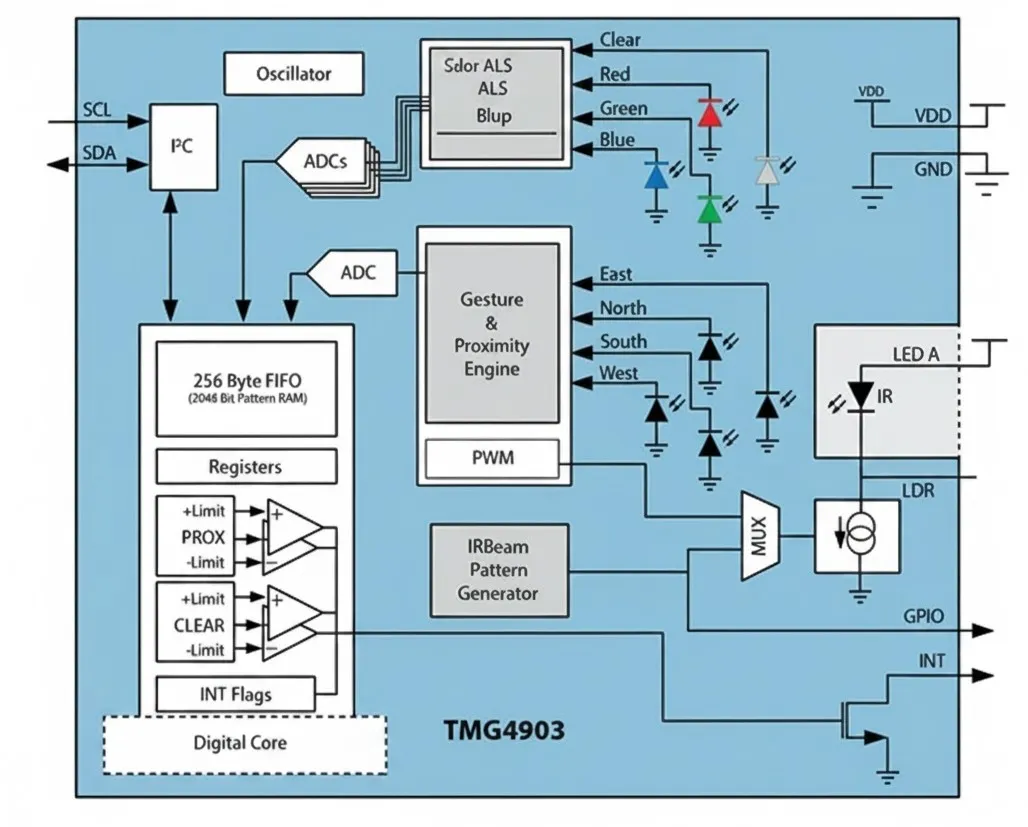
The module supports automatic tuning for 3D gesture recognition and proximity sensing. IR LED timing and power are adjusted to reduce noise and power consumption while optimizing sensitivity and dynamic range. The module suppresses ambient-light noise and applies auto-calibration to compensate for electrical noise and optical crosstalk. The integrated LED driver dedicates the engine to gesture recognition, reducing processing requirements on the host processor.
Getting started
The TMG4903 EVM evaluation kit comprises a main controller board that includes the gesture device and a PIC microcontroller, and it provides a standard USB 2.0 interface and cable. The supplied software lets designers configure and log key functions such as ambient-light sensing, proximity sensing, and combined gesture recognition. A user guide details parameters such as pulse length, pulses per gesture cycle, and gesture-cycle frequency.
In operation, raw gesture data captured by four directional photodiodes is presented on a 3D grid alongside Z data from the proximity sensor. The system can detect and identify moving gestures as well as "long" gestures that simulate a button press.
Lower-cost option for designers and enthusiasts
For designers and hobbyists seeking an inexpensive introduction to gesture sensing and recognition, the SparkFun SEN12787 RGB and gesture-sensor breakout provides a platform to explore ambient-light and color measurement, proximity detection, and non-contact gesture sensing. It is based on the Avago APDS9960, an integrated module with filters, photodiodes, and an I2C interface.
The APDS9960 measures 3.94 x 2.36 x 1.35 mm and includes an IR LED and a factory-calibrated LED driver. Gesture and proximity detection use four directional photodiodes together with ambient-light data. The engine features automatic activation, ambient-light subtraction, and crosstalk removal. Adjustable IR LED timing minimizes power and noise. Recommended supply voltage is 2.4 to 3.6 V. At 3 V, supply currents range from about 1 μA (sleep), 38 μA (wait), and 200 μA (active) up to 790 μA during gesture and proximity pulses.
The breakout board exposes multiple pins, including VL (optional IR LED supply), GND, VCC, SDA (I2C data), SCL (I2C clock), and INT (interrupt). The module can demonstrate gesture recognition to control microcontroller-based devices, computers, or robots.