ALLPCB


Tech companies' race to commercialize generative artificial intelligence has overshadowed substantial work on AI at the network edge. Vendors aim to run AI on IoT devices that are often constrained by memory, bandwidth, and power.
Analog Devices, Inc. offers a microcontroller (MCU) that integrates a low-power convolutional neural network (CNN) accelerator. The device is designed to perform AI inference on battery-powered devices, addressing limitations of edge processing.
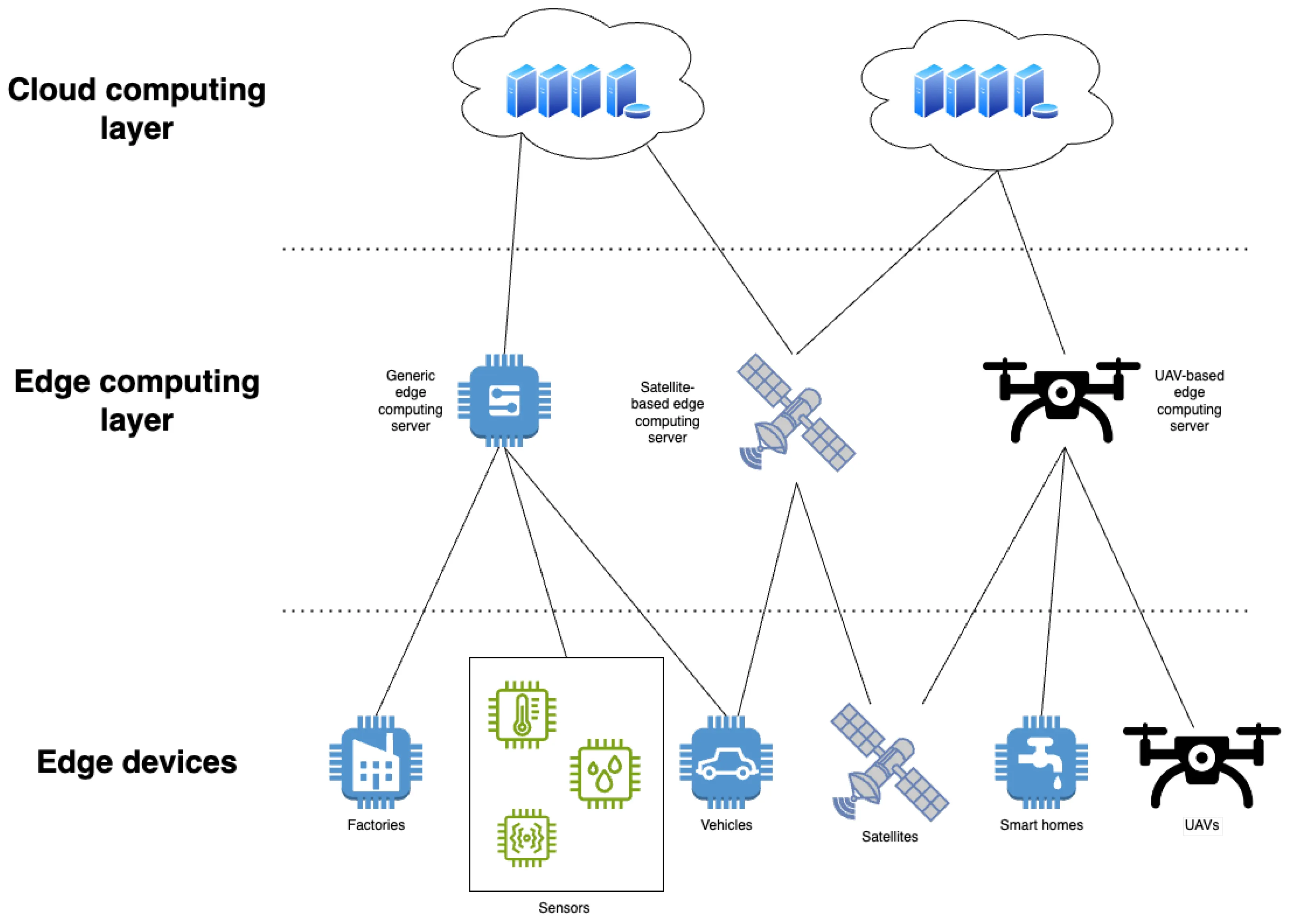
While investments in generative AI emphasize large-scale data centers and increased compute capacity, edge AI focuses on running models locally and efficiently. Edge models can detect objects, analyze medical images, and process automotive camera feeds to identify obstacles, pedestrians, and road signs for safer driving. CNNs can also analyze images on the edge to detect anomalies and monitor factory equipment. In agriculture, CNNs can detect pests and assess crop growth using images from drones, robots, and smart cameras.
Optimized for deep CNNs
The MAX78002 is an ultra-low-power system-on-chip that combines an Arm Cortex-M4 processor with a floating-point unit and a hardware CNN accelerator. It is optimized for deep CNNs and object-recognition tasks.
The CNN engine includes 2 MB of weight storage, supports 1-, 2-, 4-, and 8-bit weight formats, and can handle models with up to 16 million weights. Because the CNN weight memory is RAM-based, models can be updated during operation.
The accelerator supports programmable input image sizes up to 2048 x 2048 pixels, giving designers flexibility to handle high-resolution medical imaging or smaller inputs for resource-constrained devices. Network depth is programmable up to 128 layers, and per-layer channel width is programmable up to 1024 channels, allowing tradeoffs between model expressiveness and resource usage.
MAX78002 supports multiple high-speed, low-power interfaces, including I2S, MIPI CSI-2 serial camera, parallel camera (PCIF), and SD 3.0/SDIO 3.0/eMMC 4.51. These interfaces make the device suitable for a range of AI use cases such as industrial sensing, process control, online visual quality inspection, portable medical diagnostics, factory robotics, and drone navigation.
Power management is key
Ultra-low-power MCUs are critical for edge AI, particularly for battery-powered IoT devices. The MAX78002 can achieve inference energy consumption on the order of a few microjoules.
The MCU includes an integrated single-inductor multiple-output (SIMO) switching-mode power supply, supporting an input voltage range of 2.85 V to 3.6 V. Designers can also choose to control an external switch to provide a dedicated external supply for the CNN. The power management unit can precisely control power distribution between the CPU and peripheral circuits to support high-performance operation at minimal power.
A single-cell lithium battery can power the device. The three buck regulator outputs in the SIMO are voltage-programmable to optimize power efficiency. Because the MAX78002 requires only one inductor and one capacitor for the SIMO, the BOM can be simplified.
An integrated dynamic voltage scaling (DVS) controller adaptively adjusts voltages to reduce dynamic power. Using a fixed high-speed oscillator and the core supply, the DVS controller enables the Arm core to run at the lowest practical voltage, helping designers balance performance and power. An Arm peripheral bus interface provides control and status access.
The MCU includes 2.5 MB of on-chip flash for nonvolatile storage of code and data, and 384 KB of internal SRAM that can retain application data in low-power modes except during full power-off.
Simplifying MAX78002 applications
The MAX78002EVKIT evaluation kit supports AI application development with the MCU. The kit includes a 2.4-inch TFT display for interactive UI development and for visualizing inference results.
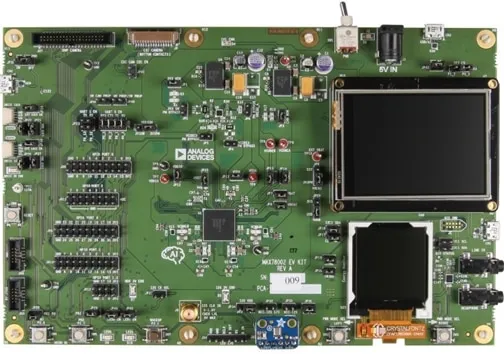
The evaluation board enables energy consumption tracking via an energy monitor, with formatted results shown on the auxiliary TFT display. The kit also provides USB 2.0, SWD JTAG, USB-accessible UART, and dual QWIIC connectors to facilitate debugging, programming, and peripheral integration.
Conclusion
Limited memory, bandwidth, and power in edge IoT devices present challenges for AI application development. The MAX78002 MCU supports development of energy-efficient inference-capable AI applications. The MAX78002EVKIT enables rapid prototyping, touch-enabled UI development, peripheral integration, and power consumption monitoring.