ALLPCB


Overview
Touchscreen technology is a gesture-based direct-manipulation interface. Direct manipulation is the ability to operate the digital environment shown on a display. A touchscreen is an electronic visual display that can detect and locate a touch within its display area. This usually refers to touching the device display with a finger or hand. The technology is widely used in computers, user-interactive machines, smartphones, tablet computers, and other devices, replacing many functions of the mouse and keyboard.
Adoption and System Structure
Touchscreen technology has existed for many years, and advanced touchscreen techniques have developed rapidly in recent times. Companies have incorporated this technology into a wider range of products. The three most common touchscreen technologies are resistive, capacitive, and surface acoustic wave (SAW). Most low-end touchscreen modules are mounted on a standard printed circuit plug-in board and use the SPI protocol. Such systems typically consist of two parts: hardware and software. The hardware architecture often includes an independent embedded system using an 8-bit microcontroller, several types of interfaces, and driver circuits. System software drivers are usually developed in the C programming language.
Types of Touchscreen Technology
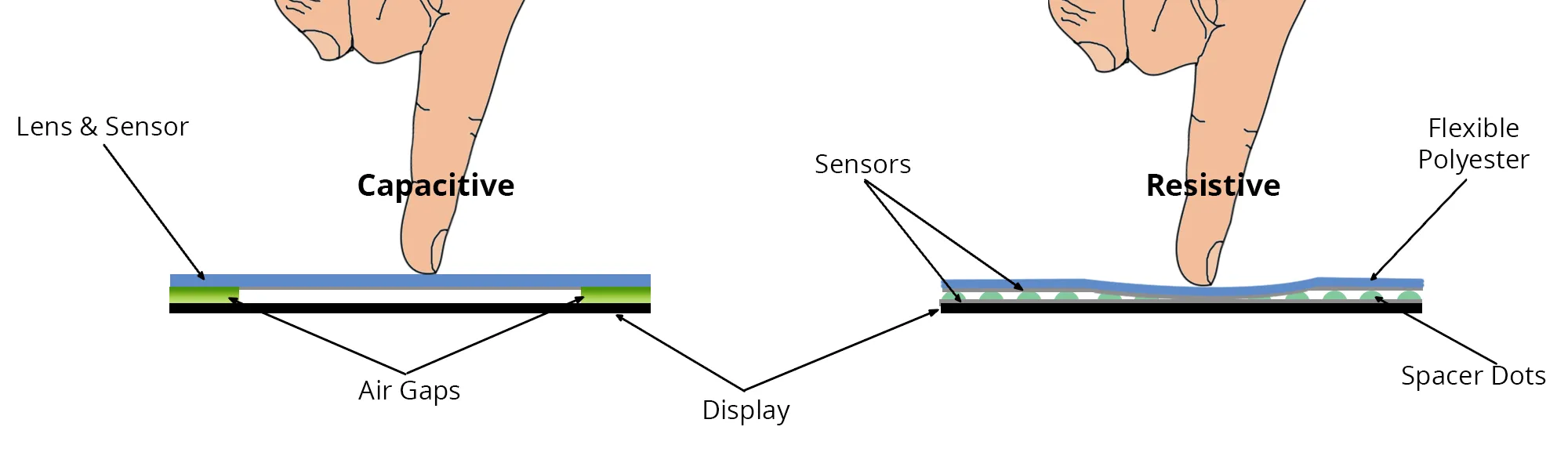
A touchscreen is a two-dimensional sensing device made from two layers of material separated by spacers. There are four main touchscreen technologies: resistive, capacitive, surface acoustic wave (SAW), and infrared (IR).
Resistive
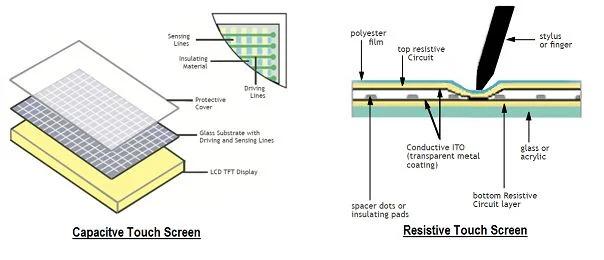
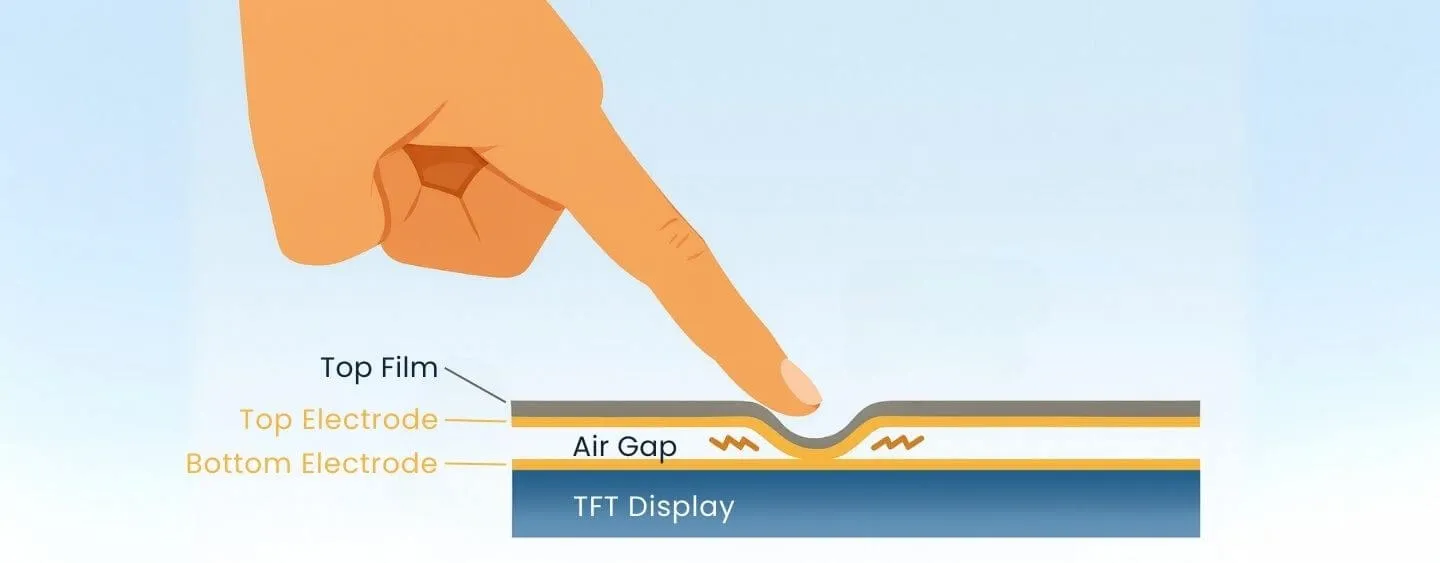
Resistive touchscreens consist of a flexible top layer, often polyethylene, and a rigid bottom layer of glass separated by insulating dots, connected to a touchscreen controller. Resistive panels are more affordable but typically transmit only about 75% of the display's light, and the top layer can be damaged by sharp objects. Resistive touchscreens are categorized as 4-wire, 5-wire, 6-wire, 7-wire, and 8-wire variants. All these modules have similar construction, but they differ in the method used to determine touch coordinates.
Capacitive
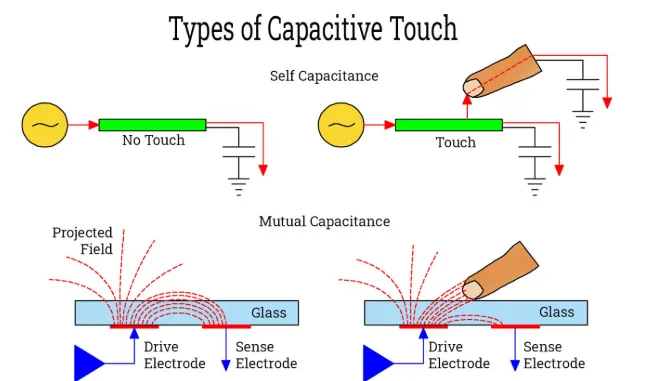
Capacitive touch panels are coated with a material that stores electric charge. Capacitive systems can transmit up to 90% of the display's light. Capacitive technology is divided into two types. In surface capacitive technology, only one side of the insulator is coated with a conductive layer. When a finger touches the screen, charge is conducted on the uncoated side, forming a dynamic capacitor. The controller detects the touch position by measuring changes in capacitance at the four corners of the screen.
In projected capacitive technology, the conductive layer, typically indium tin oxide, is etched to form a grid of horizontal and vertical electrodes. This approach senses along the X and Y axes using a clear etched ITO pattern. To improve accuracy, the projected capacitive panel includes a sensor at each intersection of the rows and columns.
Infrared (IR)
In infrared touchscreen technology, X and Y axis arrays are equipped with pairs of infrared emitters and photodetectors. Whenever the user touches the screen, the photodetectors detect the light pattern emitted by the LEDs, allowing the system to determine the touch location.
Surface Acoustic Wave (SAW)
Surface acoustic wave technology places transducers along the X and Y axes of the display glass and uses several reflectors. When the screen is touched, the acoustic waves are absorbed and the touch is detected at that point. Reflectors are used to route signals from one transducer to another. This technology provides good signal transmission and image quality.