ALLPCB


Overview
Researchers at Sungkyunkwan University in Korea have developed a bipolar, stretchable surface electromyography (sEMG) electrode array combined with a graph neural network (GNN) using self-attention to recognize hand gestures. The array covers the forearm to collect spatial samples of EMG activity for 18 gestures, and the trained GNN distinguishes static and dynamic gestures with accuracy up to 97%.
System concept and data flow
The stretchable sEMG sensor patch is worn around the forearm and connected to an onboard wireless acquisition module. Forearm skeletal muscles, when activated, couple to the multichannel sensors on the skin to generate sEMG signals. The acquisition system detects these signals and transmits them wirelessly via onboard Bluetooth. Over time, the collected raw sEMG dataset is converted into image-like representations that serve as inputs to the neural network for high-accuracy gesture recognition.
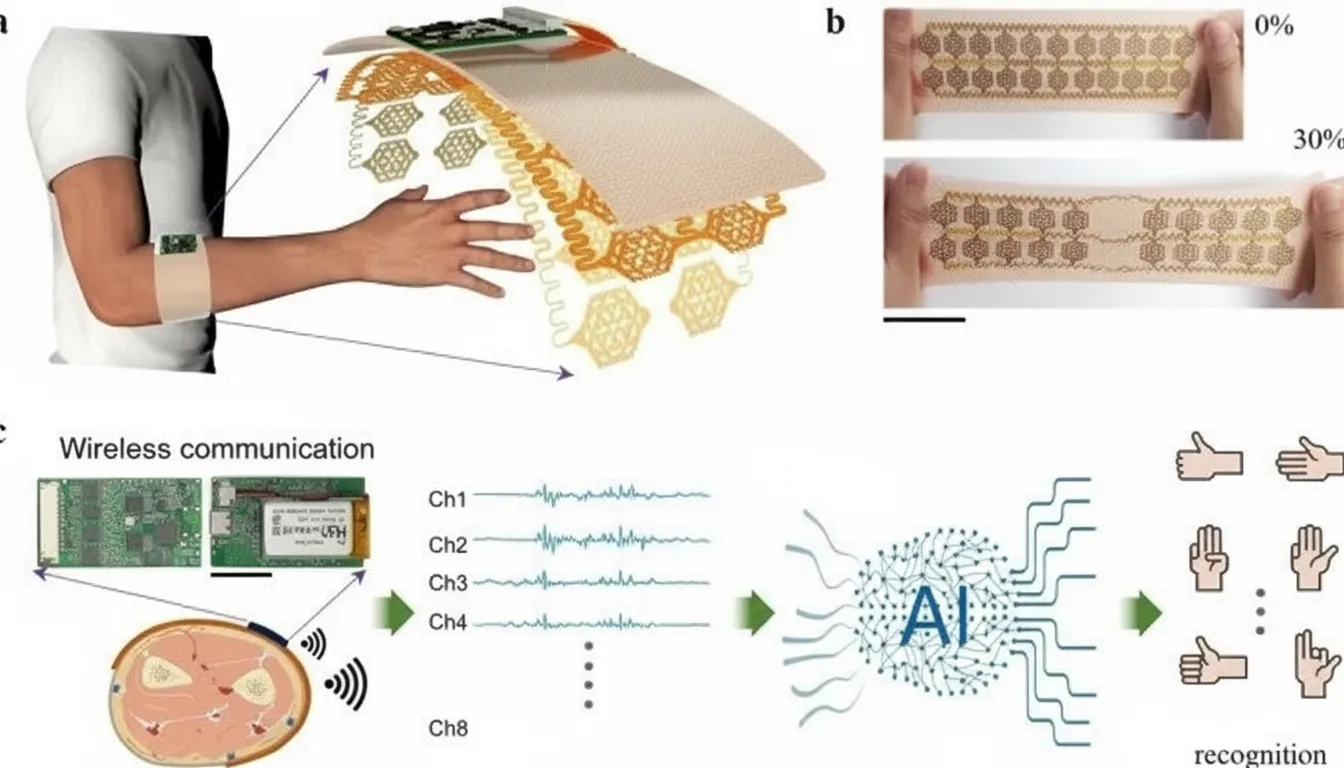
Concept diagram of the stretchable array sEMG sensor with a GNN for static and dynamic gesture recognition
Sensor design
The array consists of a 2 × 10 electrode layout. Eight pairs of electrodes, oriented perpendicular to the neutral axis of the sensor, function as bipolar measurement electrodes that record sEMG. The remaining four electrodes act as reference (ground) electrodes to reduce background noise. Each electrode is a thin metal pattern supported by a hexagonal polyimide (PI) frame and uses a Kirigami-based serpentine wiring geometry, referred to as Kirigami serpentine metal (KSM) electrodes.
The adhesive patch on the sensor array is perforated to provide skin-like properties such as stretchability and vapor permeability, while maintaining stable EMG transmission. Even after more than 72 hours of continuous wear and more than 10 cycles of reuse, recognition accuracy remained approximately 95%.
Placement, gestures, and model evaluation
Gesture recognition accuracy varies with the sensor array placement on the skin, as channel crosstalk between muscles can affect the signals. The study evaluated 18 gestures in total: 1 rest gesture, 13 static gestures, and 4 dynamic gestures. To determine the optimal electrode placement for the 18 gestures, four positions on the forearm were tested and scored using a GNN-based model. Position 2 yielded the highest accuracy at 97.76 ± 0.03%, likely because the electrodes were well aligned with different muscle groups at that location.
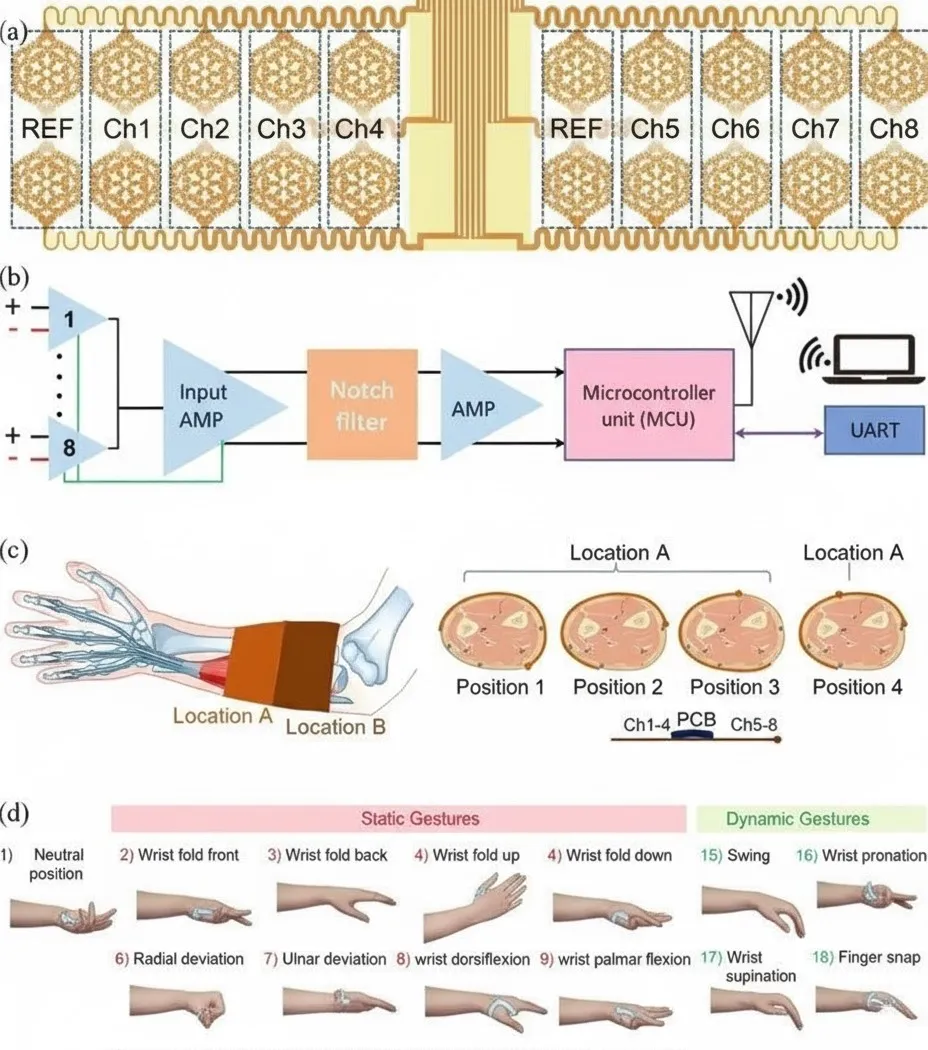
Large-area sEMG sensor array enabling continuous real-time monitoring of various static and dynamic forearm gestures
Long-term stability and reusability
To evaluate long-term usability, sEMG signals were recorded every 24 hours. The raw sEMG signals across all channels showed little change over a 72-hour period, demonstrating the array's stability. Reusability tests, consisting of repeated removal and reapplication cycles, produced similar results and confirmed robust EMG transmission after multiple uses.
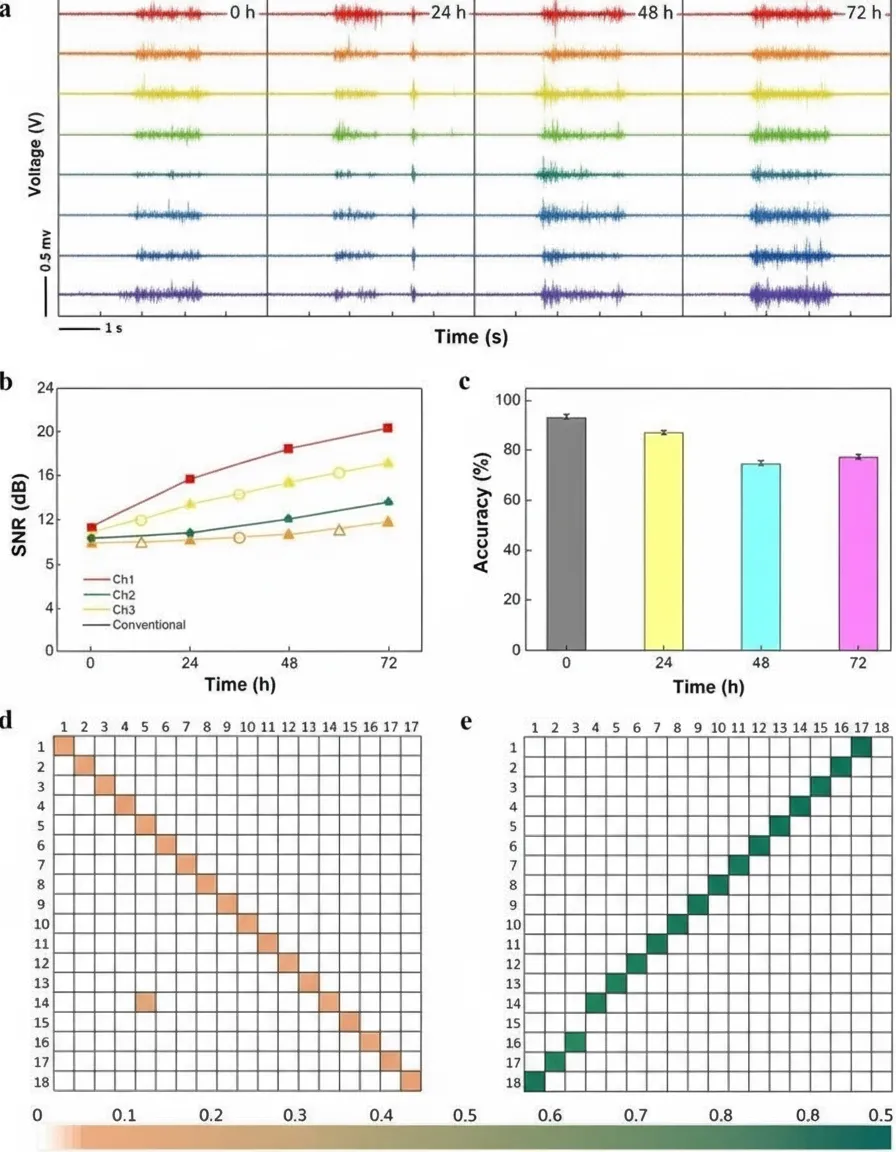
Evaluation of long-term usability of the stretchable array by recording sEMG for 18 gestures and using a graph attention network
Conclusion and potential applications
The study demonstrates a large-area, stretchable bipolar sEMG electrode array integrated with an onboard Bluetooth acquisition module for wireless sEMG monitoring. A GNN-based system trained on the collected data can recognize 18 gestures, both static and dynamic, with an average accuracy of 97%. The combination of stretchable, adhesive, and breathable patch support with Kirigami-based electrodes provides stable EMG recordings for long-term use and repeated wear cycles. Fast and accurate gesture recognition from this system could enable efficient control applications, including prosthetic devices, virtual reality interfaces, and gesture-based communication such as sign language interpretation.