ALLPCB


Introduction
Choosing the most suitable accelerometer for an application can be challenging because datasheets from different manufacturers often emphasize different specifications. This is the second part of a series that examines MEMS accelerometer parameters from three application perspectives: wearables, condition-based monitoring (CBM), and Internet of Things (IoT) or wireless sensor network deployments.
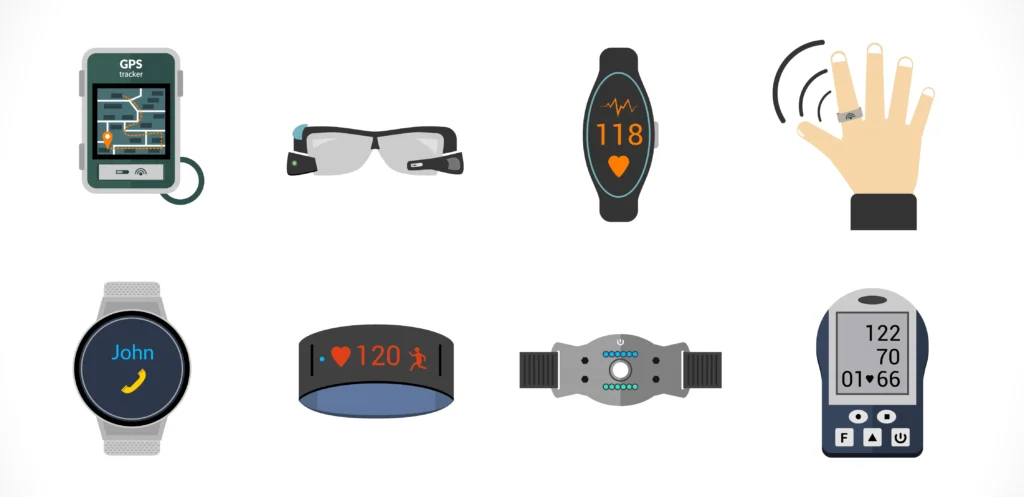
Wearable Devices
Key metrics: ultra-low power, small size, integrated features that support energy management, and usability.
For battery-powered wearable applications, the primary requirement is ultra-low power consumption, often in the microampere range, to maximize battery life. Other important factors are package size and integrated features such as spare ADC channels and deep FIFO buffers to support power management and functional requirements. MEMS accelerometers are commonly used in wearables because of these characteristics.
Table 1 in the original material lists vital sign monitoring (VSM) use cases and typical accelerometer configurations. In wearable systems, accelerometers are used for activity classification, free-fall detection, motion presence detection to determine whether a system should power up, shut down, or sleep, and to assist data fusion with ECG and other VSM measurements. The same low-power accelerometers are also suitable for wireless sensor networks and IoT applications.
When selecting an accelerometer for ultra-low-power applications, evaluate the device behavior at the datasheet-specified power levels. One important consideration is whether bandwidth and sampling rate are reduced to levels that no longer capture the required acceleration signals. Some products reduce average power by duty-cycling the sensor, which can miss critical events because the effective sampling rate is reduced. Capturing real-time human motion requires higher instantaneous power.
Devices such as the ADXL362 and ADXL363 do not under-sample and alias the input signal; they sample the full sensor bandwidth at the set data rate. Power consumption scales dynamically with sampling rate. Notably, these devices can sample at up to 400 Hz while consuming as little as 3 μA. Higher data rates in wearables enable features such as single- and double-tap detection. The sampling rate can be reduced to 6 Hz for pick-up or motion-detection wake-up, at which point average current can be as low as 270 nA. These characteristics also make such devices suitable for implanted systems where battery replacement is difficult.
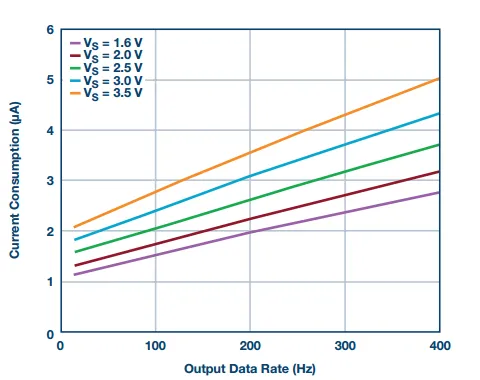
Figure 1. ADXL362 supply current versus output data rate
For applications that only need infrequent acceleration polls, the ADXL362 and ADXL363 provide a wake-up mode with 270 nA supply current. The ADXL363 integrates a three-axis MEMS accelerometer, a temperature sensor (typical scale 0.065°C), and an onboard ADC input for synchronous conversion of external signals, in a small thin package (3 mm × 3.25 mm × 1.06 mm). Acceleration and temperature data can be stored in a 512-sample multimode FIFO, allowing up to approximately 13 seconds of buffered data.
ADI developed a demonstration VSM watch that uses devices such as the ADXL362 to illustrate how ultra-low-power accelerometers can be employed in battery-powered, space-constrained systems.
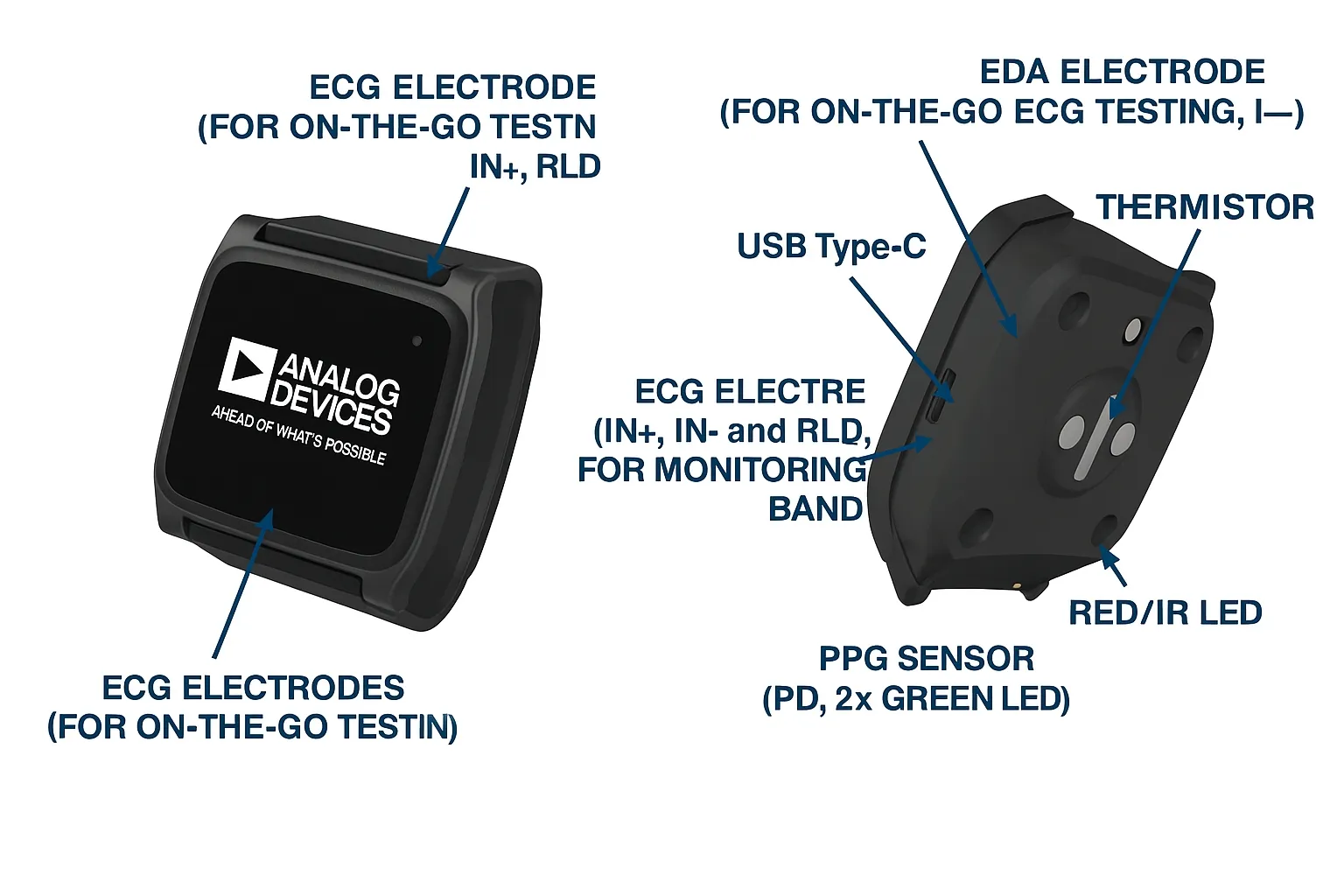
Figure 2. VSM demonstration watch integrating multiple ADI components to illustrate ultra?low power, small form factor applications
The accelerometer in such designs is used to track motion and record activity, and to help remove motion-related artifacts from other measurements.
Condition-Based Monitoring (CBM)
Key metrics: low noise, wide bandwidth, signal processing capability, appropriate g-range, and low power.
CBM systems monitor parameters such as machine vibration to detect and signal potential faults. CBM is a key element of preventive maintenance for turbines, fans, pumps, motors, and other mechanical equipment. For CBM, accelerometer requirements include low noise and wide bandwidth. At the time of writing, few MEMS accelerometers offer bandwidth above 3.3 kHz; some specialized manufacturers provide up to 7 kHz.
With advances in industrial IoT, there is increasing interest in reducing wiring and using wireless, ultra-low-power sensing. MEMS accelerometers offer advantages over piezoelectric accelerometers in size, weight, power, and potential for integrated intelligence. Piezoelectric accelerometers remain common in CBM due to good linearity, SNR, high-temperature performance, and wide bandwidth (typically 3 Hz to 30 kHz and, in some cases, much higher). However, piezoelectric sensors perform poorly at DC and low frequencies, which can be an issue in low-RPM applications such as wind turbines. The mechanical nature of piezoelectric sensors also makes high-volume, low-cost manufacturing more challenging and limits flexibility in interfaces and power management.
Capacitive MEMS accelerometers offer higher integration and richer features, supporting self-test, peak detect, spectral alarms, FFT, data storage, shock survivability up to 10,000 g, DC response, and reduced size and mass. Devices such as the ADXL354/ADXL355 and ADXL356/ADXL357 provide very low noise and good temperature stability, making them well suited for CBM applications, though bandwidth limits may constrain deeper diagnostic analysis. Even with limited bandwidth, low-noise MEMS accelerometers can provide useful measurements, for example in low-speed wind-turbine monitoring where DC response is required.
The ADXL100x single-axis accelerometer family is optimized for industrial CBM, offering measurement bandwidth up to 50 kHz, g ranges up to ±100 g, and very low noise, approaching piezoelectric sensor performance.
See the referenced article "MEMS accelerometer performance has matured" for a detailed comparison between MEMS capacitive and piezoelectric accelerometers.
Unlike many piezoelectric sensors, MEMS capacitive accelerometers can integrate intelligence such as over-range detection circuits that flag events approximately twice the specified g-range. This feature is useful in smart measurement and monitoring systems. Some accelerometers implement internal clock-based protection to guard the sensor element during sustained over-range events, reducing host processor load and increasing node intelligence—both important for CBM and industrial IoT solutions.
Recent generations of MEMS capacitive accelerometers have narrowed the performance gap with piezoelectric sensors, enabling MEMS devices to be used in applications previously dominated by piezoelectric sensors. Low-noise MEMS devices can replace piezoelectric sensors in many CBM applications. Integrated CBM subsystems such as the ADIS16227 and ADIS16228 provide semi-autonomous, fully integrated wideband vibration analysis capabilities, including programmable multi-band alarms, dual-level alarm and fault definition, adjustable response delay to reduce false positives, and internal self-test with status flags.
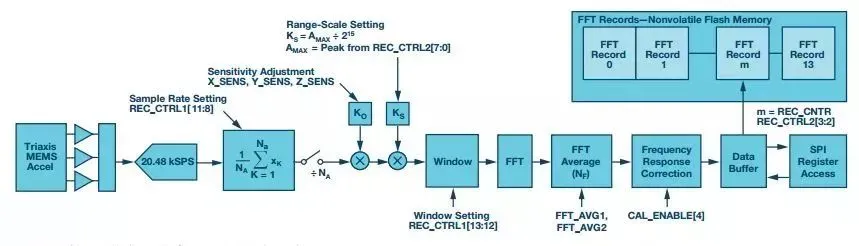
Figure 3. Digital three-axis vibration sensor with integrated FFT analysis and storage
Frequency-domain processing in these subsystems includes per-axis 512-point real-value FFT and FFT averaging to reduce background noise variation and improve resolution. Fully integrated vibration analysis systems can reduce design time, cost, processor requirements, and space constraints, making them suitable for many CBM applications.
IoT and Wireless Sensor Networks
Key metrics: low power, integrated features to enable intelligent energy-efficient measurement, small size, deep FIFO, and appropriate bandwidth.
Large-scale IoT deployments will require millions of sensors, many installed in inaccessible or space-constrained locations such as rooftops, streetlight poles, masts, bridges, or inside heavy machinery. Many of these sensors will be wireless and battery powered and may use some form of energy harvesting.
A common trend in IoT is to minimize the amount of raw data transmitted to the cloud or local servers by performing local processing at the sensor node. Local intelligence that discriminates between useful and non-useful data reduces bandwidth and cost. This requires sensors with on-chip intelligence while maintaining ultra-low power. Standard IoT signal chains deploy local processing at the edge to reduce data transmission volume.
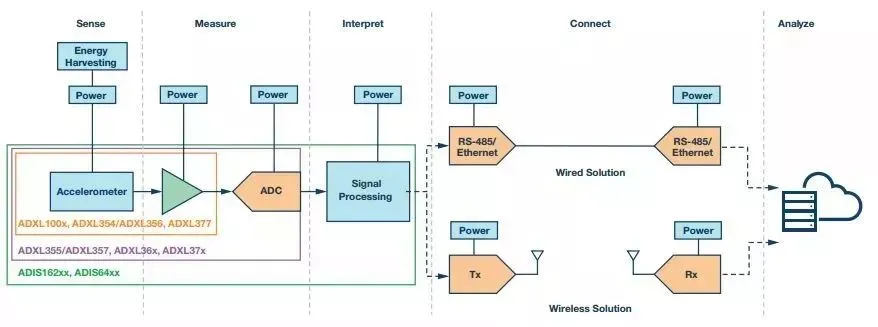
Figure 4. Edge sensor node solution
Not all solutions require wireless connectivity; many industrial deployments still use wired interfaces such as RS-485, 4 mA to 20 mA loops, or industrial Ethernet.
With an intelligent node, only useful data is transmitted, saving energy and bandwidth. The amount of local processing in CBM depends on factors such as machine value, complexity, and system cost. Transmitted data can range from simple over-range alarms to full data streams. Standards such as ISO 10816 specify alarm conditions based on vibration velocity for machines at specific RPMs, aiming to optimize machine and bearing life and reduce transmitted data volume for better support of wireless sensor network architectures.
Accelerometers used in ISO 10816 applications typically require g-ranges up to 50 g or lower, with low noise at low frequencies because acceleration data is often integrated to generate a single speed value in mm/sec rms. Integrating acceleration data that contains low-frequency noise produces linearly increasing errors in the velocity output. The ISO standard specifies 1 Hz to 1 kHz measurement range, but many users want integration down to 0.1 Hz. Historically, charge-coupled piezoelectric accelerometers were limited by high low-frequency noise, but next-generation MEMS accelerometers can maintain low baseline noise down to near-DC, limited by the 1/f noise corner of the signal conditioning electronics, which can be designed as low as 0.01 Hz.
MEMS accelerometers can be used in both low-cost CBM deployments and embedded solutions because they are generally smaller and less expensive than piezoelectric sensors.
Wide-ranging accelerometer product portfolios that include ultra-low-power devices and integrated features are well suited to intelligent sensor nodes, helping extend battery life and reduce bandwidth by performing event detection and data reduction on the node. Key device capabilities for IoT sensor nodes include low-power operation (e.g., ADXL362, ADXL363), and rich feature sets for energy management and event detection such as threshold activity, spectral-line profile alarms, peak acceleration, and long-duration activity/inactivity detection (e.g., ADXL372, ADXL375).
Storing acceleration samples in FIFO and using event detection allows the host processor to remain asleep while the accelerometer autonomously captures pre- and post-event data. On an impact event, data preceding the event can be frozen in FIFO. Without FIFO, the processor must continuously sample and process, which shortens battery life. The ADXL362 and ADXL363 FIFOs can store more than 13 seconds of data, enabling capture of events leading up to a trigger. These devices use full-bandwidth sampling at all data rates to prevent input signal aliasing while maintaining ultra-low power.
Asset Health Monitoring (AHM)
Key metrics: low power, integrated features for intelligent energy-efficient measurement, small size, deep FIFO, and appropriate bandwidth.
Asset health monitoring refers to monitoring high-value assets over time while in storage or transit. Assets such as shipping containers, pipelines, high-density batteries, or sensitive equipment can experience impacts or shocks that affect function or safety. IoT provides a reporting infrastructure for such events. Sensors for AHM must measure high-g impacts while maintaining ultra-low power. Other considerations for embedded battery-powered or portable solutions include package size, oversampling and anti-aliasing behavior for accurate high-frequency capture, and intelligence that allows the host processor to sleep longer and to detect and capture impact events via interrupt-driven algorithms.
The ADXL372 is an ultra-low-power ±200 g MEMS accelerometer designed for intelligent IoT edge nodes in asset monitoring. It includes features developed for AHM, simplifying system design and enabling system-level power savings. High-g events such as impacts typically contain wideband acceleration components. Accurate capture of these events requires sufficient bandwidth; insufficient bandwidth reduces measured event amplitude and leads to errors. Some devices fail to meet Nyquist sampling criteria for these events.
The ADXL375 and ADXL372 provide options to capture the full impact waveform for further analysis without host intervention. Using impact interrupt registers in combination with the accelerometer's internal FIFO enables capture of pre-trigger data. Figure 7 illustrates the importance of adequate FIFO depth to capture impact characteristics prior to the trigger event. Without sufficient FIFO, events cannot be recorded for later analysis.
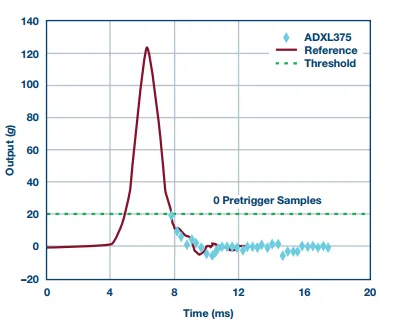
Figure 5. Accurate capture of impact characteristics
The ADXL372 can operate with bandwidths up to 3.2 kHz while maintaining ultra-low power. A steep filter roll-off helps suppress out-of-band components; the ADXL372 integrates a fourth-order low-pass anti-aliasing filter. Without anti-aliasing, any input frequency above half the output data rate will alias into the measurement band and create errors. The selectable fourth-order low-pass filter provides flexibility for different application needs.
Using the instant-on impact detection feature, the ADXL372 can be configured to capture impacts above a specified threshold while remaining in an ultra-low-power mode. After an impact, the accelerometer enters full-measurement mode to capture the event waveform precisely.
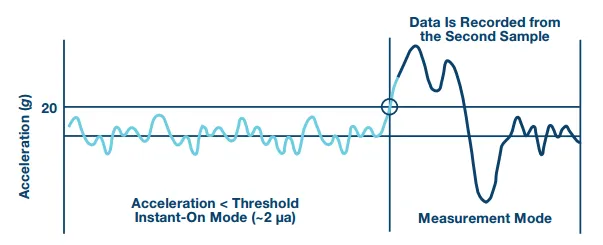
Figure 6. Instant-on mode at default threshold
Some applications only require peak acceleration samples from impacts, which can reduce FIFO usage and extend the interval between host reads to save energy. The ADXL372 FIFO can store peak acceleration samples per axis. Maximum storage time depends on the selected allocation; at 400 Hz ODR, 512 single-axis samples correspond to 1.28 seconds. At 3200 Hz ODR, 170 three-axis samples provide a 50 ms window sufficient to capture typical impact waveforms.
Appropriate FIFO usage allows the host processor to remain asleep while the accelerometer autonomously collects data, reducing system-level power. Alternatively, FIFO-based collection reduces host processing load, allowing it to service other tasks.
Other high-g accelerometers exist on the market, but many are less suitable for AHM/SHM IoT edge-node applications due to narrower bandwidth or higher power. Devices that offer low-power modes but cannot perform accurate high-bandwidth measurements are generally limited by bandwidth. The ADXL372 supports a low-power, leave-it-in-place deployment model for AHM/SHM sensor nodes.
Conclusion
MEMS capacitive accelerometers now cover a wide range of application requirements. Newer devices offer low noise, low power, high stability, and temperature stability, with integrated features that reduce system complexity. These characteristics make MEMS accelerometers suitable for wearable devices, condition-based monitoring, IoT sensor nodes, and asset health monitoring. Datasheets and evaluation information for specific devices are available from manufacturers for engineering assessment and prototyping.