ALLPCB


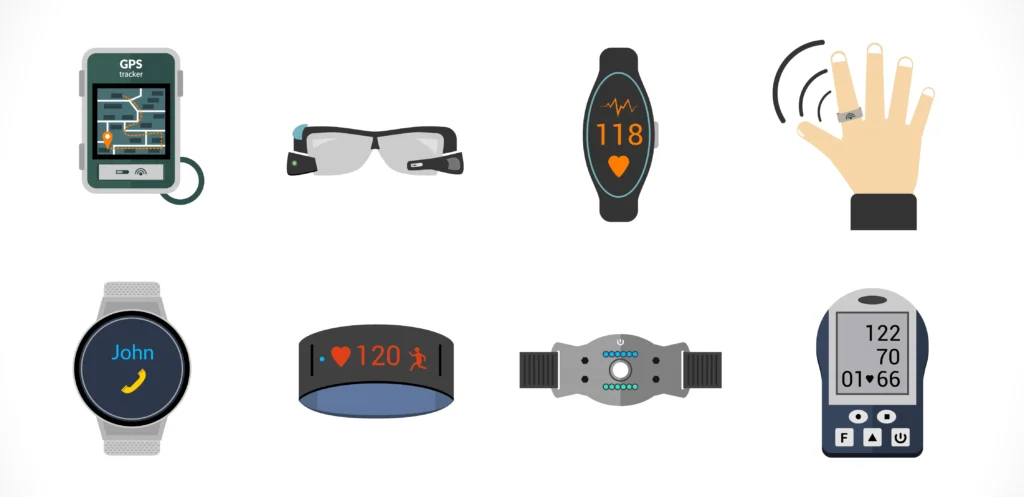
The wearable electronics market is growing rapidly. Because these devices and their batteries are very small, careful design is required to ensure battery life lasts months or years rather than hours or days. That means attention to every detail from clock startup to MOSFET switching. The following points refine battery calculations down to the minute. Some techniques yield small savings while others are substantial, and taken together they can produce meaningful energy reduction.
Sleep Modes
If a device cannot be fully powered off, the most effective energy strategy is to keep it in a low-power sleep state as much as possible. Wakeup should be controlled by time or events such as interrupts, button presses, or motion. You can configure wakeup frequency and post-wakeup behavior, and use dynamic sleep intervals so sleep duration varies with context. For example, a health monitor may sample frequently during activity but increase the sampling interval when activity slows or stops to save battery.
Inter-IC Communication
Unlike SPI, I2C requires pull-up resistors, which increase power consumption. Pin capacitance between ICs also consumes energy, so reduce transmitted data where possible. For example, with four communication lines, 5 pF pin capacitance per line, 3.3V, and 20 MHz operation, the pin capacitances alone draw about 660 uA (current = 0.5 C V f; C is pin capacitance, V is voltage, f is frequency). That capacitance reflects all transmit/receive combinations between ICs. Depending on system function, this energy can be significant. High-integration chips are often most efficient because peripheral, RAM, and flash accesses occur internally and avoid pin capacitance. Note that much of pin capacitance is caused by ESD protection diodes.
Power Efficiency
Maximizing efficiency starts with selecting an appropriate switching regulator. Synchronous regulators can exceed 95% efficiency. Standby efficiency is also important, so measure device currents in different modes and compute regulator efficiency at those currents to assess each mode's effect on overall power. Some regulators have very low no-load quiescent currents. For example, the Analog Devices ADP5301 buck regulator has no-load quiescent current as low as 180 nA and supports a hysteretic mode that switches to short pulses at very low load to charge the output capacitor, then returns to low quiescent operation. Depending on input and output voltages, low quiescent current can improve efficiency substantially at low loads. The ADP5301 can supply up to 0.5 A and provides an external resistor-adjustable output. Older regulators that draw several mA with no load are much less suitable for low-power wearables.
If a switching regulator uses external MOSFETs, MOSFET switching time can cause significant losses. The transition from off to on is when a switching MOSFET dissipates the most power. When fully on, voltage drop is small and losses are low, but during partial conduction there can be a large voltage drop together with high current. To minimize time spent in this region, select fast switching devices with low gate capacitance and low on-resistance.
Power Shutdown
If powering down during sleep, consider whether you can keep power-supply decoupling capacitance small. Capacitors must be charged when power is applied, and frequent power-cycling wastes the energy stored in those capacitors (unless that energy remains usable on next startup). For example, in a 3.3V supply, a 1 uF capacitor cycled 100 times per second consumes about 165 uA. Many ICs draw less current in sleep than this, so leaving circuits powered during sleep is often preferable to full power-off. Exceptions are devices without a low-power sleep mode or with relatively high sleep current. Replacing a 1 uF decoupling capacitor with 100 nF can save substantial energy.
Lower Supply Voltage
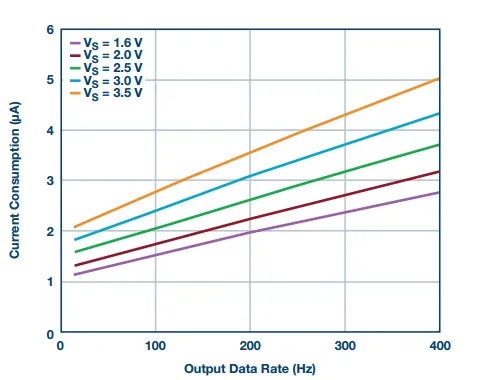
Even if current draw remains similar, power decreases at lower voltage. If a microcontroller is driven at 1.8V instead of 3.3V, power at the same current is roughly halved. Digital devices often draw less current at lower voltage, further reducing power. Note that maximum clock frequency typically decreases at lower voltage, so although current may drop, execution time may increase accordingly.
For example, Microchip nanoWatt XLP PIC24F16KA102 at 3.3V and 2 MHz consumes 695 uA, while at 1.8V it consumes 363 uA, reducing power by about 70%. However, at 3.3V the controller can run at 32 MHz, whereas at 1.8V the maximum clock is 8 MHz.
Clock Frequency
Choose a clock frequency appropriate for the application rather than the fastest available. Many microcontrollers provide adjustable clock multipliers so software can vary clock speed. If code execution time before returning to sleep is the limiting factor, a faster clock may be most efficient. Other operations may not scale with CPU speed, and the microcontroller can "tick" time while waiting for events; in such cases periodic interrupts can be used to wake the processor.
Another approach is to reduce the running clock frequency while the processor is in a "wait" state and return to full frequency when work is required. Ideally use sleep modes, but clock startup and stabilization incur energy costs, so in some scenarios sleep modes are not the optimal choice.
Clock Startup
Waiting for the system clock to stabilize wastes energy. If code can run during clock establishment, that helps, but if some circuits require a stable, accurate clock, the processor must wait and energy is wasted. Some microcontrollers provide fast-start oscillators to reduce startup time and energy.
32-Bit Microcontrollers
Not every design needs a 32-bit controller. Depending on the workload and compiler efficiency, 8- or 16-bit controllers can be more efficient. If Bluetooth or network interfaces are used, larger memory may be required and 16- or 32-bit processors may be appropriate. A TCP/IP web server generally requires a 32-bit processor. Well-written code can reduce resource and power consumption.
Processors supporting wider data bandwidth often consume more power. Accessing 32-bit RAM and flash typically uses more power than accessing 16-bit memory, and larger memories have higher leakage. Design and code efficiently and avoid choosing processors with excess memory; minimize memory while meeting capacity requirements.
RF Power Consumption
For RF interfaces such as Bluetooth, consider transmission range. In addition to using low transmit power, receiver sensitivity can often be adjustable; lower sensitivity reduces power. For example, the Nordic Semiconductor nRF52832 draws about 10.9 mA at high sensitivity and about 6.1 mA at normal sensitivity.
Custom ICs
The most fundamental low-power solution is a fully custom IC implementing only the necessary circuits. Eliminating circuits needed to drive off-chip devices reduces power, but custom silicon is the slowest and most expensive route to market. This tradeoff helps explain why some watchmakers achieve multi-year battery life while fitness bands often last only days.
Summary
Designing a low-power system requires consideration of many factors. Create a spreadsheet listing all system components, current consumption, duty cycles, voltages, and total power. Estimate power for each operating mode and validate key information by building and testing a prototype system.