ALLPCB


Introduction
Users expect smart devices to combine functionality, security, and long battery life. To meet these expectations, developers are now focusing on flexible MCUs that provide low-power performance and sufficient memory for moderate feature sets, while also supporting secure updates for feature enhancements and bug fixes.
Define the user experience
Many user expectations are similar to those developers have addressed in the past. However, for emerging smart products there are notable differences. Users increasingly expect compact, lightweight products that are comfortable to wear or unobtrusive in the home or workplace. They prefer devices that require minimal attention, whose use, charging, and updates are straightforward, and that remain secure.
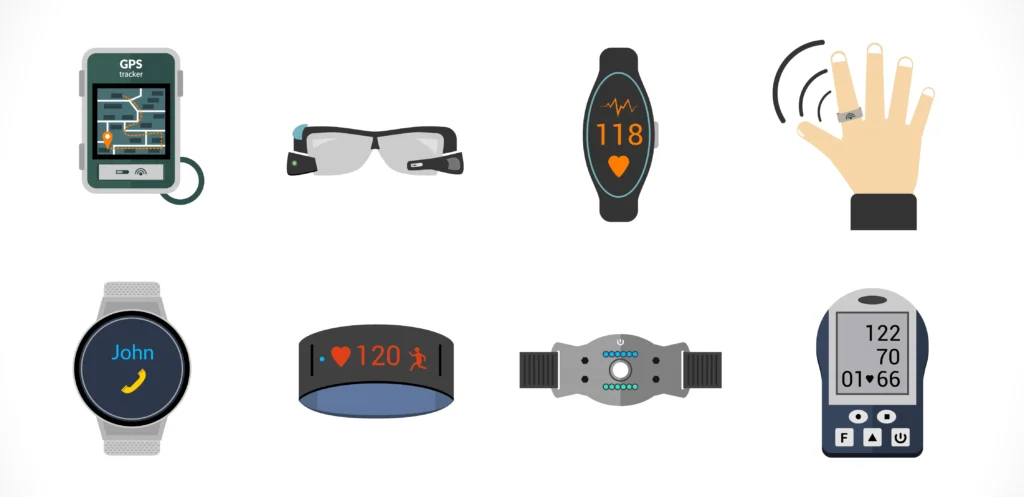
Beyond ease of interaction, users expect smart devices to resemble traditional products with similar size and style. For example, a wearable fitness device that looks like a bracelet or watch is more readily accepted than an awkward-looking gadget.
Value remains critical: a stylish wearable that provides little useful information will not succeed. Combining technology and style requires a degree of embedded intelligence.
To achieve this embedded intelligence, developers must translate high-level capabilities such as comfortable interaction, familiar appearance, and high-value information into concrete application requirements.
Expanding requirements
To meet user expectations for effortless interaction, devices need enough performance to run complex application software and deliver fast results. These functional requirements translate into processor needs: the processor must execute application code while extracting more useful information from increasing sensor modalities.
When accessing sensitive information, these devices require strong security mechanisms that do not unduly degrade application performance.
In addition, devices must support unobtrusive software updates to respond to new attack vectors without burdening users. Designs also need efficient power management to extend battery life and avoid bulky batteries or frequent recharging.
Meeting usability and aesthetic expectations increases the challenge. Large batteries, oversized enclosures, or clumsy user interfaces can discourage users from interacting with a product.
Developers must balance form and function, focusing on solutions that address conflicts between high performance and low power, rich features and small size, flexibility and security.
Cost is another factor. With rapid growth in IoT, wearables, and smart products, hardware and software must be updatable to support future requirements. Planning for future enhancements often requires extra power headroom and storage in the initial design, which increases cost and must be balanced against projected needs.
For designers, the MCU at the core of an embedded smart product is a natural focus point for addressing these requirements. While 8-bit and 16-bit MCUs remain popular, rising user expectations are pushing systems toward higher performance and richer features. A 32-bit MCU can complete operations like 32-bit addition in fewer instruction cycles than 8-bit or 16-bit MCUs (Listing 1).
Copy  anl PSW, #0E7H ;Register Bank 0
mov a, r0 ;load X low byte into acc
add a, r4 ;add Y low byte
mov r0, a ;save result
mov a, rl ;load X next byte into acc
addc a, r5 ;add Y next byte with carry
mov rl, a ;save result
mov a, r2 ;load X next byte into acc
addc a, r6 ;add Y next byte
mov r2, a ;save result
mov a, r3 ;load X high byte into acc
addc a, r7 ;add Y high byte with carry
mov r3, a
mov C, OV
ret

(A)
mov a, r0
add rl
mov r0, a
ret

(B)
Listing 1: The number of instruction cycles an 8-bit MCU requires to perform a 32-bit addition (A) is significantly higher than for a 32-bit MCU (B).
As designers combine multiple sensor data streams for sensor fusion algorithms, high-performance 32-bit MCUs become increasingly important. Sensor fusion is used in applications such as generating accurate heading and indoor positioning information, which users expect from wearables and mobile products. Advanced MCUs with integrated features are useful for implementing this embedded intelligence.
Darwin MCU features
The Darwin MCU family is targeted at the needs of emerging smart products. The series combines low-power operation with a broad set of integrated features, including devices such as the MAX32620, MAX32625, and MAX32630.
Darwin MCUs are based on a 32-bit Arm Cortex-M4 with an integrated floating point unit (FPU). They support low-power operation and include modules for peripheral management, power monitoring, and cryptography. Secure variants expand security support with an integrated trust protection unit (TPU) to help assure confidentiality, integrity, and authenticity in interactions between the device and external hosts.
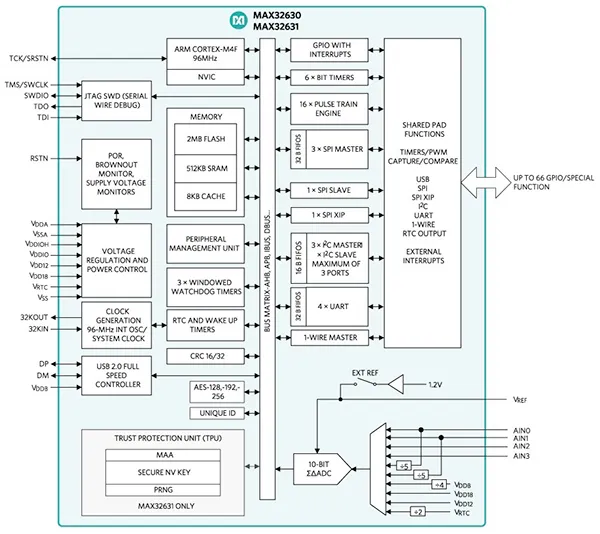
The MCU's analog and digital peripherals and serial interfaces can simplify hardware design for systems using multiple sensors. Reference evaluation kits demonstrate this simplified approach, integrating sensors such as body temperature sensors, ECG analog front ends, and pulse oximetry sensors suitable for typical wearable fitness applications.
Darwin's instruction set architecture supports both 16-bit and 32-bit instructions, reducing code size while retaining the per-byte advantages of a 32-bit architecture. In addition to an integrated FPU, the CPU architecture includes hardware multiply-accumulate (MAC) and single-instruction multiple-data (SIMD) capabilities to provide digital signal processing functionality.
The combination of floating-point and DSP instructions helps Darwin MCUs execute data-intensive algorithms faster, enabling embedded intelligence in next-generation products. These MCUs integrate sufficient on-chip memory to store algorithms, application code, and system-level software such as real-time kernels, communication stacks, and security protocol stacks. The Darwin family offers multiple flash and SRAM options: MAX32630/MAX32631 provide 2 MB flash and 512 KB SRAM; MAX32620 provides 2 MB flash and 256 KB SRAM; MAX32625 provides 512 KB flash and 160 KB SRAM. To simplify memory use, Darwin MCUs support a unified memory map that merges various memory types and mapped registers into a single address space.
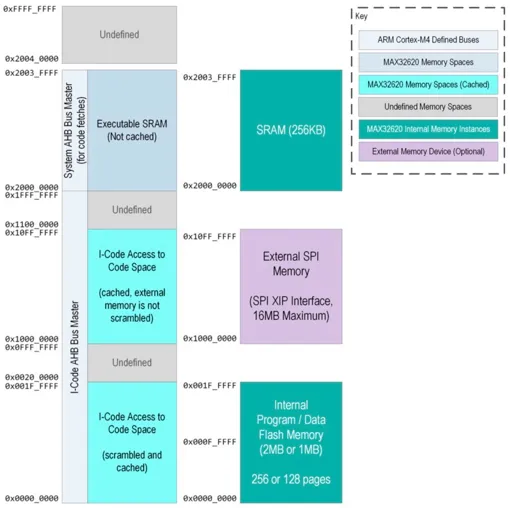
Developers can expand available flash to support very large code sets or system libraries. The MCUs support execute-in-place (XIP), allowing the CPU to run code directly from external flash; reference designs illustrate this approach with external flash devices.
Power and low-power modes
Despite their memory and processing capabilities, Darwin MCUs address low-power requirements. In the devices discussed, MAX32630/MAX32631 support retention of 512 KB SRAM at as low as 3.4 μW. In full active mode, power consumption is about 130 μW/MHz. A special mode using an integrated peripheral management unit (PMU) supports peripheral operation at around 30 μW/MHz while the CPU core remains in an ultra-low-power sleep state.
Darwin MCUs can run peripherals while the CPU is sleeping, enabling developers to reduce power by minimizing the time the CPU must remain active. Rather than periodically polling sensors with a fully active CPU and sending results to a host, developers can use instructions such as wait-for-interrupt, wait-for-event, and sleep-on-exit to minimize effective duty cycle and lower overall system power.
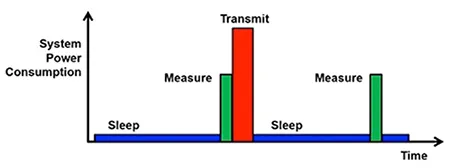
Slower MCUs that take longer to transition from sleep to active waste power during wake-up. These Darwin devices have wake times around 5 μs, reducing wasted energy during transitions. Combined with SRAM retention during sleep, they can resume processing rapidly without the long delays and energy costs of saving to and restoring from external nonvolatile memory. This enables efficient, power-sensitive applications.
Development support
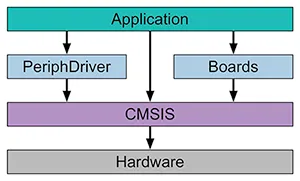
Firmware SDKs are available that include peripheral drivers, board support packages, and example applications. The SDK's peripheral and board libraries are built on the Arm Cortex Microcontroller Software Interface Standard (CMSIS) API. Applications can interact with the libraries or directly with CMSIS to access the underlying hardware as needed.
Conclusion
Users expect wearables, IoT devices, and other smart products to provide complex applications, be easy to interact with, comfortable to wear, and deliver useful information. To meet these expectations, developers need MCUs that combine rich functionality, high processing performance, and low-power operation.
The Darwin MCU family provides a feature set and performance profile suitable for these requirements and can be used to implement embedded intelligence in devices that must balance performance, power, and security.