ALLPCB


Overview
Wireless technology can provide a convenient battery-charging solution for wearables that lack charging ports for design or aesthetic reasons. Historically, implementing wireless charging required custom RF design and expertise in electromagnetic induction. Today, designers can implement inductive wireless charging in low-power wearable designs using off-the-shelf components from manufacturers such as Freescale Semiconductor, TDK, Texas Instruments, and Toshiba.
Wireless power dates back to the early 19th century when Michael Faraday described how a conductor in a magnetic field can generate an electromotive force by electromagnetic induction. In the late 19th century, Nikola Tesla applied Faraday's law in practice, using magnetically coupled resonant techniques in his New York laboratory to light lamps wirelessly. The principle of electromagnetic induction now powers RFID tags, contactless smart cards, induction cooktops, and provides the technical basis for wireless chargers used by electric toothbrushes, smartphones, and emerging wearables such as smartwatches.
For wearables where a charging port is inconvenient, space-consuming, or undesirable, wireless charging is an attractive option. Removing wired charging ports can also reduce the risk of contamination and water ingress, improving product reliability. These devices replace external ports with a receiver coil placed safely beneath the wearable enclosure.
In inductive power transfer, driving current through a coil generates a magnetic field that induces current in a nearby secondary coil. Coil alignment and separation are critical to achieving efficient transfer. In consumer applications, guided wireless chargers provide alignment aids that help users place the mobile unit on the base at the designated position. By contrast, free-positioning chargers typically include multiple coils in the base station and power the appropriate coil in response to feedback from the remote unit.
Communication Channels
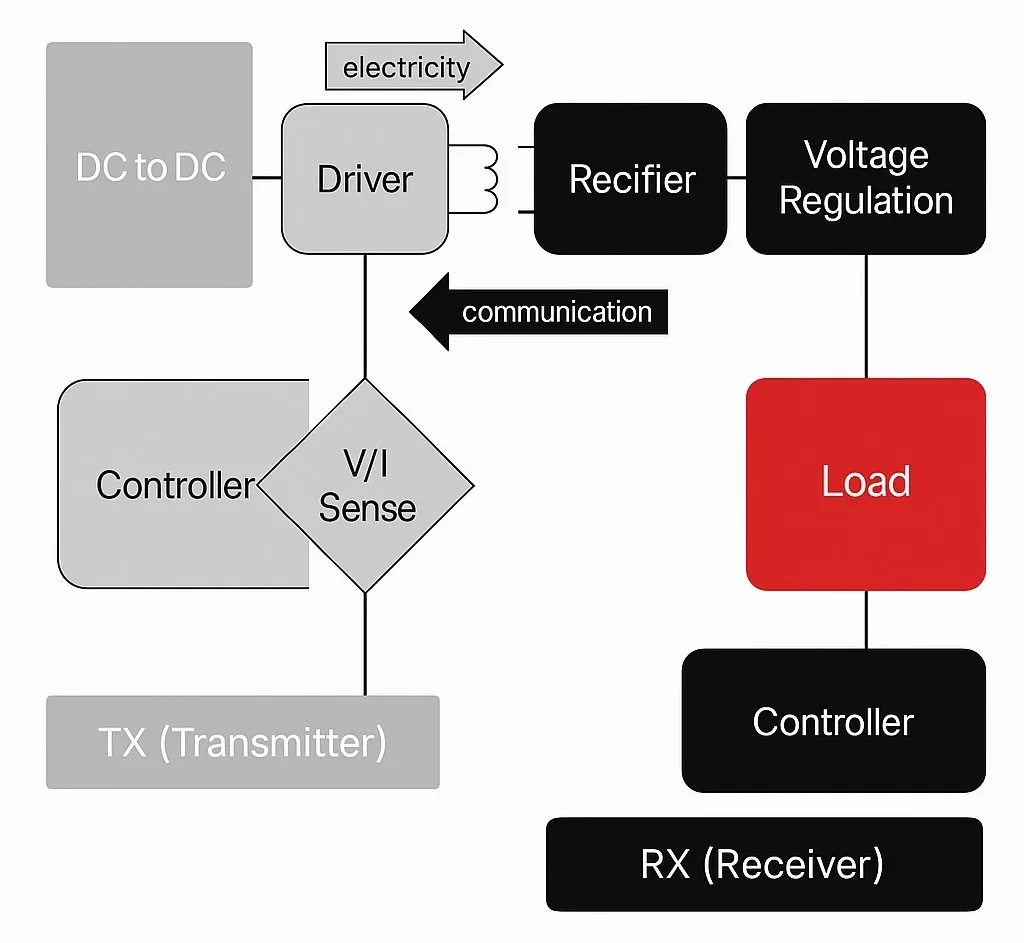
Communication is key for both guided and free-positioning wireless charging systems. During transmitter operation, the receiver modulates the load on its antenna to send data packets back to the transmitter. The transmitter demodulates the reflected load to reconstruct the packets (Figure 1).
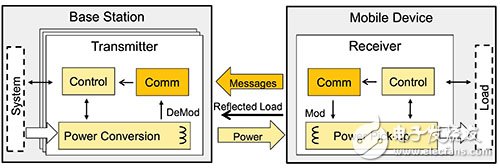
Figure 1: A typical wireless charging system includes a power-transmission base station and a power-receiving device, using electromagnetic coupling for power transfer and communication.
Both system types use data from the receiver to manage transmitter power. During operation, the transmitter responds to feedback from the receiver to increase or decrease power delivered to the transmit coil as needed. Free-positioning systems use the same general method to select the optimal coil relative to the remote device.
Designers can use these communication paths not only for control signals but also to return application data to the transmitter. Although the information bandwidth is limited, it is sufficient for device authentication, status reporting, and transmission of sensor data collected by the remote device.
The combination of power regulation, control, and communication produces circuit-design requirements with complex power and control logic (Figure 2). Semiconductor vendors provide integrated solutions that address these needs.

Figure 2: Wireless charging systems can quickly increase in complexity to meet diverse requirements for power-transfer optimization and communication. (Source: Texas Instruments)
Standard Solutions
Standardized wireless charging solutions have matured as industrial standards have been adopted. These standards define the basic requirements of wireless charging protocols. Although they aim to enable interoperability between mobile devices and base stations from different vendors, they are built on two wireless charging techniques: inductive charging and resonant charging.
Inductive charging requires precise alignment between transmitter and receiver but is typically more efficient than resonant charging. Resonant charging is less sensitive to alignment and distance, and it can charge multiple devices simultaneously. Industry standards organizations, including the Wireless Power Consortium (WPC), Power Matters Alliance (PMA), and Alliance for Wireless Power (A4WP), are collaborating on early-stage interoperability efforts.
While initial standards targeted high-volume consumer applications, these approaches have become the foundation for wearable charging solutions. For example, although the WPC Qi standard commonly uses larger A11 50 mm transmit coils, designers can choose smaller coils with lower resistance to reduce power loss and better match the form factor and power-transfer levels of many wearables. For instance, a 30 mm diameter TDK WR303050 coil has 0.41 ohm DC resistance and a physical and power profile that suits many wearable applications.
For power control in wireless charging, devices such as Toshiba TB6865FG and TB6860WBG complement existing standard-based components. Like other products in this class, these Toshiba ICs integrate multiple functions to simplify design and require few external components to support a WPC Qi-compliant wireless charging system (Figure 3).
Figure 3: Devices such as the Toshiba TB6865FG transmitter and TB6860WBG receiver integrate multiple functions to simplify implementation of standard-based wireless charging systems. (Source: Toshiba)
The TB6860WBG receiver combines modulation and control circuitry with rectification-based power capture, an integrated high-performance DC-to-DC converter, a configurable lithium-battery charger circuit, and protection features. The TB6865FG transmitter integrates an MCU and extensive analog functionality, including PWM circuits, switch control, onboard filtering, and front-end driver circuits. The TB6865FG can control two coil groups independently, allowing simultaneous charging of two mobile devices.
Freescale Semiconductor offers MWCT1000 and MWCT1101 transmitters based on a 32-bit 56800EX core. The processor provides MCU functionality and DSP capability, enabling extensive features while consuming no more than 30 mA in active mode. It can detect nearby receivers with only 30 mW of standby power. During power transfer, Freescale devices can achieve efficiencies above 75%. Freescale also offers MWCT1001A and MWCT1003A for automotive applications.
The BQ51221 supports both WPC and PMA standards, and most TI receivers are designed to WPC Qi specifications. TI's Qi-compliant receivers include 5 W devices with regulated outputs of 5 V (BQ51013A and BQ51013B), 7 V (BQ51010B), and 8 V (BQ51020 and BQ51021). Other members of the family, such as BQ51050B (4.2 V output) and BQ51051B (4.35 V), integrate lithium-battery chargers to provide comprehensive power management for wearables.
BQ51003 is designed for low-power applications and is a 2.5 W receiver well suited to wearables. By pairing the BQ51003 with a low-power linear charger such as the TI BQ25100, designers can implement a complete wireless-charging receiver subsystem with integrated lithium-battery management. For lithium charging, the BQ25100 can accurately control fast charge currents from 10 mA up to 250 mA and can terminate charging as low as 1 mA to support small coin-cell lithium batteries.
On the transmitter side, TI's BQ500211A and BQ500212A provide full Qi functionality, including continuous monitoring of transfer efficiency for foreign object detection (FOD) and parasitic metal object detection (PMOD). In addition to FOD and PMOD, the BQ500410 supports free-positioning designs with a three-coil transmitter array. For low-power transmitter designs, the BQ500210 can operate with supply currents as low as 8 mA.
Summary
For wearables, wireless charging addresses the demand for compact solutions and eliminates concerns about port size and reliability. Historically, using wireless power required specialized knowledge of electromagnetic theory and RF design. Today, designers can implement wireless charging in very small wearable devices using readily available IC components.