ALLPCB


Overview
STMicroelectronics offers a family of wireless power ICs covering 1 W to 100 W. The STWLC38 is a Qi 1.3 certified wireless power receiver optimized for space-constrained products such as wearables and earphones. It supports up to 15 W while the overall solution footprint, including external components, is just 7 mm x 7 mm. The STWLC38 can be paired with the STWBC86 transmitter IC.
Key IC Details
The STWLC38 is available in a 2.1 mm x 3.3 mm WLCSP40 package. Output voltage is adjustable from 4 V to 12 V with 25 mV resolution. The device integrates an ARM 32-bit Cortex-M0+ core running up to 64 MHz. Memory includes 64 kB ROM, 16 kB RAM, and 32 kB of nonvolatile RRAM for firmware patches.
Foreign object detection, or FOD, is an important safety feature in wireless charging design. FOD identifies metallic objects in the field between transmitter and receiver and disconnects power when necessary. Induced eddy currents in such metal can cause rapid heating. The STWLC38 supports precise voltage and current measurement and includes protections for overcurrent, overvoltage, and overtemperature conditions.
Transmitter IC
The STWBC86 transmitter IC is compatible with the Qi 1.2.4 standard and supports up to 5 W under the Qi protocol. It is a single-chip solution with an integrated full-bridge inverter and an ARM 32-bit Cortex-M0+ core at 64 MHz, 8 kB RAM, and 8 kB of multi-time programmable flash for firmware patches. The design is optimized for the Qi A11a topology and uses low RDS(on) power MOSFETs to improve efficiency.
Reference Designs and Development Resources
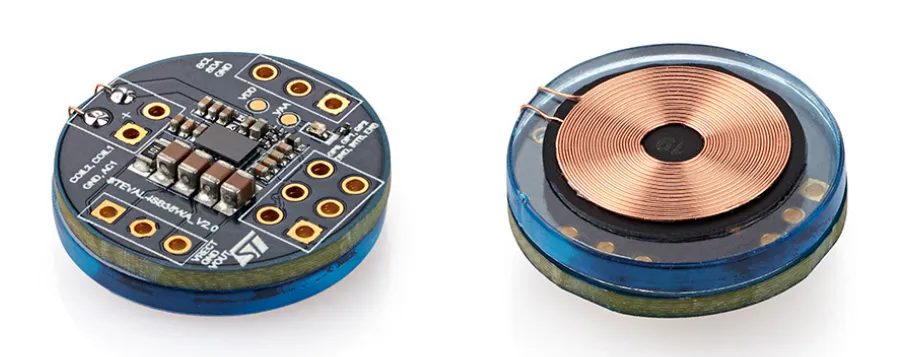
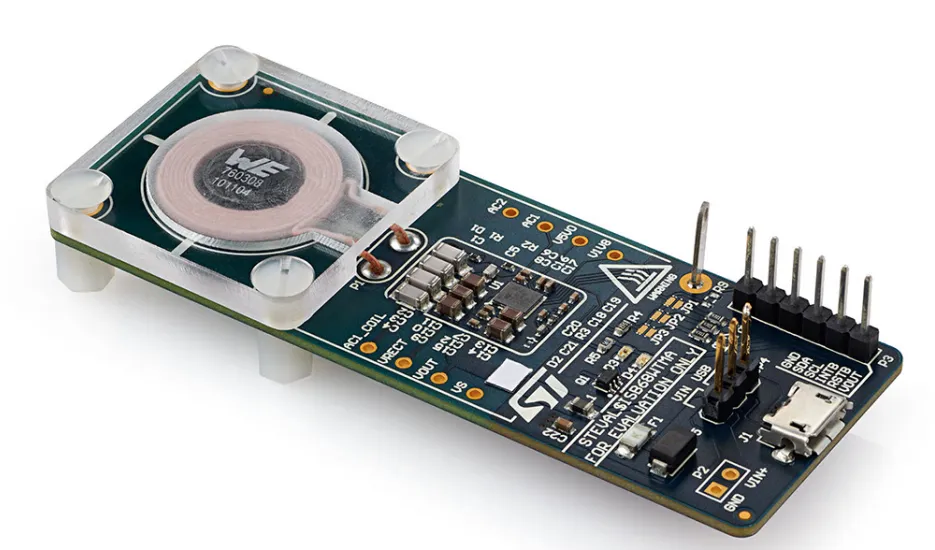
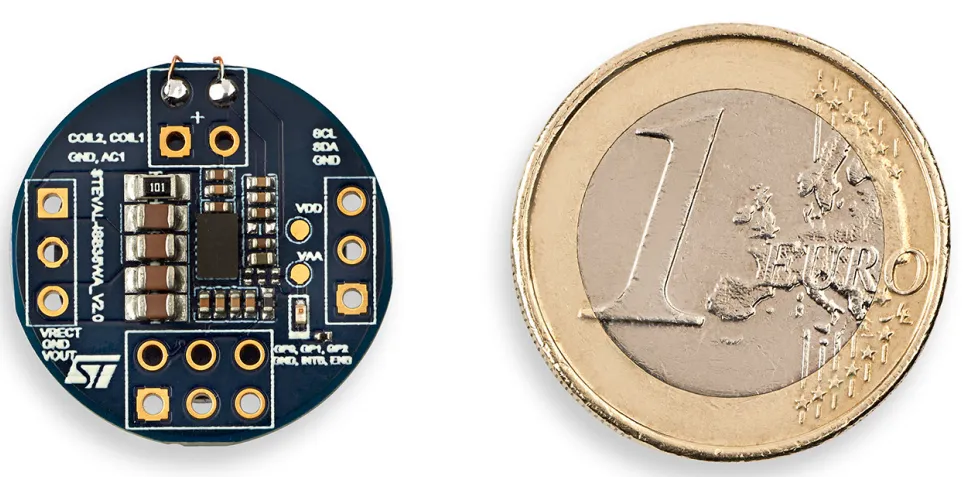
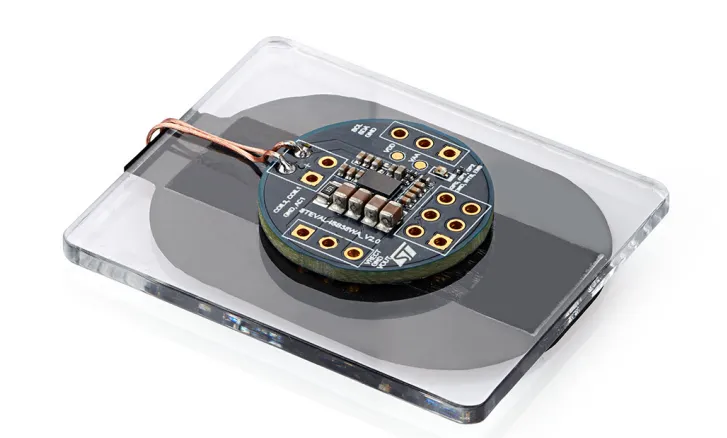
To simplify development, ST provides mature reference solutions targeting wearables. The STDES-WLC38WA (receiver) and STDES-WBC86TX (transmitter) form a complete wearable wireless charging solution. These reference designs include PCB Gerber files, firmware, software, design guides, and technical notes, enabling developers to reproduce the hardware and use it as a plug-and-play starting point. The reference PCB measures 7 mm x 7 mm, making it suitable for space-limited devices.
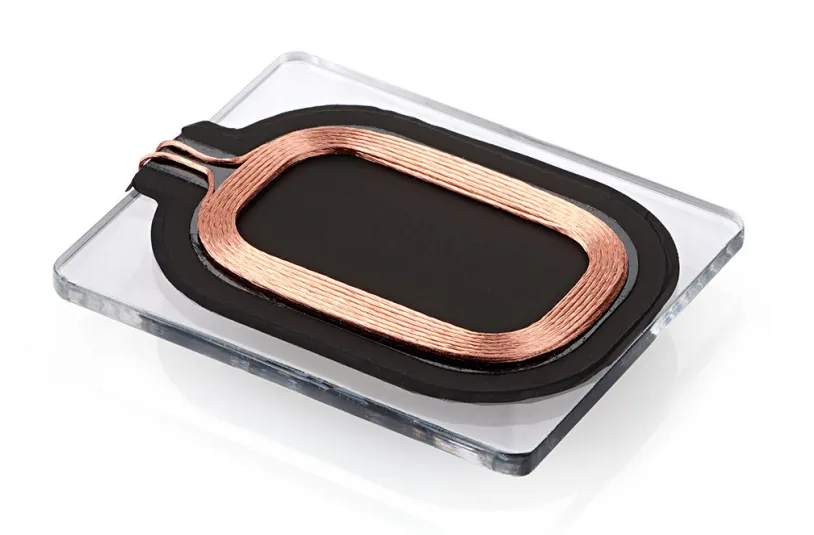
The STDES-WLC38TWS reference design targets TWS charging cases. A custom coil optimized for typical TWS enclosures is available, allowing developers to integrate wireless charging into charging cases more easily. These reference designs can shorten time to market.
Efficiency
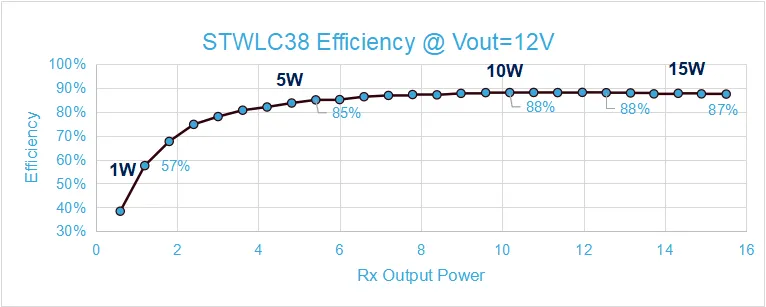
Within the 5 W to 15 W range, the STWLC38 demonstrates competitive efficiency among similar receivers, as shown in the reference efficiency curve.
User Experience and Features
User experience for wireless charging depends heavily on ease of alignment between transmitter and receiver. Misalignment can degrade charging performance and lead to failed charge sessions. ST implements a patented Adaptive Rectifier Configuration, or ARC, which allows charging to continue even with receiver-to-transmitter misalignment up to 50 percent. This reduces alignment sensitivity for devices such as smartwatches.
ST receiver ICs also support reverse wireless charging, enabling a device with an ST-based receiver to act as a transmitter to charge another device wirelessly, for example a smartwatch or another smartphone.
Testing and Compliance
Achieving full Qi certification can be time-consuming and costly. ST provides a pre-compliance test solution to help developers evaluate device-to-charger interactions and proceed toward Qi certification.