ALLPCB


Electromagnetic waves are fundamental to modern life, especially in the 5G era of IoT. Devices like smartphones, computers, iPads, and smartwatches are common sources of electromagnetic waves. However, electromagnetic waves are also a form of electromagnetic radiation. The term "radiation" often carries negative connotations, largely due to the well-known dangers of nuclear radiation.
Ionizing vs. Non-Ionizing Radiation
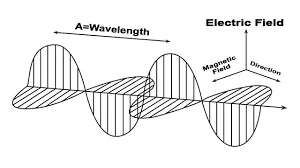
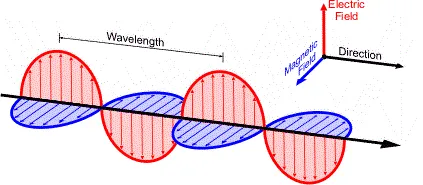
Electromagnetic radiation can be categorized into two types: ionizing and non-ionizing. The electromagnetic spectrum is broad, ranging from long-wave radio waves to gamma rays. This includes radio waves used for broadcasting and wireless communication, microwaves, infrared, visible light, ultraviolet light, X-rays, and gamma rays.
Non-ionizing radiation does not have enough energy to remove electrons from atoms or alter molecular structures. In contrast, ionizing radiation can strip electrons from atoms, changing molecular structures and directly damaging cells in organic matter. Examples of ionizing radiation include ultraviolet light, X-rays, and gamma rays. The most common forms of radiation in daily life, such as radio waves and visible light, are non-ionizing and pose a lower risk to human health, though their effects should not be disregarded.
Potential Health Effects of Mobile Phone Radiation
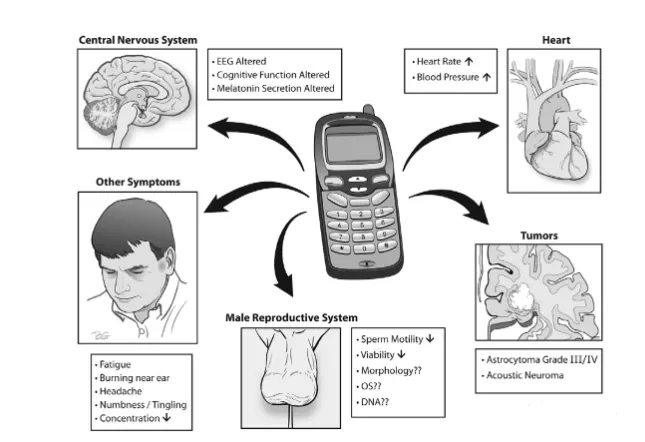
The paper "Cell phones: modern man's nemesis?" outlines several potential health risks associated with mobile phone radiation, as summarized below:
Cardiovascular System Effects
In a 1998 study, Braun et al. exposed human volunteers to 900 MHz RF electromagnetic waves (RF-EMW) for 35 minutes and reported an increase in blood pressure (both systolic and diastolic) of 5-10 mmHg. This was accompanied by a significant reduction in capillary perfusion due to vasoconstriction.
Impact on Sleep
A 2000 experiment by Huber et al. found that while there was no significant change in overall sleep quality, 30 minutes of exposure to 900 MHz electromagnetic radiation significantly increased the time it took to fall asleep, which could lead to insomnia over time.
Effects on Neurohormone Secretion
Increased Cancer Risk
The carcinogenic potential of mobile phone radiation is one of the most debated topics in research. Addressing public concern, Hardell et al. (2006) conducted an epidemiological questionnaire-based study and concluded that there was a positive correlation between mobile phone usage and the incidence of astrocytoma (Grades III-IV) and acoustic neuroma.
One case study involved a woman with multifocal breast cancer. This was unusual as she had no predisposition to the disease. Her doctors noted a pattern in the cancer's distribution that matched the outline of her mobile phone. The woman confirmed that she frequently kept her phone in her bra, leading them to connect the radiation exposure to the development of her cancer cells.
Impact on Male Fertility
Although the effects of mobile phone radiation on the male reproductive system are not yet definitively clarified in many reports, a 2009 study examined 150 men who regularly wore their phones on their belts. Scientists observed a decrease in pelvic bone mineral density on the side where the phone was carried.
Why a Weaker Signal Leads to Higher Radiation
Mobile phones achieve wireless communication by connecting to a base station, which then relays the signal to the intended recipient's phone. This process involves two main sources of electromagnetic radiation: the downlink signal from the base station to the phone, and the uplink signal from the phone to the base station. During a call, a user is exposed to radiation from both the base station and their own device.
Base station radiation is a common public concern, sometimes leading to requests for their removal in residential areas due to health worries.
Base Station Radiation
For a typical 5G base station, the average power per channel is about 5W. With 64 channels, the total power is 320W, or approximately 55 dBm. While this seems high, the path loss of electromagnetic waves increases with the square of the distance.
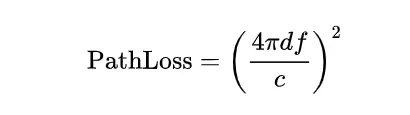
Where d is the distance, f is the frequency, and c is the speed of light. Path loss varies with both distance and frequency.
Using the free-space path loss formula, we can estimate the radiation from a 5G base station operating at 2.6 GHz. The following table shows an idealized power level based solely on path loss. Even at a distance of just 10 meters, the radiation reaching a person is only about 0.2 milliwatts.
In practice, the radiation from 5G base stations is even lower. According to China Telecom, 5G base station power and radiation levels are well within national safety limits. Measurements taken 10 meters from a 5G base station show radiation levels of approximately 1-1.5 μW/cm2.
Mobile Phone Radiation
In contrast, the radiation impact from a mobile phone is often greater due to its close proximity to the body. According to the latest 3GPP standards for 5G mobile phone transmission power on the Sub-6 GHz spectrum, Power Class 3 is 23 dBm and Power Class 2 is 26 dBm. For mainstream 5G bands (e.g., FDD n1, n3, n8; TDD n41, n77, n78), the power classes are as follows:
- 5G FDD (SA mode): Max transmit power is Class 3 (23 dBm).
- 5G TDD (SA mode): Max transmit power is Class 2 (26 dBm).
- 5G FDD + 5G TDD CA (SA mode): Max transmit power is Class 3 (23 dBm).
- 5G TDD + 5G TDD CA (SA mode): Max transmit power is Class 3 (23 dBm).
- 4G FDD + 5G TDD DC (NSA mode): Max transmit power is Class 3 (23 dBm).
- 4G TDD + 5G TDD DC (NSA mode): The max transmit power defined in R15 is Class 3 (23 dBm), while the R16 version can support Class 2 (26 dBm).
This means that the weaker the signal, the higher the power the phone must transmit to maintain communication with the base station. In poor signal areas, your phone may operate at its maximum power of 26 dBm (398 mW). This is significantly higher than the radiation received from a base station at a 10-meter distance.
According to tests by telecom providers, a phone in standby mode has a radiation value of about 17.1 μW/cm2, which increases to about 93.1 μW/cm2 during a call. The farther a phone is from a base station (and thus the weaker the signal), the greater its radiation output during a call.
Radiation Levels in Perspective
Even at maximum power, mobile phone radiation remains within safety limits. In China, mobile communication base station radiation standards are based on IEC standards. The permissible radiation limits in other countries are often higher:
- USA and Japan: 600 μW/cm2
- European Union: 450 μW/cm2
- China: 40 μW/cm2
In practice, base station radiation is far below China's standard, and even further below European and American standards. Furthermore, 5G networks use a denser grid of base stations, allowing each one to operate at lower power. As measured, radiation 10 meters from a 5G base station is about 1-1.5 μW/cm2. Base stations also use adaptive power control to reduce their transmit power for terminals that are closer.
The radiation level from a base station is often lower than that of many common household appliances. For example, a microwave oven at a distance of 1 meter can emit radiation of 268 μW/cm2. It is more important to be aware of the radiation sources in our immediate vicinity.