ALLPCB


To improve energy efficiency, grid management, and power quality, engineers have developed smart grids. The increasing complexity of smart grids includes the relatively recent concept of microgrids. When connecting microgrids to utility grids, the ability to control power flow using real-time data management to maintain supply standards becomes more important than ever.
Microgrids and Distributed Generation
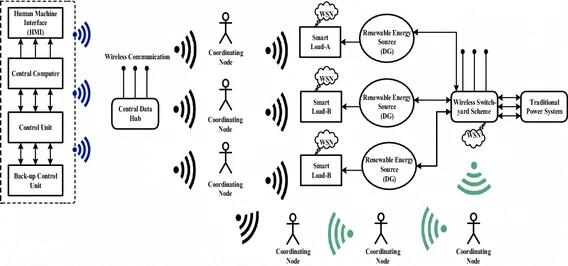
Microgrids are an important component of smart grid approaches. These small-scale power producers appear in forward-looking communities, campuses, military facilities, and other complexes. A microgrid can supply power to the utility grid or draw power from it. It can also disconnect from the main grid and operate autonomously.
Because localized power systems can be installed by a wide range of parties, ensuring quality standards and proper grid synchronization is critical. Real-time power management and telemetry are central to smart grids, and advanced algorithms and fast, reliable digital resources are necessary to balance and optimize the related systems. Microgrids continuously optimize for power efficiency and power quality in real time.
Optimizing Power: Grid-Tied Microinverters
One key building block for microgrids that combine solar PV is the microinverter mounted at the panel level. These inverters, typically rated under 500 W and tied to the grid, use microcontrollers to perform all control functions. One primary role of the MCU is to act as a maximum power point tracker (MPPT), executing algorithms to maximize PV power output. The MCU also handles DC-AC inversion using a phase-locked loop (PLL) for grid synchronization. Maintaining a low-distortion current injection to the grid while preserving maximum PV power efficiency can be challenging; including an inverter on each solar panel helps mitigate power losses caused by shading. Advances in fast digital technologies and lower component costs have made this architecture feasible.
Microcontroller vendors such as Texas Instruments provide design resources for engineers implementing microinverter designs. For example, TI's C2000 Piccolo microcontrollers are widely used in digital-control microinverter applications. To support prototyping, TI offers a 250 W grid-tied solar microinverter reference design that uses a C2000 Piccolo isolation control card. The controlCARD, based on the C2000 Piccolo F28035 MCU, provides GPIO, ADCs, and power control components in a 100-pin DIMM format. It targets prototyping and small-volume applications by providing the digital control elements on a single board; only the power-conversion components need to be added for a complete end design. The board also includes optoisolators for serial bus and JTAG ports, noise filters and ADC input clamp protection, and a stable voltage reference for ADC use. TI supplies associated design resources including BOMs, schematics, test data, and design files to accelerate inverter development.
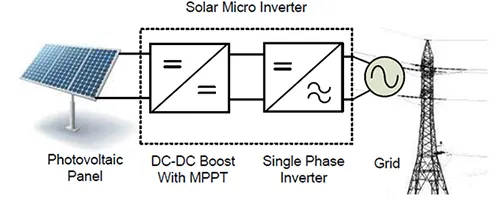
Figure 1: PV source connected to the AC grid.
DC-DC Stage and MPPT
Any digitally controlled grid-tied microinverter design has two core modules. The first module is a DC-DC flyback converter controlled by the MPPT software algorithm. To obtain optimal power from the PV panel, the converter must operate the panel at its maximum power point. The MPPT algorithm determines the panel output current to achieve maximum power transfer in real time. Because maximum power depends on temperature and irradiance, MPPT requires timely sensor data. The first-stage circuit also provides high-frequency isolation.
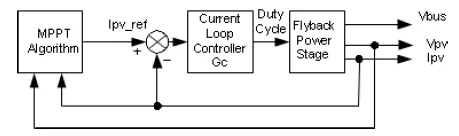
Figure 2: DC-DC converter control loop and MPPT.
DC-AC Inversion and Control
The second module is the single-phase DC-AC inverter. The enhanced peripherals and optimized core of C2000 microcontrollers make them suitable for control applications. The MCU ADC and PWM peripherals are designed to integrate multiple control loops and ensure sampled PWM waveforms.
Inverter control software uses three feedback signals: AC line voltage (VLN), DC bus voltage (Vbus), and main inductor current (IL). These feedback signals optimize the four PWM outputs that drive inverter output. The inverter maintains the DC bus at the required setpoint to inject a controlled sine wave into the grid, with grid synchronization achieved via a PLL. The schematic in Figure 3 shows how a Piccolo-based controlCARD interfaces with the converter, inverter, and main grid.
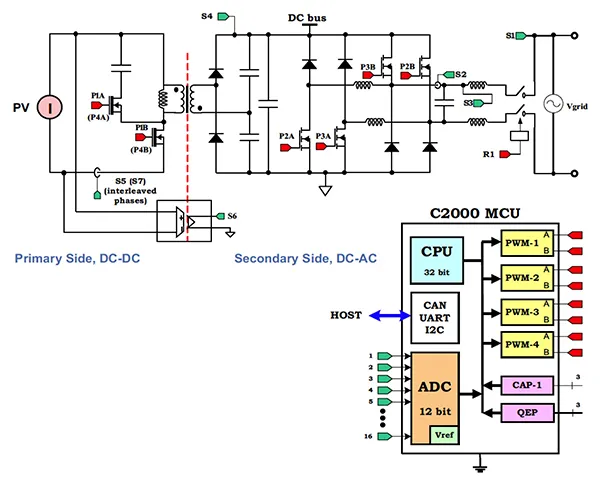
Figure 3: Functional schematic of the Piccolo controlCARD integrating the MCU, DC-DC converter, and DC-AC inverter.
Captured control signals can be analyzed for statistics and trend logging; this data supports the development of new control algorithms and prediction models to forecast grid behavior and mitigate issues. Compliance reporting and audit logs are useful for management and stakeholders. Cloud computing enables collection of large volumes of telemetry that would otherwise require extensive on-site storage.
Delivering Data to Users
Putting operational data into the hands of those who can act on it is an objective; modern mobile devices provide a convenient platform for data delivery and control. Mobile devices can serve as an alternative to custom HMIs, and adding cloud connectivity to designs is relatively straightforward. Wi-Fi and Bluetooth are common methods to achieve this, and in some cases a gateway may be required, especially when multiple energy components compose the microgrid solution.
Cloud Connectivity and Wireless Modules
Real-time data from microinverter control loops can be collected and forwarded to cloud applications. This not only helps visualize current load and supply parameters, but stored data can be analyzed over time to establish trends in generation capability and consumption characteristics. Packetizing data for forwarding to cloud applications can be implemented on a Piccolo MCU, requiring a wireless connection via a local gateway or Wi-Fi access point. There are two main approaches to integrating wireless: using pre-certified module solutions or a discrete implementation. One example module is TI's SimpleLink CC3200MOD Wi-Fi solution.
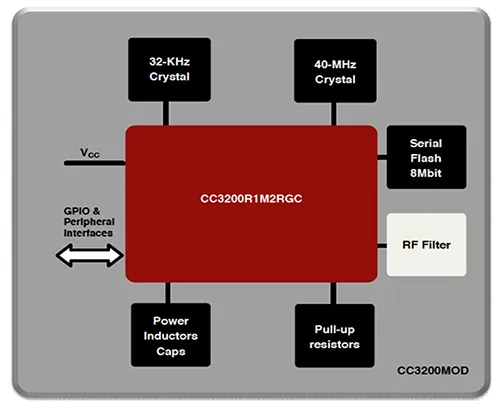
Figure 4: Functional block diagram of the TI SimpleLink CC3200 wireless SoC module.
The CC3200MOD SoC platform includes two separate ARM Cortex-M4 MCUs: an application MCU for user code and a network processor MCU for Wi-Fi and networking tasks. The application processor is a 32-bit ARM Cortex-M4 MCU optimized for embedded and IoT workloads. The device integrates standard peripherals including I2S, SD, UART, I2C, SPI, up to 27 GPIOs, a four-channel ADC, and a fast parallel camera interface.
The network MCU handles wireless, internet layers, and security functions. Security features include a 256-bit crypto engine for secure, rapid internet connectivity and measures to protect local firmware. The SimpleLink system supports rapid implementation, design support, and scalability. Physical separation of the network MCU provides an additional security boundary.
The power management subsystem includes a DC-DC converter supporting a wide input range. Low-power modes offer deep sleep (135 μA with 256 KB RAM retention), hibernate (4.5 μA), and shutdown (1 μA).
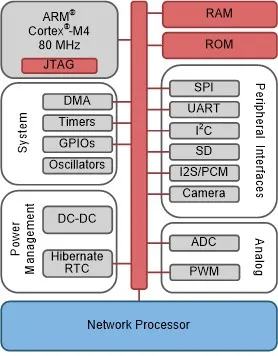
Figure 5: CC3200 hardware overview.
The network MCU supports station, access point, and Wi-Fi Direct connection modes. CC3220x Series SimpleLink devices also include embedded IPv6/IPv4 TCP/IP and TLS/SSL stacks, an HTTP server, and other internet protocol support. These devices support many Wi-Fi provisioning methods, increasing system flexibility.
The CC3200 LaunchPad development board aids Wi-Fi prototyping. The board supports the CC3200 Wi-Fi SoC module and helps expose module I/O for integration with a C2000 microinverter MCU.
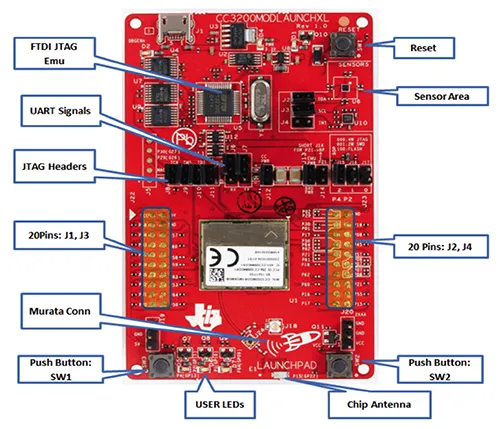
Figure 6: TI CC3200 LaunchPad development board.
Development resources, technical documentation, and application examples are available for the CC3200 LaunchPad environment.
Conclusion
Combining C2000 MCUs and CC3220x wireless SoC MCUs enables integrated microinverter and connectivity solutions for next-generation smart grid systems. These MCUs together provide a comprehensive IoT-capable platform with software, tools, sample applications, reference designs, and online documentation.
C2000 MCUs are suitable for grid optimization tasks. These 32-bit high-performance processors are well suited for real-time control applications requiring fast, precise sensing and closed-loop control. The CC3200 SimpleLink wireless solution establishes the link between cloud services and sensor networks, providing secure, reliable data transfer between users and critical sensors. With such components, connecting microgrids to smart grid management chains and human interfaces becomes a practical engineering task.