ALLPCB


Overview
As the share of renewable energy increases, the smart grid must address the variability and uncertainty of different energy sources.
Renewable Energy Context
Renewable energy (RE), including hydro, biomass, geothermal, photovoltaic and wind, faces criticism. Some deny anthropogenic climate change and oppose phasing out fossil-fuel power plants. Others accept warming but argue that only nuclear power can avert long-term harm. A separate argument claims that manufacturing and maintaining solar panels and wind turbines could produce more carbon than they save, so carbon capture for conventional plants would be preferable.
Many developed countries continue to expand renewable generation. For example, 36 U.S. states have renewable portfolio standards that aimed for 20% renewable generation by 2020. Germany set a target of about 35% renewable generation by 2020. In 2014, China’s share of electricity from renewable sources was 23%.
Variability and Uncertainty
Two notable drawbacks of renewable generation are variability (generation changes with wind and sunlight) and uncertainty (timing and magnitude are hard to predict). This makes it difficult to guarantee resource availability during peak demand. For example, a wind farm might generate power 40% of the time, but predicting when it will produce is hard. As the renewable share of total generation grows, this challenge becomes more severe.
Reliability Metrics
Supply-side variability and uncertainty complicate management and use because they reduce reliability, which can cause significant economic losses. The power sector measures reliability with two metrics:
- System Average Interruption Duration Index (SAIDI): the average duration of interruptions per customer per year.
- System Average Interruption Frequency Index (SAIFI): the average number of interruptions per customer per year.
In 2007, when renewables represented a smaller share, U.S. average SAIDI and SAIFI were about 240 and 1.5 respectively (based on aggregated utility data), meaning supply was available about 99.964% of the time. Germany showed slightly better availability, about 99.996% of the time.
Conventional Design and Balancing
To maintain high reliability, traditional power systems are designed around historical and forecasted demand. Large central plants supply baseload demand and operate continuously, typically using coal or uranium fission to deliver large amounts of stable, low-cost power. Intermediate-load plants often use reciprocating or combined-cycle gas turbines and are most efficient when running continuously. Peaking plants—often gas or oil-fired—can ramp quickly to meet demand peaks but operate less efficiently.
To preserve reliability while increasing renewable penetration, many systems maintain conventional backup capacity. For example, some U.S. wind projects have increased conventional generation reserves to about 9% of capacity, roughly 15% relative to wind output. Although this raises costs and emissions, it prevents shortages when wind or solar underperform.
Distributed Generation and the Smart Grid
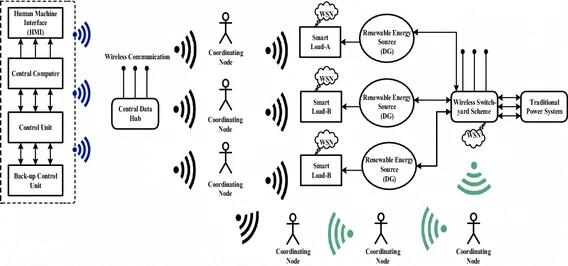
The smart grid is a modernized network that supports bidirectional energy flows and uses communications and control mechanisms. Distributed generation—combining many smaller sources such as rooftop photovoltaic panels, local wind farms, tidal, and small hydro—can mitigate variability and uncertainty without simply adding more central plants.
Distributed generation is often located closer to load centers than traditional remote central plants, reducing transmission distances, losses, and costs for both generators and consumers.
Fast communications can also provide operators with timely alerts and enable automated switching between sources. For example, cloud-based control can orchestrate a smooth transition from photovoltaic to hydro generation and back when sunlight returns, using power electronics to direct flows.
Deployment Considerations
Building a national or regional smart grid requires substantial time, engineering work, security measures, and investment. However, delaying deployment risks foregoing the benefits of cleaner generation and complicating future integration as renewable shares grow. Studies indicate that integrating up to about 35% of wind and solar into the grid can substantially reduce carbon emissions without major additional infrastructure by leveraging geographic diversity. Once renewable penetration approaches 50%, smart grid capabilities become essential to maintain reliability.