ALLPCB


Concept of the smart grid
The smart grid is a next-generation power system based on advanced information technology, sensing technology, and automation control. It integrates renewable, distributed, and low-emission energy sources and enables efficient scheduling and optimized management of energy. The smart grid acquires and analyzes internal and external information through a set of hardware and software devices and data interfaces to optimize, adjust, and control energy distribution and consumption, improving system reliability and decision accuracy.
Key characteristics
- Multi-energy complementarity: The smart grid is a multi-energy system that ensures efficient power supply from diverse sources, including wind, solar, and tidal energy.
- Multi-network connectivity: The system supports multiple interconnected networks to form a unified flow of electric power and enable optimal load allocation, including cross-regional connections to further optimize energy analysis and control.
- Dynamic balance: With energy storage and scheduling capabilities, the smart grid monitors and manages various energy sources like a large integrated system and can balance loads across the network to improve operational efficiency.
- High reliability: The smart grid applies statistical analysis, modeling, and prediction across generation, transmission, and consumption stages, and can autonomously adjust control based on demand to ensure steady supply and high system reliability.
How the smart grid works
The smart grid relies on information technology, sensors, communications, and control technologies. Its core objective is to make the grid intelligent, efficient, and reliable. Main functional elements include:
- Monitoring and diagnosis: Sensors provide real-time monitoring across the system, detecting and diagnosing anomalies to enable rapid fault detection and protection.
- High-speed communications: Secure and reliable communication systems enable information exchange among grid components, allowing fast transmission of data, commands, and status information.
- Data management and analytics: Data acquisition and management systems collect and analyze grid data in real time, using big data techniques for intelligent analytics and mining.
- Control and optimization: Intelligent control systems apply algorithms and strategies to optimize the operation of devices and resource use for precise control.
- Collective coordination: Coordinated use of distributed and renewable generation improves direct integration of renewables into the grid.
- Intelligent dispatch and management: Dispatch systems enable automated management and adjustment of operational indicators to improve energy utilization and operational quality.
Smart grid architecture
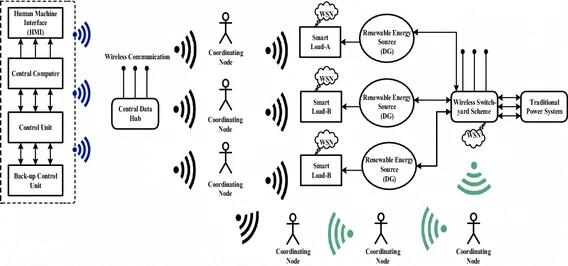
The smart grid is composed of sensors, communications, computing, controllers, and related technologies. Principal components include:
- Sensors: Devices that collect data such as voltage, current, power, frequency, and temperature signals across the grid.
- Communication systems: Media and technologies for data transmission and sharing, including fiber optics, SMS, LTE, Ethernet, and other communication methods.
- Data storage and management: Systems for effective storage and management of collected grid data.
- Big data analytics platform: Platforms for processing and analyzing data to extract useful information for condition diagnostics and monitoring.
- Intelligent controllers: Controllers that use algorithms and control strategies to monitor and optimize grid operation in real time.
- Energy storage technologies: Devices such as batteries and supercapacitors to make effective use of intermittent renewable supplies.
- Energy management platform: Integrated software and algorithms for efficient and fine-grained energy management, including optimized allocation, reduced consumption, load balancing, and peak-shaving.
Together these components implement a complete operational chain from data acquisition, transmission, storage, and processing to real-time control, enabling efficient, reliable, safe, and clean grid operation.
Advantages and disadvantages
Advantages
- Energy diversification: Optimized supply and distribution allow combined use of traditional and renewable sources, improving utilization efficiency and flexibility.
- Improved stability: Real-time monitoring and dispatch enable rapid response to anomalies, enhancing system stability.
- Higher supply efficiency: Load balancing and coordinated sources improve market operation, increase supply efficiency, and reduce energy losses.
- Environmental benefits: Effective integration of renewables reduces reliance on conventional fuels and lowers pollution and resource waste.
Disadvantages
- High technical cost: Building and operating a smart grid require significant investment, especially for cloud computing, big data, and Internet of Things applications.
- Security risks: Data exchange and sharing via cloud and IoT raise privacy and data leakage concerns.
- Higher equipment requirements: Operation demands higher stability and reliability from grid equipment, increasing technical and maintenance challenges.
- Complex operations: Managing diverse technologies, large-scale data, monitoring, and dispatch requires specialized personnel and raises operational costs.
Applications in power systems
The smart grid has been widely applied in power systems due to its efficiency, reliability, flexibility, and sustainability. Key application areas include:
- Enhancing system stability: Real-time monitoring of equipment status enables fast detection and handling of faults, reducing outage time and scope and ensuring continuous, reliable supply.
- Optimizing energy mix: Integration of thermal, hydro, nuclear, and renewable generation allows coordinated dispatch and multi-energy complementarity to improve energy efficiency and reduce pollution.
- Faster response: The grid can adjust supply and distribution according to system conditions and use storage systems for peak shaving and valley filling, improving responsiveness and flexibility.
- Improving power quality and reducing losses: Intelligent control strategies optimize load and voltage balance, lowering line losses and power quality issues to improve economic performance and sustainability.
- Strengthening safety: Online monitoring and intelligent diagnostics enable continuous assessment of equipment status and protective actions, such as automatic isolation, to prevent equipment damage.
In summary, smart grid applications can significantly improve stability, responsiveness, and power quality, and they have important implications for sustainability and environmental protection.