ALLPCB


Overview
Data concentrators are a key communication element in smart grid architectures, providing automation, metering, and information system functions. Typically located at transformer or substation levels in the distribution network, data concentrators ensure data integrity and security when relaying energy measurement data from smart meters and usage-analysis information from utilities. These systems commonly use complex MCU-based designs that rely on last-mile power-line communication (PLC) to customer meters and energy management systems. To meet broad device requirements, engineers can use available AFE ICs and MCUs from suppliers such as Freescale Semiconductor, Maxim Integrated, STMicroelectronics, and Texas Instruments to build PLC-based data concentrators.
Role in AMI and AMR
Data concentrators act as the interface between utility control and the distribution network for smart grid deployments, managing data exchange between a utility and multiple smart meters within a geographic area (Figure 1). In automatic meter infrastructure (AMI) and automatic meter reading (AMR) systems, data concentrators, also called data collectors, provide core functions required to measure, analyze, and collect energy usage. They forward that data to central databases for billing, troubleshooting, and analysis.
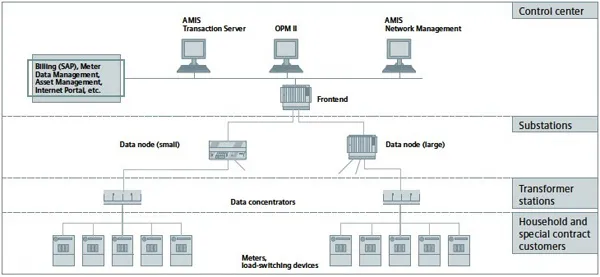
Figure 1: AMI and information systems include multi-tier data management and communications, starting with hardware data concentrators that provide data collection, processing, and security between utilities and end-user energy systems, including smart meters. (Provided by Siemens.)
Benefits to Utilities and Consumers
By enabling utilities to access information from smart meters, data concentrators help improve visibility into grid conditions, including immediate awareness of outages. With detailed distribution network data, utilities can assess overloads and imbalances, detect faults more effectively, and evaluate static losses by comparing higher-level grid power measurements with downstream smart meter measurements. The combination of granular smart meter power measurements with upstream monitoring and analysis supports better consumption insights for customers and provides information about network disturbances.
Functional Role and Security
By aggregating data from multiple smart meters and customer networks, data concentrators simplify smart meter designs, allowing meters to focus on core energy measurement tasks. Concentrators provide the communication and network functions required to connect many utility meters to the utility central servers. They synchronize measurements across multiple meters and ensure secure data transmission through authentication and encryption. As a result, a data concentrator is a complex system combining substantial processing capability with a wide range of flexible communication options to serve diverse end systems and operating environments (Figure 2).
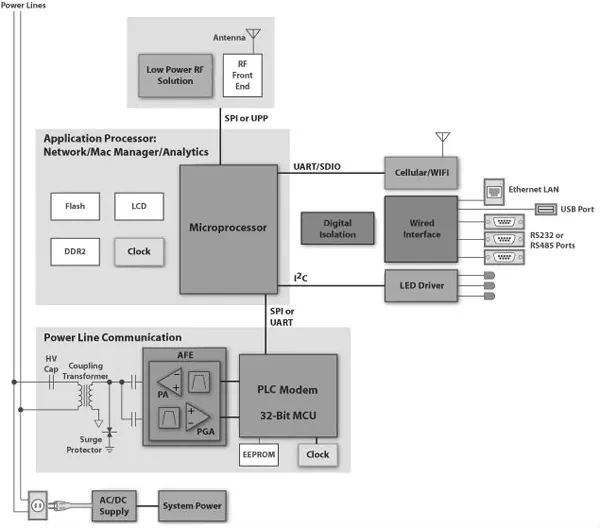
Figure 2: Typical data concentrator designs need to support power-line communication and wireless communication, plus varying levels of display support. (Provided by Texas Instruments.)
Communication Options
Data concentrators typically support both wired and wireless communication options for customer-side and utility-side interfaces. On the customer side, wired communications often include PLC, Ethernet, or even serial links, depending on specific operational requirements and constraints. Wireless communications commonly use sub-GHz, 2.4 GHz, or low-power cellular networks. On the utility side, concentrators must flexibly connect to utility servers via various methods, requiring support for a wide range of options including Ethernet, GSM, GPRS, RS interfaces, WiMAX, or telecom networks.
MCU-Based Designs
At the core of these systems, application processors act as host controllers that provide data analysis and communications. Silicon vendors offer a wide range of MCU options to support concentrator designs. For example, Texas Instruments provides families such as AM18xx, AM335x, TMS320C674x, and OMAP-L1x application processors.
TI Sitara AM18xx microprocessors, based on the ARM926EJ-S 32-bit RISC core, address low-power applications and include various on-chip peripherals such as Ethernet MAC, MDIO, UART, USB, I2C, and SPI. These devices combine ARM-core-related memory with 128 KB on-chip RAM, enhanced DMA controllers, and external memory interfaces like DDR2 and EMIFA.
TI Sitara AM335x processors, based on the ARM Cortex-A8 core, include SIMD processing coprocessors and combine the core with an on-chip graphics acceleration engine and controllers for LCD and touch-screen devices. This platform suits concentrator designs that require advanced data and graphics processing and display capabilities. In addition to multiple on-chip connectivity options, these devices offer hardware crypto accelerators to support higher security requirements in concentrator designs.
For designs with demanding data and signal processing requirements, the TI TMS320C674x family is a DSP supporting fixed- and floating-point processing. The VLIW DSP core has 64 32-bit registers, six ALUs, and two multiply units. In addition to the connectivity features described earlier, the TMS320C674x series provides secure boot functionality to protect code and prevent third-party modification of security algorithms.
For the most demanding processing needs, TI OMAP-L1x combines an ARM926EJ-S core with a TI C674x DSP core. In addition to the dual-core configuration, the OMAP-L1x family integrates many on-chip peripherals supported by the AM18xx and TMS320C674x families. Like the TMS320C674x, OMAP-L1x offers secure boot to protect code stored in Flash or EEPROM.
ARM926EJ-S cores also power MCU-based concentrator solutions from STMicroelectronics and Freescale Semiconductor. STMicroelectronics SPEAr300, SPEAr310, and SPEAr320 MCUs combine ARM cores with memory interfaces and connectivity options. Integrated crypto coprocessors can run autonomously from the main processor to perform AES, DES, SHA-1, and other encryption algorithms.
Freescale addresses concentrator designs with the i.MX28 MCU series based on ARM926EJ-S, and the MPC8308 MCU based on PowerQUICC II Pro processors. In addition to general-purpose host MCUs, Freescale offers the dual-core P1025 communications processor. The P1025 is a QorIQ device based on Power Architecture technology that provides a dual-core solution allowing application and communications tasks to coexist. Besides supporting full-featured operating systems, the P1025 provides hypervisor support for advanced concentrator applications (Figure 3).
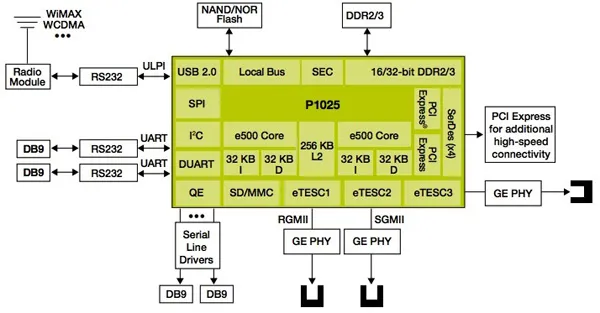
Figure 3: The Freescale P1025 dual-core communications processor combines dual e500 cores with a comprehensive set of on-chip interfaces, enabling high-performance data concentrator designs. (Provided by Freescale Semiconductor.)
Power-Line Communication
Downstream communications to smart meters and customer energy management systems can use wired or wireless links. Wired communication often relies on PLC, although the characteristics of those communications can vary greatly.
PLC transmits data about power usage over the same medium used for power delivery, offering a convenient data transport method. However, power lines are a noisy environment, with much of the noise energy concentrated in short, time-domain bursts that coincide with mains AC zero-crossing intervals. Although noise distributions vary significantly site to site, energy generally decreases at higher frequencies (Figure 4).
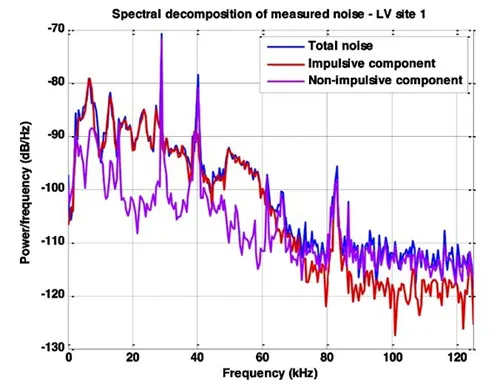
Figure 4: In addition to non-impulsive noise from various sources, power-line signals face impulse noise correlated with mains AC zero crossings. (Provided by Texas Instruments.)
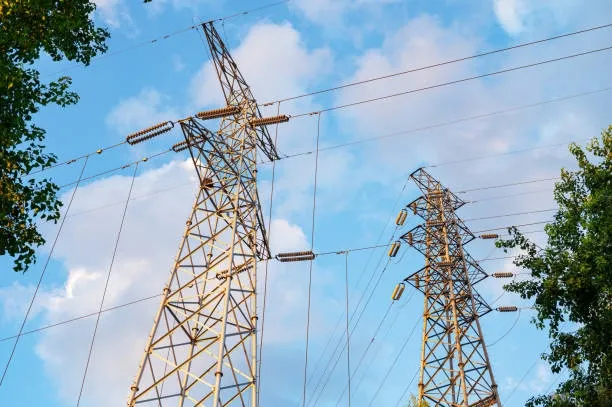
Distribution network topologies complicate customer-side communications. For example, in countries such as the United States and Japan, individual distribution transformers may serve a small number of houses, particularly in low-density rural areas. To minimize costs in these cases, concentrators are often best placed on the medium-voltage (MV) side, which requires signals to cross each distribution transformer to establish communication between low-voltage (LV) meters and the concentrator.
Noise on the MV side generally follows many characteristics of LV-side noise, but signals transmitted from MV to LV can experience significant frequency-selective attenuation that varies by site. Therefore, effective methods for MV-LV transformer crossing should support communication across the 30 to 450 kHz band.
G3-PLC is a global PLC standard designed to support communication across the MV-LV boundary. It operates across 10 to 490 kHz and enables remote communications across MV-LV transformers, reducing the number of concentrators required in a geographic area.
The G3-PLC standard specifies ways to handle overall and frequency-dependent attenuation when traversing MV-LV transformers. Transmitters adapt their overall signal level and power spectral density, while receivers implement analog and digital automatic gain control (AGC) to provide sufficient gain to compensate for overall attenuation. In severely attenuated environments, G3-PLC systems can operate as LV-side repeaters: they decode received frames from the MV side and retransmit them on the LV side at higher signal levels to overcome transformer-induced attenuation.
G3-PLC uses an 802.15.4-based MAC layer and AES-128 security to enable interoperability without compromising security. It can coexist with techniques such as S-FSK and BPL, and supports operation in noisy environments down to about -1 dB SNR.
PLC Solutions
Engineers can build PLC solutions using analog components from TI, including OPA365 CMOS power amplifiers, PGA112 programmable-gain amplifiers, and C28x Delfino or Piccolo MCUs from the TI C2000 32-bit MCU family (Figure 2).
TI integrates the full analog signal chain required for G3-PLC in the AFE031 IC. The AFE031 is a PLC AFE that includes an integrated receiver capable of detecting signals as low as 20 μVrms and offers programmable gain control to adapt to changing input signal conditions caused by power-line noise. The device power amplifier runs from a 7 to 24 V single supply, while the analog and digital signal circuitry operates from a 3.3 V supply. Paired with a TI C2000 MCU, the AFE031 requires minimal external circuitry to implement a complete PLC system solution (Figure 5).
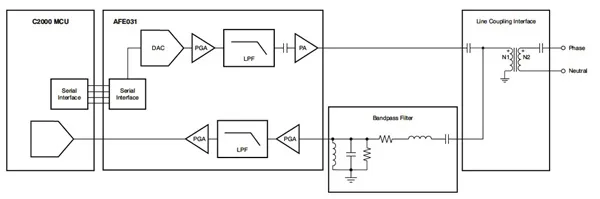
Figure 5: The TI AFE031 AFE, designed for PLC applications, integrates the full analog signal chain for PLC Tx and Rx functions and communicates with a host TI C2000 MCU via a serial interface. (Provided by Texas Instruments.)
Maxim Integrated, an original contributor to the PLC-G3 specification, offers a PLC solution with two chips: the MAX2991 AFE and the MAX2990 baseband modem. The MAX2991 AFE transceiver IC integrates a dedicated PLC analog signal chain and provides transmit and receive paths.
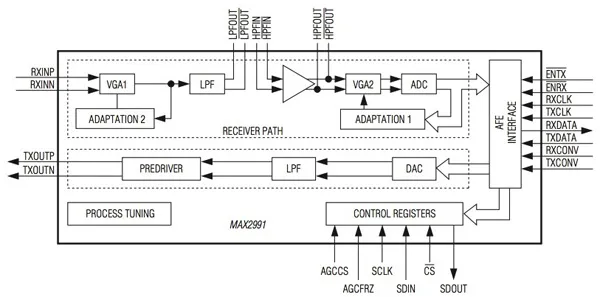
Figure 6: In the Maxim Integrated MAX2991 AFE transceiver, the transmit path injects an OFDM-modulated signal onto the power line while the receive path provides signal conditioning, filtering, and digitization of the received signal. (Provided by Maxim Integrated.)
The MAX2991 AFE IC, designed for OFDM signals over power lines, operates across 10 to 490 kHz and includes programmable filters so engineers can ensure compliance with CENELEC, FCC, and ARIB standards using the same device. The MAX2990 PLC modem IC, used with the MAX2991 AFE, provides a complete PLC solution. The MAX2990 combines Maxim's MAXQ 16-bit RISC core with PHY functionality and serial interfaces including SPI, I2C, and UART. In addition to jammer cancellation features, the device includes a DES encryption/decryption security engine.