ALLPCB


Bluetooth Low Energy (BLE), also called Bluetooth Smart, provides efficient connectivity for wearables, Internet of Things devices, and other smart products. Designers face tight power budgets as they balance always-on connectivity with long operating times. Understanding BLE peak power behavior allows engineers to select dedicated ICs and plug-in modules from suppliers such as Dialog Semiconductor, Laird Embedded Wireless Solutions, Murata Electronics, Panasonic, and Texas Instruments to meet strict power and connectivity requirements.
Power-Constrained Designs and Duty-Cycled Operation
The rapid adoption of wearables and IoT devices has increased interest in low-power design techniques, including energy harvesting, to extend battery life or eliminate batteries. Consumer demand for simple wireless connectivity forces designers to balance the available power source against application power needs, especially for wireless communication.
In wireless systems, power consumption depends on many factors. When budgeting power, engineers must account not only for familiar current requirements during receive, transmit, and idle states, but also for power demands imposed by the communication protocol itself. Simple protocols that enable fast initialization, quick transmission of short bursts of data, and rapid return to sleep typically yield lower overall energy consumption than protocols that provide more features but require longer and more power-hungry exchanges.
Interoperability and BLE
Some applications use custom protocols to meet specified range and data rate targets within a fixed power budget, trading flexibility for reduced overhead. However, many emerging wearable and IoT categories require standard-based communication to interoperate with an installed base of hosts such as smartphones, tablets, and other mobile devices. For this reason, Bluetooth has become a common option, and BLE is widely used to connect personal devices to these hosts.
Small Payloads
BLE is optimized to deliver small payloads quickly and efficiently, minimizing power consumption and latency while maximizing range to host devices. Although BLE can reach data rates of around 260 kbps, higher rates increase power consumption and may exceed the budgets of many wearables or IoT devices. Applications requiring higher throughput are typically served by other Bluetooth options such as BR/EDR.
Wearables, IoT devices, and most sensor applications spend the majority of their time in sleep or idle states, waking on external events or on timers to process data. Thus, static power consumption is critical, and fast wake-up capability is important for efficient energy use. Power-constrained designs may not tolerate lengthy initialization phases or extended handshake protocols that consume energy before a session is established.
One BLE low-power strategy is to keep the radio off whenever possible. When communication is needed, BLE uses simple procedures to minimize radio on-time. BLE devices can establish a connection, complete a transaction, and return to sleep in as little as 3 ms. By contrast, classic Bluetooth may take up to 100 ms to complete a link-level connection.
Understanding BLE Peak Power
In any low-power design, wireless communication can determine peak power requirements, while energy-harvesting systems must handle energy conversion, power management, and energy storage. Different phases of a communication transaction require different but largely predictable processing times and power levels. A typical design based on the Texas Instruments CC2541 demonstrates distinct peak-power phases associated with wake-up, RX, TX, and processing during a single connection sequence (see Figure 1).
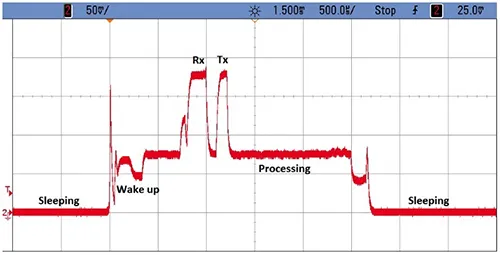
Figure 1: A BLE device such as the Texas Instruments CC2541 shows multiple peak current demands while receiving and transmitting packets during a single connection sequence. (courtesy of Texas Instruments)
In the example shown, the wake-up phase consumes about 6.0 mA and lasts roughly 400 microseconds. The initial spike visible in the figure is caused by charging capacitors in the CC2541 internal regulator when it wakes; this spike is typically eliminated by an external capacitor on the supply. After wake-up, the device experiences a short processing plateau (7.4 mA, 340 microseconds), followed by a communication initialization phase as the device prepares its RX and TX circuits. That phase produces a short peak (11.0 mA, 80 microseconds) before the full RX phase (17.5 mA, 190 microseconds), during which the device listens for a packet from the host. After RX, the device briefly returns to the base power plateau (7.4 mA, 105 microseconds) and then reaches the TX peak again (17.5 mA, 115 microseconds) when it transmits a packet to the host. After TX, the device returns to the base plateau to perform processing that depends on the application and payload size. In the illustrated case, the processing stage lasts 1280 microseconds at 7.4 mA. Finally, the device transitions back to sleep (4.1 mA, 160 microseconds) before fully entering the sleep state.
The exact BLE power profile depends on the application and the BLE device. Total processing time for each connection event can vary between events, but the time and power required for receiving and transmitting data are relatively stable. By understanding these characteristic BLE power curves, engineers can better optimize power budgets in constrained designs, especially energy-harvesting systems. Predicting peak demands also lets designers size energy storage elements, such as supercapacitors or rechargeable batteries used to supply short-term peaks in harvested-energy designs.
Reducing Power Consumption
Engineers can select BLE implementations with lower peak currents than the example in Figure 1. For example, the Texas Instruments CC2640 achieves RX at 5.9 mA and TX at 6.1 mA (0 dBm). As part of the TI SimpleLink wireless family, the CC2640 combines an ARM Cortex-M3 32-bit main processor with an ARM Cortex-M0 dedicated to radio operations. In addition to a range of digital peripherals, the device includes a sensor controller with ADC, comparators, and other analog peripherals that can autonomously collect analog and digital data while the rest of the system remains in sleep (see Figure 2). Other SimpleLink devices such as the TI CC2650 combine BLE with other connectivity options like ZigBee or 6LoWPAN.
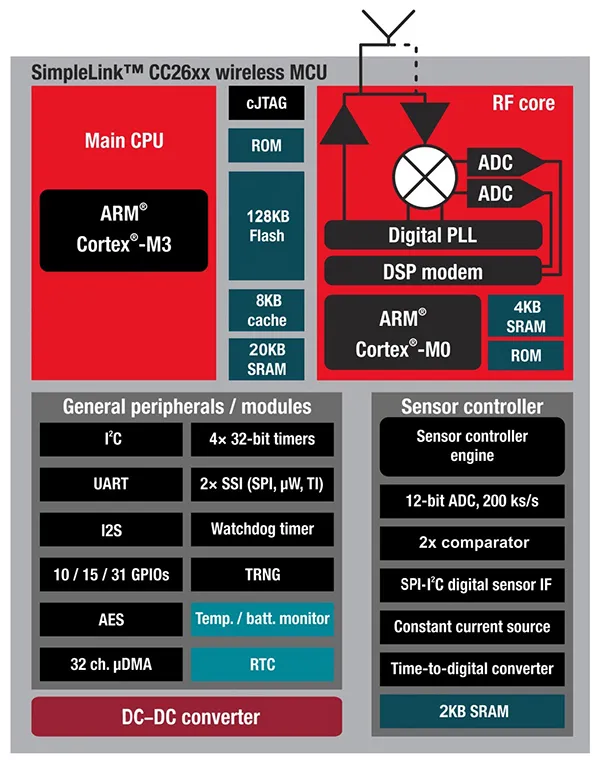
Figure 2: For its CC2640 BLE device, Texas Instruments combines multiple ARM cores with a broad set of digital and analog peripherals to enable autonomous data collection for wearables and IoT applications. (courtesy of Texas Instruments)
Dialog Semiconductor's DA14580 combines an ARM Cortex-M0 core, BLE radio, and digital peripherals, achieving RX and TX currents of just 4.9 mA (0 dBm). The device draws only 600 nA in sleep and can operate at supply voltages down to 0.9 V. The integrated transceiver implements the RF portion of the BLE protocol and, with Bluetooth 4.0 PHY, provides a link budget suitable for many BLE applications.
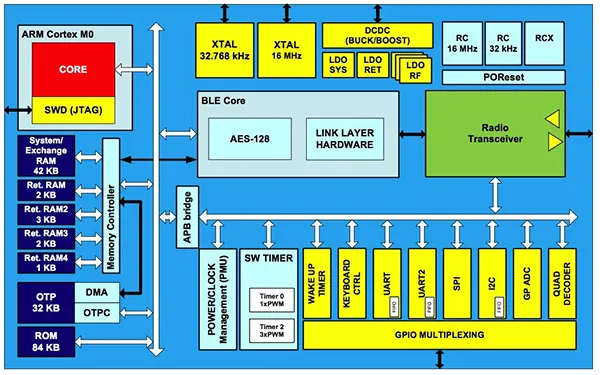
Figure 3: Dialog Semiconductor DA14580 operates down to 0.9 V and draws 600 nA in sleep. (courtesy of Dialog Semiconductor)
In addition to dedicated BLE ICs like the TI CC2640 and Dialog DA14580, designers can choose module solutions that integrate filters, crystals, antennas, and other discrete components to provide a complete BLE connectivity solution. Examples include Laird's SaBLE-x module built around the TI CC2640, and Murata and Panasonic modules that integrate the Dialog DA14580 with required supporting components.
Conclusion
For wearable and IoT designs, Bluetooth Low Energy offers an attractive wireless option combining widespread interoperability with low-power behavior suitable for battery and energy-harvesting systems. By understanding BLE communication power requirements in detail, engineers can address peak power demands in constrained designs. A range of dedicated ICs and plug-in modules enable designers to add BLE connectivity to low-power applications with predictable peak-power characteristics.