ALLPCB


Introduction
Choosing the most suitable accelerometer for an application can be difficult because datasheets from different manufacturers vary widely, making it hard to identify the most important technical specifications. This article focuses on key specifications and features from the perspectives of wearable devices, condition-based monitoring (CBM), and Internet of Things (IoT) applications.
Wearable Devices
Key metrics: ultra-low po wer, small size, integrated features that enhance power efficiency, and usability.
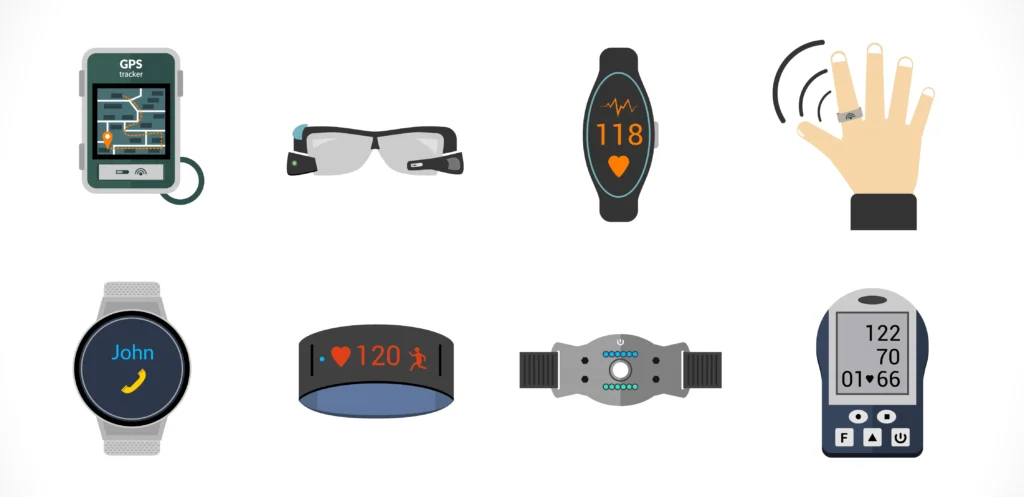
For battery-powered wearable applications, the primary accelerometer requirement is ultra-low power consumption, typically at the microamp (uA) level, to maximize battery life. Other important factors are package size and integrated features such as spare ADC channels and deep FIFO buffers that improve power management and functionality at the system level. Because of these requirements, MEMS accelerometers are commonly used in wearables.
Wearable accelerometers typically support motion classification; free-fall detection; motion presence detection to determine whether to power on, shut down, or sleep the system; and data fusion to support ECG and other vital-sign-monitoring measurements. The same accelerometers are also used in wireless sensor networks and IoT applications because of their ultra-low power characteristics.
When selecting an accelerometer for ultra-low-power applications, observe sensor behavior at the specified datasheet power levels. A key consideration is whether bandwidth and sample rate drop to a level that prevents valid acceleration measurement. Some products reduce average power by duty-cycling the sensor on and off, but this can miss critical acceleration data because the effective sampling rate is reduced. Measuring real human motion reliably requires higher continuous sampling rates and correspondingly higher power.
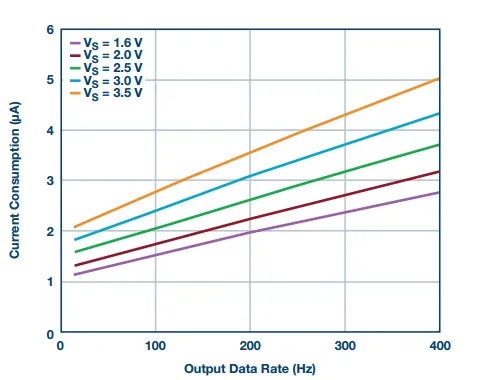
Some devices sample at the full data rate across the sensor bandwidth to avoid aliasing of input signals. Power can scale dynamically with sample rate. Devices exist that can sample up to 400 Hz while consuming only a few microamps in low-power modes, and they can reduce sample rates to a few hertz for wake-on-motion operation with sub-microamp average current. These characteristics also make certain devices suitable for implantable applications where battery replacement is difficult.
Condition Monitoring (CBM)
Key metrics: low noise, wide bandwidth, signal processing capabilities, g-range, and low power.
CBM monitors parameters such as machine vibration to detect and indicate potential faults. CBM is an important part of preventive maintenance for turbines, fans, pumps, motors, and other mechanical systems. For CBM accelerometers, low noise and wide bandwidth are critical. At the time of writing, relatively few MEMS accelerometers offer bandwidths above 3.3 kHz; some specialized manufacturers can provide up to 7 kHz.
With the growth of industrial IoT, there is increasing emphasis on reducing wiring and using wireless, ultra-low-power technologies. MEMS accelerometers often lead piezoelectric accelerometers in size, weight, power, and potential for integrated intelligence. The most common sensor in traditional CBM remains the piezoelectric accelerometer because of its linearity, signal-to-noise ratio, high-temperature performance, and wide bandwidth (typical range 3 Hz to 30 kHz, sometimes higher). However, piezoelectric sensors perform poorly at DC and low frequencies, which can miss faults in low-RPM applications such as wind turbines.
Capacitive MEMS accelerometers offer higher integration and richer functionality, including self-test, peak acceleration detection, spectral alarms, FFT, data storage, shock tolerance up to 10,000 g, DC response capability, and smaller size and weight. Specific MEMS devices have very low noise and excellent temperature stability, making them suitable for CBM, though bandwidth limitations can restrict deeper diagnostic analysis. Even with limited bandwidth, MEMS accelerometers can provide important measurements, for example in low-speed rotating equipment where response down to DC is required.
Some single-axis MEMS accelerometers optimized for industrial CBM provide bandwidths up to 50 kHz and g-ranges to ±100 g, with low noise performance that can approach that of piezoelectric sensors. These devices often include integrated overrange detection circuits that flag severe overrange events, which is important when designing smart measurement and monitoring systems. Internal clock-based protection mechanisms can disable sensing under sustained overrange conditions, reducing host processor load and increasing node intelligence—both important for CBM and industrial IoT solutions.
Advances in MEMS capacitive accelerometer performance have enabled these devices to compete in areas previously dominated by piezoelectric sensors. New CBM solutions are increasingly integrated with IoT architectures to provide improved detection, connectivity, storage, and analysis at the edge. More comprehensive CBM subsystems also exist that integrate wideband vibration analysis, programmability for multiple alarm bands, multi-level alarm and fault definitions, adjustable response delays to reduce false positives, and internal self-test flags. Frequency-domain processing options in some integrated subsystems include per-axis 512-point real FFT and FFT averaging to reduce baseline noise variation and improve resolution. Fully integrated vibration analysis systems can shorten design time, reduce system cost and processor requirements, and simplify packaging constraints for CBM applications.
IoT and Wireless Sensor Networks
Key metrics: power consumption, integrated features supporting intelligent power and measurement management, small size, deep FIFO, and appropriate bandwidth.
Mass deployment of IoT requires millions of sensors, many installed in hard-to-reach or space-constrained locations such as rooftops, streetlight poles, masts, bridges, or inside heavy machinery. These constraints mean many sensors will be battery-powered, wireless, and may require some form of energy harvesting.
To reduce bandwidth and cost, IoT trends favor local, edge-level processing to separate useful data from noise before transmission to cloud or local servers. This requires sensors with on-node intelligence while maintaining ultra-low power consumption. Standard IoT data chains include sensing, local processing, storage, and communication. Not all solutions require wireless connectivity; wired interfaces such as RS-485, 4–20 mA loops, or industrial Ethernet remain necessary for many applications.
With on-node intelligence, only useful events are transmitted, saving energy and bandwidth. The amount of processing at the sensor node depends on factors such as machine cost and complexity and the CBM system budget. Transmitted data can range from simple overrange alarms to continuous data streams. Standards like ISO 10816 define alarm conditions for machines at given RPMs and vibration velocity thresholds, with the goal of optimizing system and bearing life and reducing transmitted data volume to support deployment in wireless sensor network architectures.
For accelerometers used in ISO 10816 applications, a typical requirement is a g-range of 50 g or less and low noise at low frequencies, because systems periodically integrate acceleration data to form a single velocity point in mm/sec rms. Integrating acceleration data that contains low-frequency noise can linearly increase error in the velocity output. ISO measurement ranges are commonly 1 Hz to 1 kHz, though users often require integration down to 0.1 Hz. Historically, charge-coupled piezoelectric accelerometers were limited by high low-frequency noise, but next-generation MEMS accelerometers can maintain low baseline noise down toward DC, potentially limited only by 1/f noise in the signal conditioning electronics. With careful design, the 1/f corner can be as low as 0.01 Hz. MEMS devices can be used both in low-cost CBM applications and integrated embedded solutions because they are smaller and less expensive than many piezoelectric sensors.
Sensor node products that integrate ultra-low-power operation and a rich feature set help extend battery life and reduce bandwidth by enabling energy management and event-specific detection such as threshold activity, spectral-line alarms, peak acceleration detection, and very long activity/inactivity monitoring. Features like deep FIFO buffers and event-triggered capture allow the host processor to remain asleep while the accelerometer autonomously collects pre-event data. FIFO depths of several hundred samples can preserve the waveform leading into an event, which is essential for post-event analysis. A full-bandwidth sampling architecture across all data rates prevents aliasing without relying on power duty-cycling, preserving measurement integrity while maintaining low average power.
Asset Health Monitoring (AHM)
Key metrics: power consumption, integrated intelligent features for power and measurement management, small size, deep FIFO, and appropriate bandwidth.
Asset health monitoring typically refers to tracking high-value assets over time, whether stationary or in transit. These assets may be goods in shipping containers, remote pipelines, or portable equipment. Such assets are vulnerable to impacts or shocks that could affect functionality or safety. IoT provides a reporting infrastructure for these events. Sensors for AHM must measure high-g impacts while maintaining ultra-low power consumption. Other key characteristics for battery-powered or portable AHM sensors include small size, appropriate oversampling and anti-aliasing for accurate high-frequency capture, and intelligent features that increase host sleep time and allow interrupt-driven algorithms to detect and capture impact characteristics.
Micro-power high-g MEMS accelerometers are available to address asset monitoring requirements for smart IoT edge nodes. These devices include features developed for AHM, simplifying system design and enabling system-level power savings. High-g events like impacts are broadband in nature; accurate capture requires sufficient bandwidth because inadequate bandwidth significantly reduces measured amplitude and can lead to incorrect conclusions. Datasheet-specified bandwidth is therefore a critical parameter. Some devices fail to meet Nyquist sampling requirements at higher frequencies.
Features that combine shock/impact interrupts with internal FIFO allow the accelerometer to collect pre-event data and freeze the FIFO so the host processor can later retrieve the event trace. This approach captures detailed impact characteristics without continuous host intervention. A sufficiently deep FIFO is essential to capture the waveform leading into an event; insufficient FIFO prevents reliable recording and retention of impact events for analysis.
Certain micro-power accelerometers offer operating bandwidths up to several kilohertz at very low power levels and integrate steep anti-aliasing filters to suppress out-of-band content. Without anti-aliasing, input signals above half the output data rate will alias into the measurement band, causing errors. Selectable filter bandwidths give application designers flexibility.
Some applications only require peak acceleration samples from impact events, since peak values alone can be informative. FIFO configurations that store peak samples per axis extend the interval between host reads, saving power. For example, a FIFO configured with 512 single-axis samples or partitioned into multiple axis configurations can preserve up to 1.28 seconds of data at specific ODRs, or provide a time window sufficient to capture typical impact waveforms at higher ODRs. Proper FIFO use allows long host sleep intervals while the accelerometer autonomously collects event data, reducing system-level power consumption and host processing load.
Competing high-g accelerometers may exist, but many are unsuitable for IoT edge-node AHM/SHM applications due to narrow bandwidth or higher power consumption. Devices that combine appropriate bandwidth, low power, and rich on-chip features enable practical, "deploy-and-forget" AHM/SHM implementations and can expand the range of assets that are practical to monitor.
Conclusion
There is a broad range of accelerometer products for different applications, including navigation, inertial measurement, automotive stability and safety, medical alignment, and more. Modern MEMS capacitive accelerometers suit applications that require low noise, low power, high stability, and temperature stability. Many devices include low-bias characteristics and integrated intelligent features to improve overall system performance and reduce design complexity. Datasheets and technical documentation are available from manufacturers to support device selection. The devices discussed and others are offered for evaluation and prototyping in development projects.