ALLPCB


Overview
Accelerometers are a key technology for wearable designs. Nearly every device can benefit from knowing its orientation, and adding an accelerometer enables new user interface methods. If a system knows how it is moving, it can respond in different ways, from changing the display to reflect position or orientation to supporting gesture control. On-chip processing included with many accelerometers can provide position data and act as a sensor-fusion hub. This saves space, weight, and power by allowing other sensors to connect to the accelerometer without consuming cycles in a central controller or application processor.
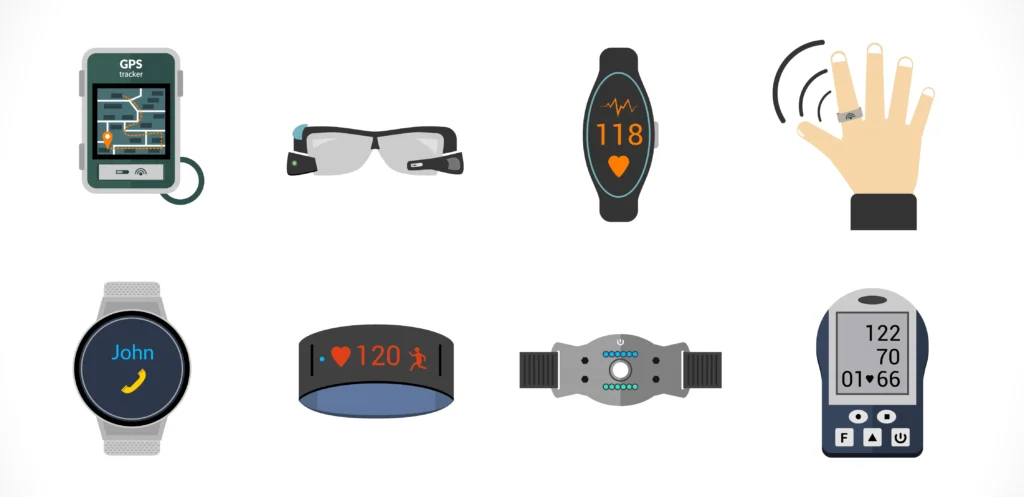
These capabilities originated in the mobile phone industry, but accelerometers are now used in many other designs, from fitness systems to smartwatches. Interfaces have also evolved from analog links to simple digital buses and to controllers that incorporate other sensor data. Wearable accelerometers are available as 2-axis and 3-axis devices, and as full 6-axis parts that integrate temperature and magnetic sensors to provide additional functionality in a design.
MMA3202 Dual-Axis Accelerometer
The MMA3202 series dual-axis (X and Y) silicon capacitive MEMS accelerometer from Freescale Semiconductor includes signal conditioning, a fourth-order low-pass filter, temperature compensation, and independent outputs for the two axes. Zero-g offset, full-scale span, and filter cutoff frequencies are factory-set, requiring no external trimming, which simplifies inclusion in production designs. The device also offers a complete power-on self-test to verify system operation.
The accelerometer consists of a surface-micromachined capacitive sensing element, or g-cell, and a CMOS signal-conditioning ASIC in a single package, with a wafer-level seal using high-capacity micromachined cap wafers. The g-cell is a polysilicon mechanical structure that can be considered as two fixed plates with a movable plate between them. When the system is subjected to acceleration, the center plate deflects from its rest position and that motion is translated to a capacitance change between the plates. The CMOS ASIC measures the g-cell capacitances using switched-capacitor techniques and extracts acceleration from the difference between two capacitors. The ASIC also provides signal conditioning and switched-capacitor filtering, producing a high-level output voltage proportional to acceleration. X-axis and Y-axis sensitivities are specified at the factory.
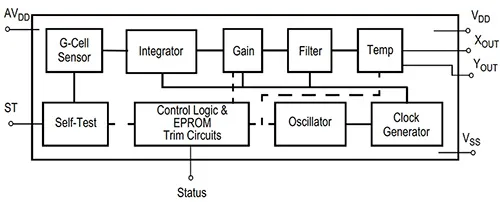
Figure 1: The MMA3202 dual-axis accelerometer shows different sensitivities on the X axis and Y axis.
System Integration
Two-axis devices can be integrated into wearable designs easily. Place the accelerometer as close as possible to the central microcontroller and decouple its power with a 0.1 μF capacitor. Ensuring there is a ground plane under the accelerometer helps reduce noise, and that ground plane should be connected to any exposed pads in the interface.
An RC filter of 1 kΩ and 0.01 μF on the accelerometer outputs helps minimize clock noise from switched-capacitor filter circuits. It is also important to ensure PCB routing for power and ground does not couple power noise into the accelerometer and that neither the accelerometer nor the microcontroller lies in a high-current path. Choose ADC sampling rates and switching frequencies for any external power regulators so they do not interfere with the accelerometer internal sampling frequency. This prevents aliasing errors that could produce erroneous sensor results and false system responses.
Multi-Axis and Inertial Modules
For advanced wearable navigation, the ADIS16305 iSensor provides a complete inertial system including gyroscopes and a three-axis accelerometer. Each sensor combines iMEMS technology with signal conditioning optimized for dynamic performance. Factory calibration characterizes each sensor's sensitivity, bias, alignment, and linear acceleration. Each sensor therefore has its own dynamic compensation formula, providing accurate measurements across conditions.
The ADIS16305 provides a straightforward and cost-effective way to integrate precise multi-axis inertial sensing because all necessary motion testing and calibration are performed during factory production, which reduces system integration time. An improved SPI interface and register structure provide faster data capture and configuration control. The ADIS16305 uses a pinout compatible with related ADIS parts for flexible interface connector use.
User registers provide input/output operations on the addressed SPI interface. Each 16-bit register has two 7-bit addresses: one for the high byte and one for the low byte. Although the ADIS16305 autonomously generates data, it operates as an SPI slave, using 16-bit transactions with the system processor as the SPI master. Individual register reads require two such 16-bit sequences; the first provides read command and target register address bits, and the second sequence sends the register contents on the data-out line. SPI operates in full-duplex mode, allowing the master processor to read data from the data-out line while simultaneously shifting the next target address on the data-in line using the same clock pulses.
STMicroelectronics offers the A3G4250D, a low-power three-axis angular rate sensor with low-rate stability and consistent sensitivity over time and temperature. The sensing element and interface chip combine to provide angular rate measurements to the outside world through a standard SPI digital interface, simplifying integration with controllers. An I2C-compatible interface is also available. The sensor element is produced using a dedicated micromachining process for inertial sensors and actuators. The A3G4250D has a ±245 dps full scale and allows user-selectable bandwidth to measure rates while consuming only the power required by the application.
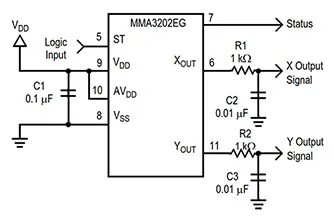
Figure 2: Integrating the MMA3202 dual-axis accelerometer into a design.
Freescale's Xtrinsic FXOS8700CQ is a 6-axis sensor combining a linear accelerometer and magnetometer that can be used in wearable designs ranging from portable navigation to medical monitoring. The package integrates a three-axis linear accelerometer and a three-axis magnetometer with selectable I2C or SPI serial interfaces, a 14-bit accelerometer ADC and a 16-bit magnetometer ADC, and additional embedded DSP functions.
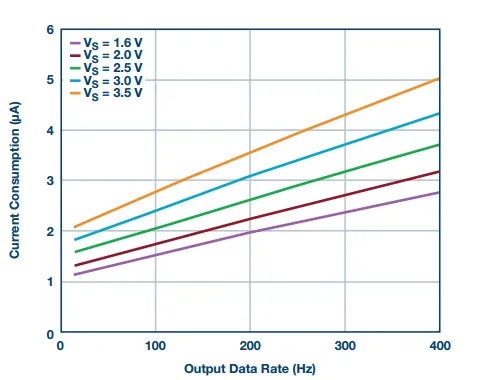
The FXOS8700CQ supports dynamic, user-selectable accelerometer full-scale ranges of ±2 g, ±4 g, and ±8 g, and a fixed magnetic measurement range of ±1200 μT. Output data rates range from 1.563 Hz to 800 Hz, selectable independently for each sensor. Interleaved magnetic and accelerometer output data rates up to 400 Hz are supported. Programmable automatic ODR changes and automatic wake-and-return-to-sleep features conserve power and can be used with magnetic and acceleration event interrupt sources.
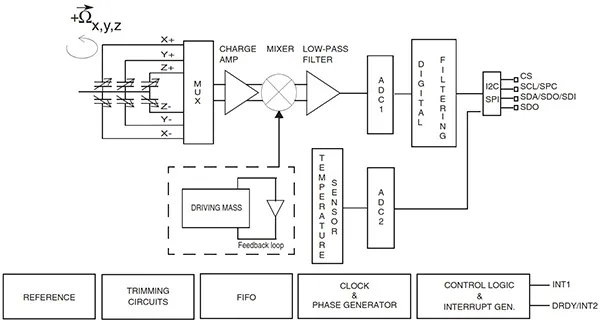
Figure 3: Structural view of the A3G4250D three-axis angular rate sensor from STMicroelectronics.
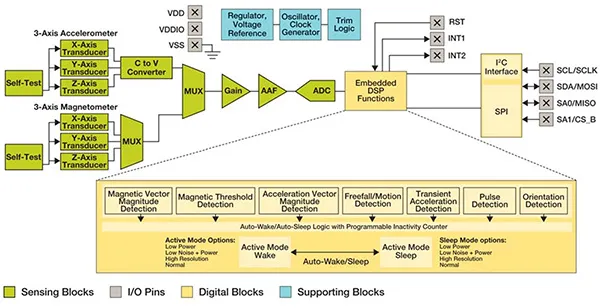
Figure 4: The Xtrinsic FXOS8700CQ 6-axis accelerometer and magnetic sensor can be used to build an electronic compass for wearable systems.
Conclusion
Many modern accelerometers provide simple SPI or I2C interfaces from the sensor to the central processor, making integration straightforward for wearable systems using 2-axis, 3-axis, or 6-axis sensors. However, sensor placement requires attention. Avoid high-current paths and ensure sampling rates are chosen to prevent aliasing from switching power supplies, so data remain accurate. Proper integration enables designers to add new user interface techniques and positioning features to current wearable devices.