ALLPCB


What is a microgrid?
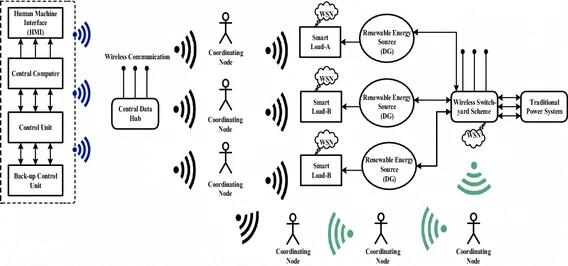
A microgrid is a network unit composed of distributed power sources, loads, energy storage systems, and control devices. It is an autonomous system capable of self-control, protection, and management. A microgrid can operate connected to the external grid or islanded. Compared with the traditional large grid, a microgrid refers to multiple distributed generators and their associated loads arranged in a specific topology and connected to the conventional grid via static switches. Developing and extending microgrids can facilitate large-scale integration of distributed and renewable generation, enable reliable multi-form energy supply to loads, and serve as an effective approach for transitioning the conventional grid toward a smart grid.
What is a smart grid?
A smart grid is the digitalization of the power grid, sometimes called "Grid 2.0". It is built on an integrated, high-speed, bidirectional communication network and leverages advanced sensing and measurement, equipment technology, control methods, and decision support systems to achieve reliable, secure, economical, efficient, and environmentally friendly power delivery. Key features include self-healing, demand response and user participation, resilience to attacks, power quality that meets modern user needs, accommodation of diverse generation types, enabling electricity markets, and optimized asset operation.
Context and common ground
Both concepts are new ideas in the power systems field and are related to large-scale deployment of renewable energy technologies, because traditional grids cannot absorb large amounts of photovoltaic, solar thermal, and wind power. These technologies were proposed to address that limitation, with microgrids being a particularly prominent example.
Main differences
Distributed smart grids and microgrids are both advanced power systems based on distributed generation and storage technologies, but they differ in several ways:
- Scope: Distributed smart grids have a broader geographic and functional coverage, typically spanning cities, towns, and industrial zones. Microgrids are smaller in scale, usually covering residential communities, campuses, or single enterprises.
- Energy sources: Distributed smart grids use a more diverse set of energy sources. In addition to solar, wind, and gas, they can integrate fuel cells and large-scale storage systems. Microgrids often rely on a limited set of sources, such as solar or gas.
- Control approach: Distributed smart grids employ more advanced intelligent control techniques that improve system stability and efficiency. Microgrid control is relatively simpler and better suited for localized power supply.
- Application scenarios: Distributed smart grids are suitable for large-area deployments in urban, rural, and industrial settings, where benefits are more pronounced. Microgrids suit relatively closed or self-contained environments, such as residential areas, schools, and commercial districts.
Evolution of control strategies
From project form and focus, earlier microgrid projects were viewed from the power system perspective, emphasizing safe and stable control when distributed generation is connected and operating either islanded or grid-connected. In concept, system architecture, and control architecture, a microgrid often resembled a scaled-down version of a large grid.
By contrast, distributed smart grids emphasize economics and interaction in addition to basic safety and stability. Under objectives such as electricity price signals and increased consumption of green power, the focus shifts to coordinating loads, storage, and distributed generation to optimize "source-network-load-storage" interactions. The perspective moves from dispatch control toward interactive coordination, and the underlying control paradigm changes from command-based to collaborative, self-regulating, and autonomous modes, reflecting stronger decentralization.
Integrating distribution and consumption
Distributed smart grids must incorporate a large number of dispersed low-voltage load resources below 0.4 kV, including low-voltage grid-connected distributed PV, and project scales can be more diverse rather than being centered on large MW-scale distributed energy projects.
Another likely characteristic of distributed smart grids is bridging the distribution-to-consumption link by integrating public distribution systems and customer-owned distribution systems. From a power system perspective they are a single entity, but property rights and management boundaries have often created artificial separation. Grid operators constrained by these boundaries have not fully leveraged end-user, load-side resources. Distributed smart grids aim to overcome this limitation by creating an operational and technical architecture that integrates distribution and consumption.
Conclusion
In summary, distributed smart grids and microgrids are both advanced systems based on distributed generation and storage, but they target different scenarios and application scales and therefore exhibit distinct characteristics and advantages.