ALLPCB


Common touchscreen technologies
Common touchscreen technologies include the following:
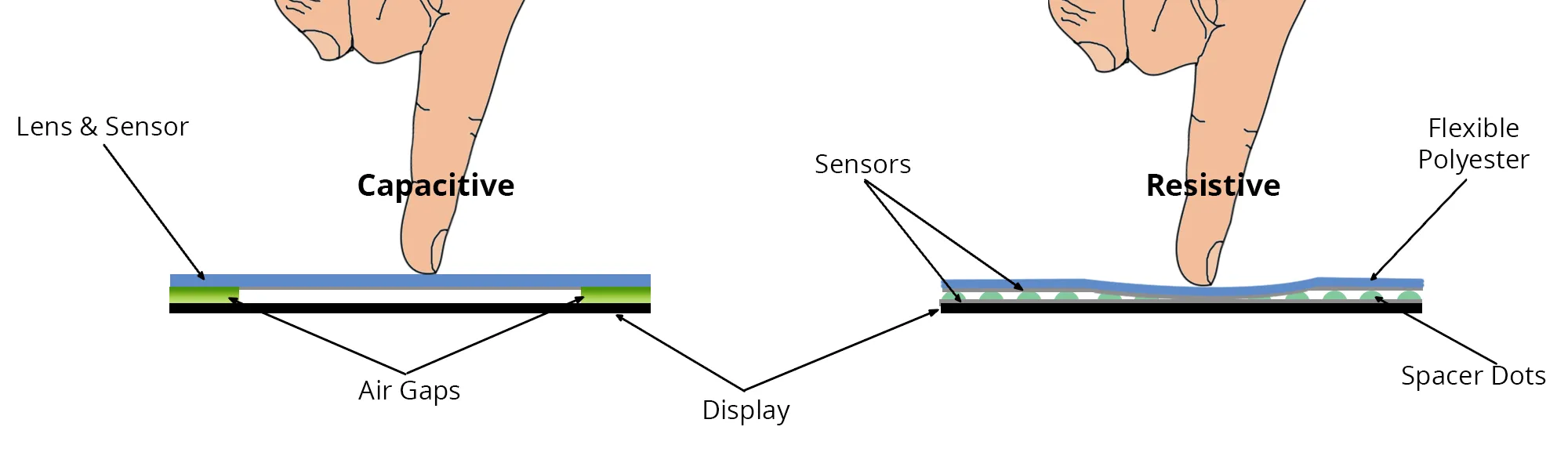
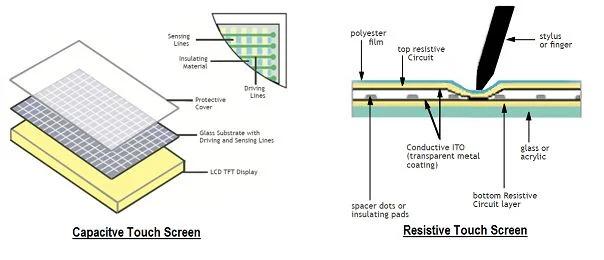
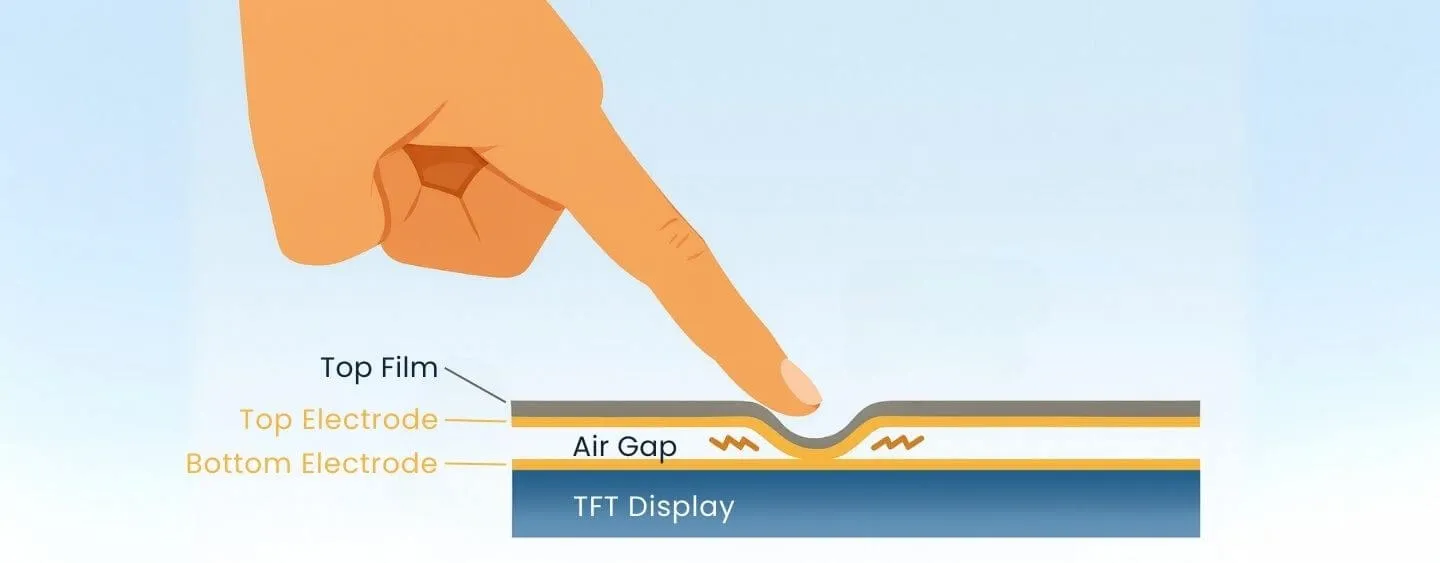
Resistive touchscreen: A resistive touchscreen detects touch position through pressure-induced contact between two transparent conductive layers. When pressure is applied, the two conductive layers touch and form a current path, allowing the touch coordinates to be determined. Resistive touchscreens offer good accuracy and can support multi-touch in some implementations, but they require a certain amount of pressure from the touching object.
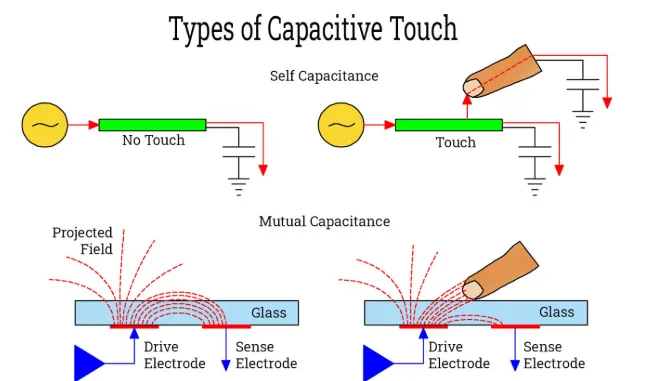
Capacitive touchscreen: A capacitive touchscreen detects touch position by sensing changes in capacitance on the surface of an insulating glass layer. When a finger or other conductive object approaches the touchscreen, it alters the local electric field and increases capacitance at that location. Capacitive sensors convert these changes into coordinate information. Capacitive touchscreens do not require pressure, support rapid swiping and multi-touch, and are widely used in smartphones and tablet computers.
Surface acoustic wave (SAW) touchscreen: A SAW touchscreen uses ultrasonic transducers to emit and receive acoustic waves across the screen surface. By detecting reflections and attenuation of the waves at the touch point, the system determines the touch position. This technology is pressure-sensitive and can support large-format touchscreens.
Light-guide touchscreen: A light-guide touchscreen routes illumination from a backlight to edges of the screen so that touch points cause local light loss. The system senses the light loss to detect touch position. Light-guide touchscreens are suitable for larger displays such as kiosks and ATMs.
Optical touchscreen: An optical touchscreen uses an infrared light grid or an array of optical sensors to detect touch position. When an object interrupts the infrared beams, the system registers the touch location. Optical touchscreens do not require pressure and are suitable for large displays and outdoor environments.
Each of these touchscreen technologies has distinct characteristics. Selection should be based on application requirements and cost considerations.
How mobile touch works
Mobile touch input is implemented by touchscreen technology, primarily using capacitive and resistive principles.
Capacitive touch: A capacitive touchscreen detects touch by sensing changes in capacitance on the surface of an insulating glass layer. The screen is covered with a conductive layer, such as ITO, which forms an electric field. With no contact, the field is uniformly distributed. When a finger or another conductive object approaches, the electric field changes and local capacitance increases. Capacitive sensors convert these changes into coordinate information to determine the touch location.
Resistive touch: A resistive touchscreen detects touch position through pressure-induced contact between two transparent conductive films. The touchscreen consists of two conductive layers separated by a small gap. When pressure is applied, the layers touch and create a current path. Each coordinate point generates a current flow, and measuring the current magnitude allows the system to determine the touch position.
Whether capacitive or resistive, a touchscreen requires a controller chip to convert the analog touch signals into digital data and transmit them to the device processor for appropriate actions and feedback. This enables users to interact with the device using fingers or other objects.