ALLPCB


Introduction
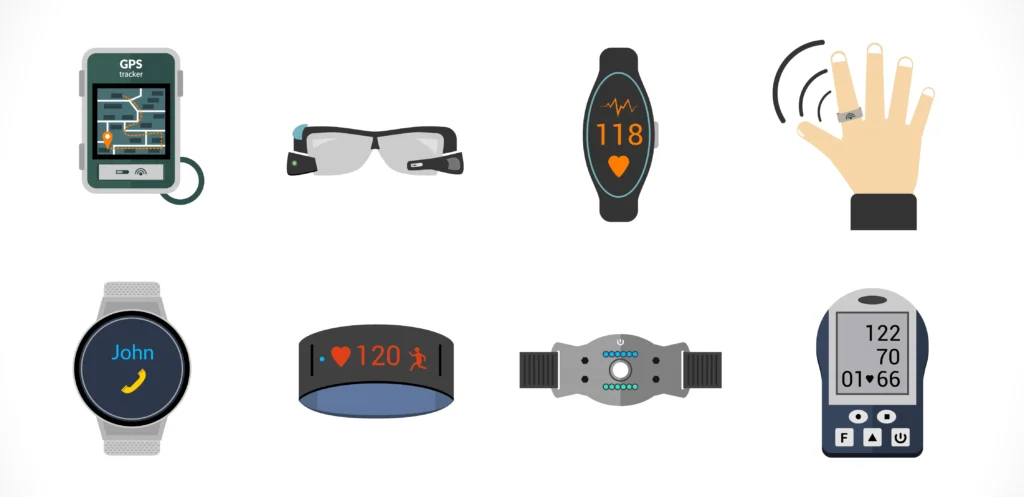
Wearable devices will occupy a significant share of the IoT market. Sensor-based, wirelessly connected wearables have moved from science fiction to real products such as smartwatches, fitness bands, and connected glasses like Google Glass. For wide adoption, wearables need long battery life, adequate privacy protection, and low cost.
Large technology companies have substantial cash reserves and have shown strong interest in wearable technology, the IoT, and the Internet of People (IoP). Announcements about investment funds for new mobile applications and connected products are common in the press.
Platforms and Industry Momentum
Recent joint statements and collaborations between major vendors and consumer brands illustrate this trend. At a recent developer forum, Intel's CEO noted that the company will continue along the wearable path by introducing additional IoT platforms and systems. For example, Intel's Edison platform is a miniature computer based on a 22 nm chip integrating Wi-Fi and Bluetooth, intended for next-generation wearable components. Plans emphasize greater usability and fashionability, the latter being key to mass acceptance.
Current Use Cases
Although the wearable concept is not new, its functional applications to date have been concentrated in industrial contexts, with relatively few consumer deployments beyond showing maintenance instructions or indicating part failures using tools like MicroOptical. Google Glass has also been used for fixed-asset maintenance, fitness, and medical applications.
Sensor Types Used in Wearables
All these applications rely on basic sensors to enable compelling features in new products. Examples of sensors currently in use include those found in Texas Instruments' 2.4 GHz Bluetooth low-energy SensorTag development kit, STMicroelectronics' L3GD20 MEMS motion sensor, STMicroelectronics' BlueNRG, and Honeywell's magnetoresistive sensor ICs. The next sections examine some of these components and why they are suitable for wearables.
Bluetooth Low Energy and the SensorTag
Bluetooth technology offers high efficiency, low power consumption, strong security, and easy implementation, making it a natural choice for wearable communications. Texas Instruments' CC2541 SensorTag development kit is designed to simplify development of low-power Bluetooth sensor applications. Application developers can quickly create smartphone applications for Bluetooth low-energy accessories without developing additional embedded hardware or software. The SensorTag kit includes:
- One CC2541 SensorTag in a housing
- One CR2032 battery
- One screw for the housing
- A quick start guide
The kit's RF board has passed FCC and IC certification and testing, meets ETSI/R&TTE requirements from 0°C to +35°C, and integrates a PCB antenna.
Sensor Set in SensorTag
The SensorTag kit includes the following sensors:
- TI IR temperature sensor (TMP006)
- Sensirion humidity sensor
- Epcos pressure sensor
- Kionix accelerometer
- InvenSense gyroscope
- Freescale magnetometer (MAG3110)
The CC2541-based SensorTag uses six sensors that are energy-efficient, low-cost, and compact surface-mount devices. The sensors use an I2C interface and connect to the same bus via independent enable signals. To maintain low current consumption, all sensors default to a disabled state and remain in sleep mode between adjacent measurements.
The CC2541 is well suited for ultra-low-power systems. Its fast mode transition times further reduce power consumption. Typical applications include 2.4 GHz proprietary and Bluetooth low-energy systems, human interface devices, consumer electronics, and mobile phone accessories.
Position and Motion Sensing
For many wearable applications, it is important to know where a device is and where it is heading. Sensors providing that information must be compact, high-performance, and reliable. One example is STMicroelectronics' LSM303C electronic compass, which integrates a 3-axis accelerometer and a 3-axis magnetometer in a single package and is claimed to be among the smallest electronic compasses available.
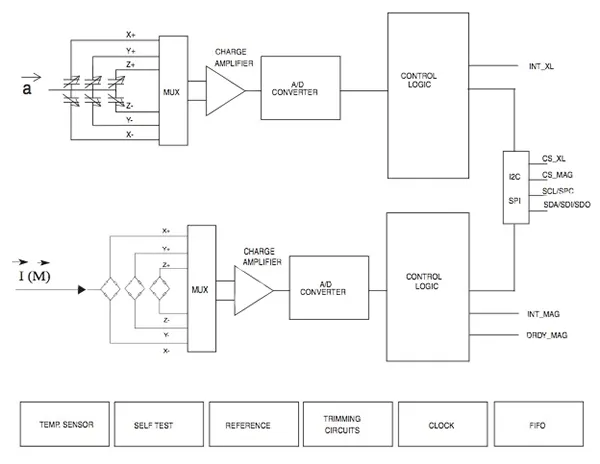
Block diagram of STMicroelectronics LSM303C electronic compass for wearables.
The chip measures only 2 mm x 2 mm and is nearly 20% smaller than comparable devices, enabling advanced navigation and motion-sensitive features in a smaller footprint.
Key features include:
- Tilt-compensated compass
- Map rotation
- Position detection
- Motion-activated functions
- Free-fall detection
- Single-tap/double-tap recognition
- Pedometer
- Intelligent power-saving modes
In motion-monitoring wristbands or smartwatches, saving PCB area is critical. The LSM303C can save nearly 1 mm2 of printed circuit board space compared with competing parts, allowing designers to optimize component layout and minimize interference between Wi-Fi, Bluetooth, and cellular radios. The small size helps reduce overall wearable volume.
Low-Power Radio and Network Processors
Beyond the sensors themselves, enabling technologies provide the connectivity and low-power operation needed by wearable applications. STMicroelectronics' BlueNRG low-energy Bluetooth network processor is an example. In applications such as watches, fitness equipment, wellness and sports, and consumer medical and assistive devices, BlueNRG can operate as a master or a slave device.
This full-featured low-energy Bluetooth protocol stack runs on an embedded ARM Cortex-M0 core, and non-volatile flash memory allows field upgrades. It is designed to meet strict peak current requirements when using standard coin cells: the maximum peak current at 1 dBm output power is only 10 mA. Very low-power sleep modes and short mode transition times ensure minimal average current consumption and longer battery life. BlueNRG also provides an option to connect an external microcontroller over an SPI transport layer.
High Sensitivity, Low Current Magnetic Sensors
Devices that meet very high sensitivity, low current operation, and extremely small footprint requirements include Honeywell's Nanopower series. The series offers multiple magnetic sensitivity options to suit different design needs, including the SM351LT for applications demanding very high magnetic sensitivity with minimal current consumption, and the SM353LT for applications that require both very high sensitivity and very low current draw.
Outlook
The convergence of IoT and wearable applications, populated by various types of sensors, will continue to grow in applications where real-time event monitoring and result communication matter. This convergence will also expand wherever field personnel need access to data to resolve issues or assess current conditions. As these technologies are adopted more widely, costs will fall, enabling even applications that seem difficult to imagine today to see large-scale use.