ALLPCB


Overview
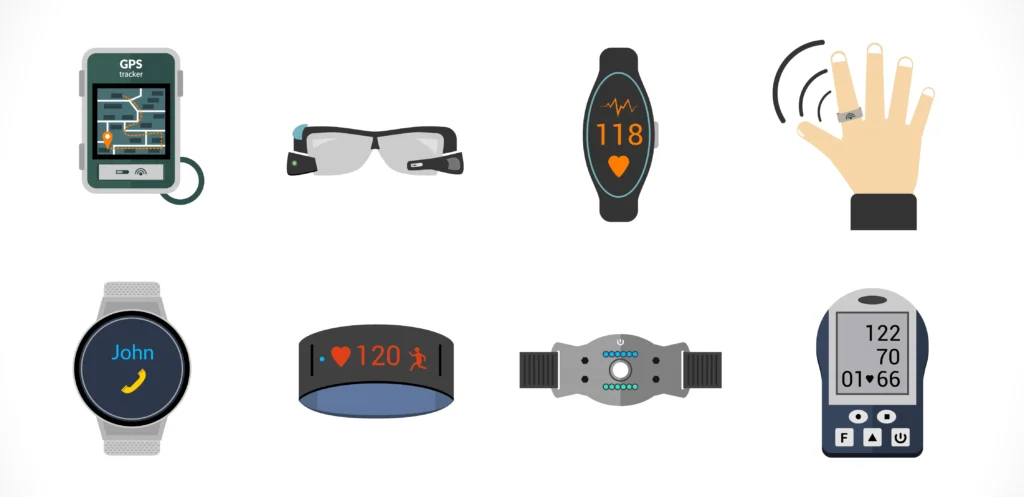
Wearable devices are emerging as a significant market for electronic components. A key requirement for these devices is convenience, not only in accessing data on the move but also in ensuring battery life that lasts through a full day.
If users must plug devices in for overnight charging, they may forget to charge them and wake to find the device unavailable for the day. Wireless charging provides a more convenient charging method. With wireless charging, a device is simply placed on a charging pad, without inserting a micro USB or similar cable, and the pad can be kept in an accessible location. A properly designed wireless charging system can charge multiple devices on one pad without sequential charging, increasing convenience for users.
Wireless charging is now used beyond wearables. The technology is commonly applied to electric toothbrushes and has been scaled for charging electric vehicle batteries.
Basic Principle
The basic operating principle of inductive charging is similar to that of a power transformer. A coil in the charging pad generates an alternating magnetic field, which is received by a coil in the device and converted back into usable current. Like conventional transformers, basic inductive charging requires the two coils to be close together for high efficiency. Otherwise, the resistance in the primary coil causes significant cumulative losses.
Using two coils to create resonant inductive coupling can improve energy transfer efficiency at longer distances. This is done by tuning each coil with an inductance and capacitive load so that both resonate at the same frequency. Under resonant conditions, substantial energy can transfer from one coil to another located several diameters away.
The coil circuit quality factor Q can be increased so a relatively strong magnetic field builds up over multiple cycles. The energy carried in this oscillating signal can exceed the instantaneous energy fed into the coil. Because the secondary coil can capture and convert part of this oscillating magnetic field, the output energy can exceed that of a conventional transformer. Tuned capacitors used for resonance can cancel stray and magnetizing inductance in the transmitter, fundamentally reducing coil winding resistance losses, which are often 10 to 100 times higher than other inductive losses.
To raise Q above that of a conventional transformer, coils are typically wound as solenoids, which also helps minimize skin effect. Low dielectric constant cores or air-core designs reduce dielectric loss.
In practice, coils are not always tuned to an exact resonant frequency. Loosely coupled systems can transfer power if the secondary coil intercepts a sufficient number of magnetic flux lines. More precise coil matching provides tighter coupling and higher power transfer, but maintaining strict coupling among coils designed to operate at resonance is often impractical. Some circuits are designed to operate under detuned conditions, where the receiver's resonance frequency differs slightly from the transmitter's.
Tightly coupled coils are sensitive to alignment, which is problematic for consumer applications where users place devices on a pad without precise positioning. To address this, transmitters can use multiple coils. This increases design complexity but improves placement flexibility. Coils do not need to overlap, simplifying assembly, although overlapping coils can increase density and receiver placement freedom.
Standards and Control
Standards are required for a single transmitter to charge different devices reliably. Two major standards in use are Powermat and Qi. The Powermat system is promoted by the Alliance for Wireless Power and is designed around a single-transmitter-coil, loosely coupled system. The Wireless Power Consortium's Qi system allows multiple configurations, including loose and tight coupling modes. Currently, most transmitters use multi-coil, tightly coupled configurations.
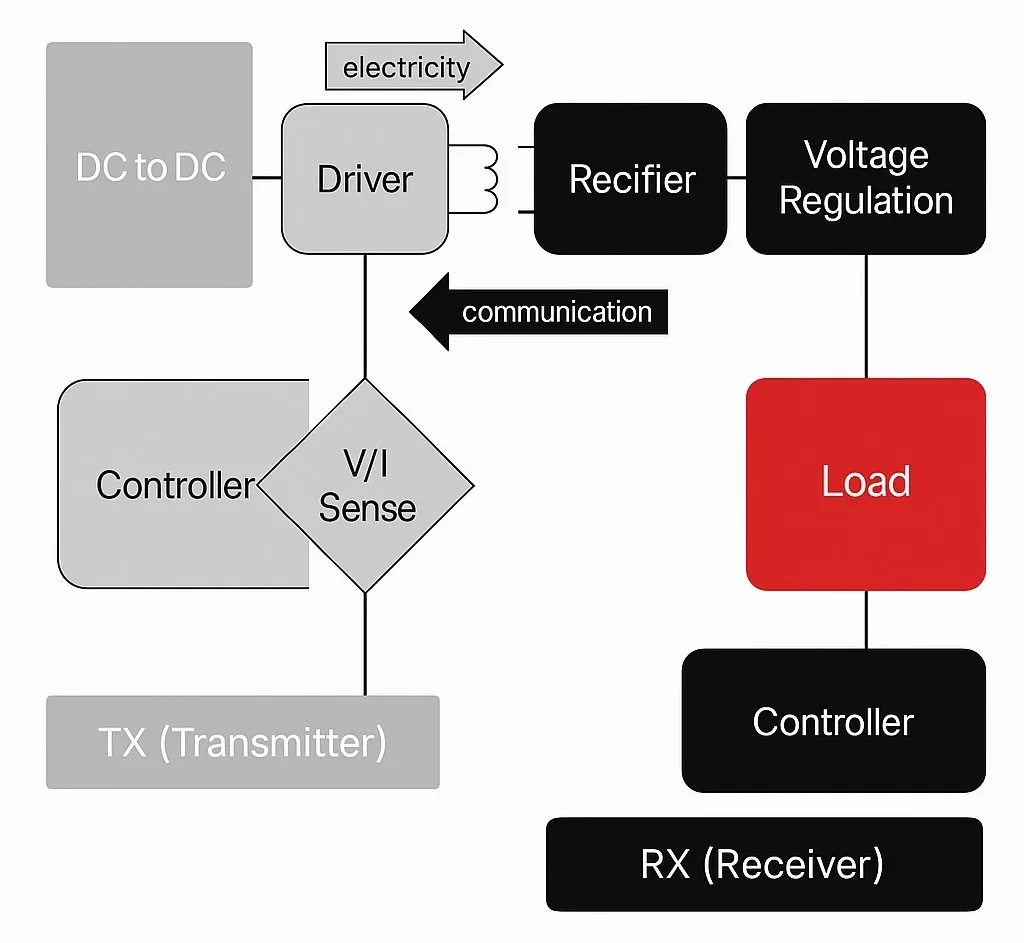
Both standards include energy management to ensure the pad operates only when a device is charging. For example, Qi specifies a communication protocol that modulates signals on the coil to check whether a device is present and whether it supports Qi. Under Qi, the transmitter can vary the switching frequency on the coil between 110 kHz and 205 kHz as the primary power control mechanism.
Qi uses simple load modulation of the coil voltage to send data to the device across the gap. Communication from the secondary coil uses a biphase, bit-encoded scheme at 2 kHz, with a start bit preceding each 8-bit data payload, followed by parity and stop bits.
Large amounts of control data can be sent. Common control packet types include signal strength, control error, requested terminal power, and rectified power level. Signal strength helps adjust the device position on the pad and, when combined with audible or visible feedback, can guide the user until the signal indicates adequate power transfer.
Control error packets indicate the difference between observed and required input voltage at the receiver coil. The transmitter typically adjusts the voltage applied to its coil using a control loop. If a large error exists, these packets are sent at a high rate, typically every 32 ms until the error falls within a threshold; thereafter they are sent every 250 ms. Control error packets are useful for regulating power transfer. Under light load, the receiver may request a higher voltage to overcome current transients, such as waking a wearable from sleep. Under heavier load, a portable device may request a lower voltage to avoid power dissipation in an LDO regulator.
A device requests a stop to power transfer when the battery is full or when an internal fault that could damage the battery is detected. Power transfer is also controlled via rectified power information, which communicates the power measured at the receiver's rectifier output. The transmitter uses this information to determine coupling efficiency and to check whether the receiver has reached its maximum power limit. Packets are sent every 350 ms to 1800 ms; the transmitter also uses gaps between packets to determine whether a device has been removed from the pad. Rectified power information also helps detect foreign objects.
Transmitter and Receiver Components
Chipsets supporting the Qi protocol and power control are available. For example, Toshiba's TB6865AFG is a high-integration transmitter device that includes an ARM Cortex-M3 processor for customer code and a PWM controller supporting an external H-bridge for power delivery. According to the Qi specification, this controller can manage power to up to two devices and supports foreign object detection.
Texas Instruments offers the bq51013 family for the secondary side. These devices perform AC/DC conversion and rectification and include the digital control functions needed to send commands to the transmitter. The bq5101x devices incorporate a low-resistance synchronous rectifier, an LDO, and voltage and current loop controllers.
Manufacturers also supply ready-made coils that support the Qi standard for use as transmitters, receivers, or both. For example, Abracon's AWCCA-50N50 series supports both transmitter and receiver applications. These coils have a diameter slightly under 50 mm and strong magnetic shielding, with selectable Q factors around 70 or 160 and DC resistances near 20 mΩ or 70 mΩ respectively.
For smaller wearables, TDK offers the WR303050 coil packaged at 30 x 30 mm with a thickness of 1 mm and a room-temperature DC resistance of 0.41 Ω.
To increase flexibility, Vishay Dale's IWAS-3827 uses a rectangular footprint of 38 mm by 27 mm. This coil has a thickness of 1 mm, DC resistance of 0.18 Ω, and a typical Q of 30.
For higher integration, TDK's TMx-66-2M7 and TMx-58-2M7 can be combined with a TI receiver chip package to create a package 66 mm long and 1 mm thick.
Other available wireless power coils include Würth Electronics' WPCC and WE-WPCC series. These coils are offered in both transmitter and receiver configurations, rated for currents from 0.8 A to 13 A and in various sizes to meet different application requirements. A Würth/TI wireless power demonstration kit (760308) uses Würth transmitter and receiver coils.
Conclusion
As ecosystems around protocols such as Qi expand, higher-integration solutions are expected to simplify design and provide simpler charging methods for wearable devices.