ALLPCB


Summary
Vishay VEML3235 ambient light sensor is a low-power, high-sensitivity device with an I2C interface, implemented using CMOS process. The sensor integrates a photodiode, amplifier, and analog circuitry on a single chip and is controlled via simple I2C commands. Its spectral response closely matches human eye response. The VEML3235/VEML3235SL offer temperature compensation, reliable refresh-rate settings without external RC low-pass filters, high dynamic detection resolution, and a software shutdown mode. Typical applications include handheld devices, notebook computers, consumer electronics, industrial and medical equipment, computing devices, and displays.
Features
- Surface-mount package type
- Integrated module:
- Ambient light sensor (ALS)
- Supply voltage VDD: 2.6 V to 3.6 V
- Communication via I2C interface
- I2C bus pull-up voltage range: 1.7 V to 3.6 V
- Floor life: 168 h, MSL 3, per J-STD-020
- Low standby current: 1 μA (typical)
- Dimensions (L × W × H):
- VEML3235: 2 mm × 2 mm × 0.87 mm
- VEML3235SL: 2.95 mm × 1.5 mm × 1.5 mm
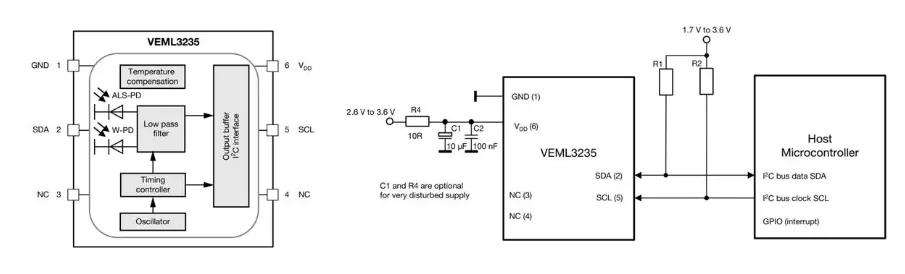
Block Diagram and Typical Application
1. Product Overview and Technical Features
The Vishay VEML3235 is a high-precision ambient light sensor in a miniature transparent 2 mm × 2 mm package, designed for accurate light measurement. The sensor integrates a high-sensitivity photodiode, low-noise amplifier, 16-bit ADC, and supports a simple I2C bus interface with an optional interrupt function.
Key parameter highlights:
- Very high sensitivity: resolution down to 0.0021 lx per count
- Wide dynamic range: 0 lx to approximately 18 klx
- Low-power design: shutdown mode current about 1 μA
- Operating temperature range: -25°C to +85°C
- Flicker suppression: support for 100 Hz and 120 Hz flicker noise rejection
2. System Architecture and Operation
2.1 Functional Block Description
The VEML3235 contains a temperature-compensated ALS photodiode, low-pass filter, output buffer, and I2C interface among other key blocks. Pin definitions are as follows:
- Pin 1: GND (ground)
- Pin 2: SDA (I2C data line)
- Pin 3, 4: NC (no connection)
- Pin 5: SCL (I2C clock line)
- Pin 6: VDD (power)
2.2 Application Circuit Design
Power configuration:
- Main supply: 2.6 V to 3.6 V
- I2C pull-up supply: 1.7 V to 3.6 V (can be level-matched to the microcontroller)
External component recommendations:
- Pull-up resistors R1, R2: recommended 2.2 kΩ to 4.7 kΩ
- Decoupling capacitors C1, C2: 10 μF and 100 nF
- Series resistor R4: 10 Ω (use if supply noise is significant)
3. Register Configuration Details
3.1 Register Map
The VEML3235 contains six user-accessible 16-bit command registers at addresses 0x00 to 0x06 (0x03 reserved).
Key register functions:
Command register 0x00 configuration:
- SD bit (bit 0): set to 1 to turn off BG and LDO (default)
- SD0 bit (bit 7): set to 1 to disable ALS and white light channel (default)
- DG bit (bit 5): digital gain selection (0 = ×1, 1 = ×2)
- GAIN bits (bits 4:3): analog gain selection
- 00 = ×1, 01 = ×2, 11 = ×4
Integration time setting (bits 6:4):
- 000 = 50 ms
- 001 = 100 ms (standard)
- 010 = 200 ms
- 011 = 400 ms
- 100 = 800 ms
4. Applications and Performance Benefits
4.1 Dark Glass Cover Applications
In applications with low-transmittance dark cover glass, the VEML3235 sensitivity of 0.0021 lx ensures accurate measurement even under low-light conditions.
4.2 Light Source Type Identification
By comparing the ratio of the ALS channel to the white-light channel, different light source types can be distinguished:
- Sources with strong infrared component (halogen/incandescent): ratio > 2
- Other sources (LED/fluorescent): ratio ≤ 2
4.3 Environmental Adaptability
The sensor shows good matching across various light sources, including LED, fluorescent, daylight, and halogen, with typical error around ±10%.
5. Typical Illuminance Reference
| Illuminance Level | Real-world Example |
|---|---|
| 1e-5 lx | Sirius starlight |
| 0.002 lx | Clear night sky without moonlight |
| 0.01 lx | Clear night sky without moon |
| 0.27 lx | Quarter moon |
| 1 lx | Quarter-moon illumination |
| 3.4 lx | Full moon at tropical latitudes |
| 50 lx | Home living room |
| 100 lx | Very overcast day |
| 400 lx | Office lighting |
| 1000 lx | Typical TV studio lighting |
| 32,000–130,000 lx | Direct sunlight |
6. Design Considerations
- Startup timing: wait 4 ms after enabling the sensor before taking the first measurement
- Saturation avoidance: when light conditions are unknown, begin measurements at the lowest gain
- Supply noise: use R-C decoupling if supply line noise is significant
- Window design: ensure the cover window is fully transparent over the visible range (400 nm to 700 nm)