ALLPCB


Overview
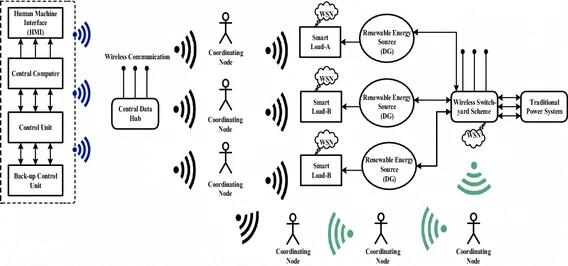
The smart grid is the expected direction for power system development. Communications, computing, and automation technologies are increasingly applied throughout the grid and integrated with conventional power engineering, significantly raising the grid's level of intelligence. Sensor and information technologies support system state analysis and decision support, enabling self-healing capabilities. Advances in dispatching, automation, and flexible transmission technologies provide the foundation for integrating renewable energy and distributed power resources.
Improvements in communication networks and the deployment of customer data acquisition technologies promote two-way interaction between the grid and end users. As these technologies further mature and become tightly integrated with the physical grid, the smart grid emerges.
Characteristics of a Smart Grid
A smart grid is based on a robust physical network, supported by a communications and information platform, and implemented through intelligent control. It is characterized by information processing, automation, and interactivity. It encompasses all stages of the power system—generation, transmission, substation, distribution, consumption, and dispatch—across all voltage levels, achieving a high degree of integration of power flow, information flow, and business flow.
Limitations of Traditional Grids
The traditional grid is a rigid system. Connection and disconnection of power sources and transfer of energy lack flexibility, so the grid has limited dynamic adaptability and configurability. Vertical, multi-level control mechanisms respond slowly and cannot form a real-time, reconfigurable system. System self-healing and restoration depend largely on physical redundancy. Customer interactions are simple and one-way, and multiple information silos exist inside the system, limiting information sharing. Although local automation has increased, incomplete information and weak sharing mean many automation systems remain fragmented and isolated, preventing a real-time, unified whole and resulting in a lower overall intelligence level.
How the Smart Grid Extends Capability
Compared with the traditional grid, the smart grid extends the ability to acquire panoramic network information—complete, accurate, time-stamped, and standardized power flow and business flow data. Built on a resilient physical network and an information exchange platform, and driven by the needs of service throughout the production process, the smart grid integrates various real-time production and operational data. By enhancing real-time dynamic analysis, diagnosis, and optimization of business flows, it supports more effective grid operation.
The smart grid further optimizes control across grid levels by creating a flattened structure with modular functions and configurable system composition. Combining centralized and distributed approaches allows flexible adaptation of network topology, intelligent reorganization of system architecture, optimal allocation of system resources, and improved service quality, forming a fundamentally different grid architecture from the traditional model.
Because the smart grid can obtain comprehensive, timely information, it can greatly improve lifecycle management of grid assets, support corporate responsibility objectives, and help achieve optimal technical-economic tradeoffs, sustainable development, higher economic returns, and better environmental protection, thereby optimizing social energy allocation and improving investment and utilization efficiency.
Key Differences
- Infrastructure innovation: The smart grid uses advanced technologies and communications networks to integrate generation, transmission, distribution, and demand-side management into an open, interconnected control platform. By contrast, traditional grid upgrades typically focus on adding conventional components without a coordinated, system-wide intelligence approach.
- Improved reliability: The smart grid leverages advanced fault monitoring and localization techniques to quickly identify faults and restore power. Traditional grids often lack comprehensive monitoring and diagnostic systems, requiring time-consuming on-site inspection to locate faults.
- Dynamic load management: In the smart grid, voltage, power flow, and frequency variations can be monitored and controlled in real time, saving energy and improving dynamic load management. Traditional grids generally lack such real-time feedback and control.
- Environmental performance and safety: The smart grid enables more efficient and sustainable energy development and use through coordinated resource allocation, which can reduce environmental impact and improve safety for the public and infrastructure. Traditional grids do not typically offer these advantages.
Conclusion
The fundamental difference between traditional and smart grids lies in innovations in communications, information processing, and automation. The smart grid not only improves power system efficiency and reliability but also supports environmental protection, energy savings, emissions reduction, and broader socioeconomic objectives.