ALLPCB


In recent years, concepts such as "smart city", "smart grid", and "ubiquitous power IoT" have been proposed. These plans overlap and influence one another, and in some pilot cities construction is progressing rapidly. For example, high-voltage power lines have been moved from overhead to underground. In some cities, main roads, renovated high-tech zones, and new developments require buried cables with a smart manhole cover installed every 50–100 m to improve urban safety and free up surface space.
Product definition and terminal functions
Product definition: An intelligent manhole cover monitoring system detects whether a cover is missing and continuously collects manhole status and underground environmental data, including water level, temperature, and hazardous gases. It uses current wireless communication and power technologies to store and transmit data. Opening events and inspection records are integrated into a unified maintenance management system with corresponding alarm handling. An electronic map displays the location, status, and alarm details so that monitoring personnel can respond promptly to thefts, damage, or other safety hazards.
Terminal functions
- Intrusion alarm: Real-time monitoring of cover opening and tampering
- Environmental monitoring: Underground O2 concentration and toxic gases such as CO and H2S
- Status management: Remote control or keyed open/close of the cover
- Interoperability: Communication protocol interfaces for integration with other systems
- Lifecycle management: Device lifecycle management based on IoT principles
Key IC roles in a typical application
Engineer Ethan Li described the use of ADI integrated circuits across sensing (iSensor MEMS), data acquisition (analog-to-digital conversion), digital isolation communications (iCoupler), and power supply (ADI Power by Linear) in a compact smart manhole cover application.
Typical signal chain
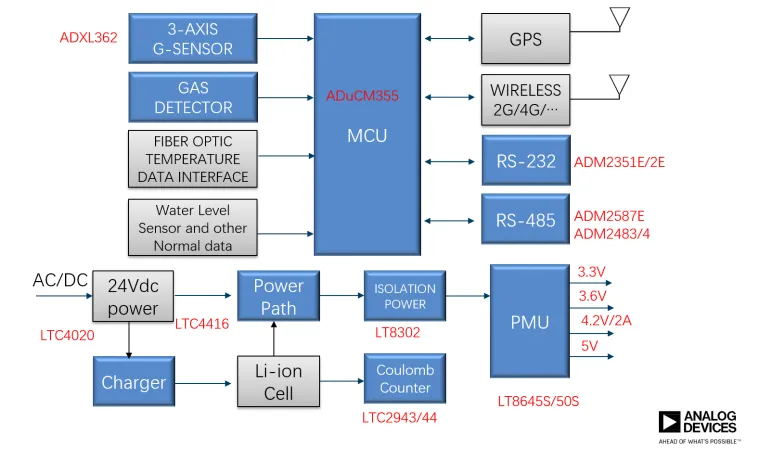
Figure 1 Typical signal chain for a power smart manhole cover
System technical requirements
- System power: 24 Vdc online supply (Vin = 16–36 V). A backup power source or Li-ion battery backup is also required
- Tilt detection: Threshold alarm with 1–2° error
- Gas detection accuracy: Approximately 5%
- Communication: Isolated RS-232/485 bus communication, data rate < 115200 bps; also 2G/4G/NB-IoT wireless
- Static power consumption: < 0.02 W
- Alarm response time: < 10 s
- Maintenance-free time: More than 1 year
Power supply system — ADI Power by Linear
The power system must start relatively large mechanical switching loads while ensuring safe manual shutdown before entering the manhole. The supply approach uses an online 24 Vdc input (Vin = 16–36 V) with a backup battery of 6–8 Li-ion cells in series (25.2 V full / 29.4 V full) for charging.
Example design: LTC4020 high-voltage buck-boost with MPPT solar charging combined with LTC4416 external path management for a high-reliability solution.
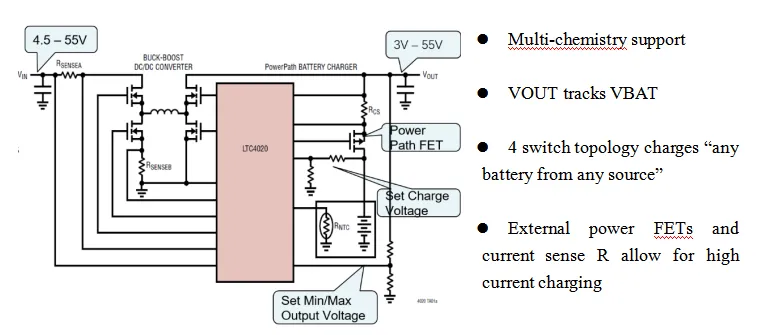
Figure 2 LTC4020 application diagram and features
Other referenced power solutions include an isolated flyback LT8302, multi-output synchronous rectifier DC/DC LT860X family, and Silent Switcher designs such as LT8609S, LTC8645S, and LTC8650S.
ADI MEMS G-sensor for tilt detection
Example design: The ultra-low-power 3-axis MEMS accelerometer ADXL362 is used to ensure the overall device's low static power consumption.
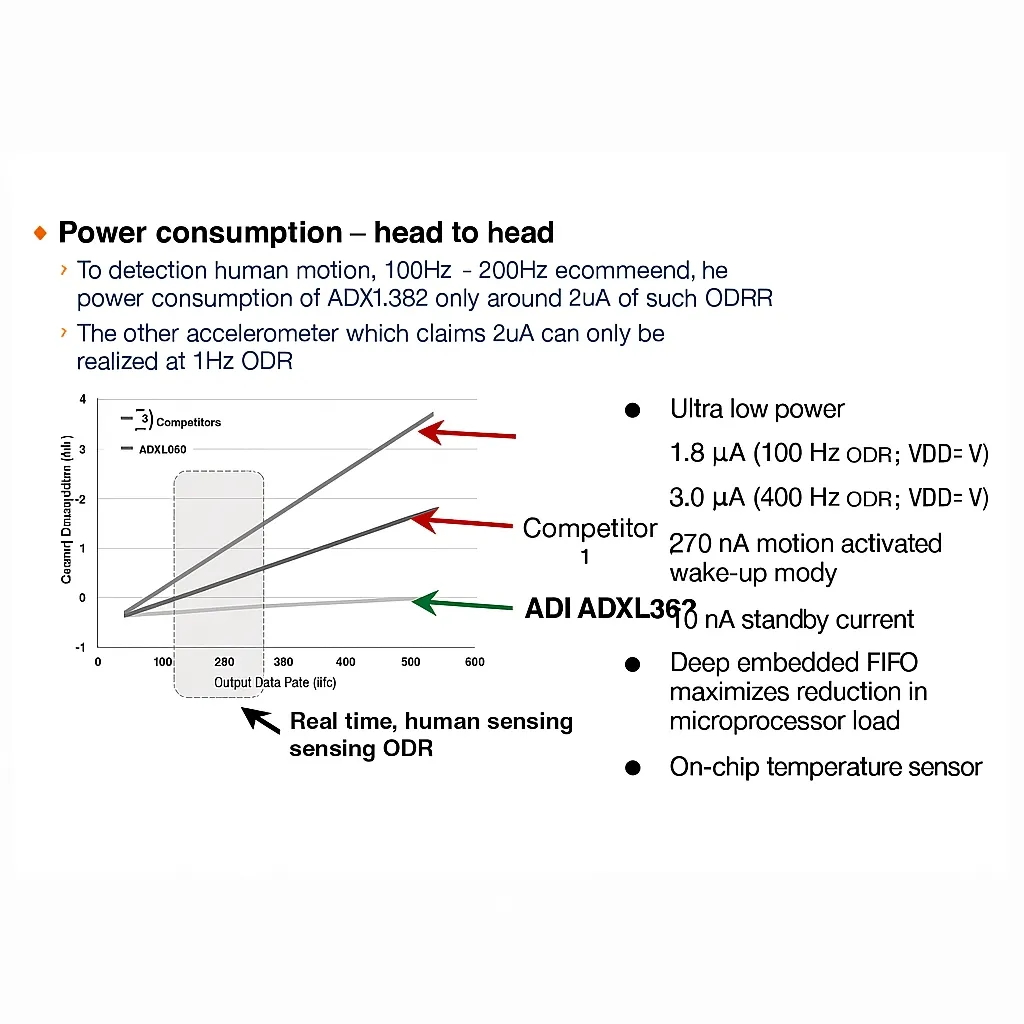
For 3-axis G-sensor tilt measurement design reference, see ADI application note AN1057.
Underground gas detection
Systems typically require O2, CO, CO2, H2S plus auxiliary measurements, with detection accuracy around 5%. Common designs use electrochemical sensors with amplifiers such as ADA4528 or AD623 for signal conditioning, followed by MCU internal ADC sampling.
Recommended example: ADI's ADuCM355, a platform-level product for electrochemical sensor-based gas detection. Its high integration, precision, reliability, small size, and low power consumption make it suitable for such applications. For detailed reference circuits, see ADI application notes CN0425 and CN0429.
Isolated communication interface
Communication methods: isolated RS-232/485 bus (functional isolation 2500 Vdc), data rates < 115200 bps, and 2G/4G/NB-IoT wireless links.
Examples of implemented designs include isolated RS-232 ADM3251E, low-cost isolated RS-485 ADM2483, and isoPower-integrated ADM2587E. Compared with traditional optocoupler or capacitive isolation, ADI iCoupler magnetic isolation offers high robustness and strong noise immunity. The next-generation magnetic isolation codec further improves interference resistance, integration, and design simplicity.
Magnetic coupling with polyimide isolation
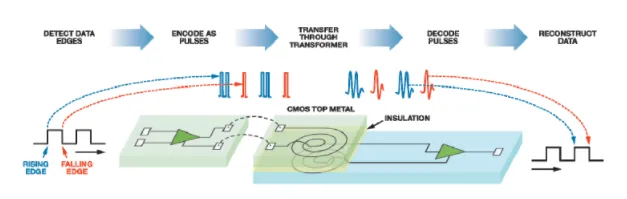
Single-ended "one-pulse/two-pulse" encoding architecture
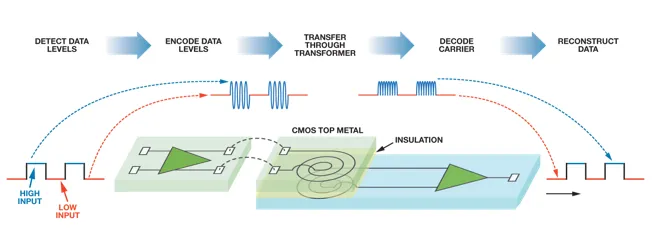
Differential on/off keying control architecture
Solution integration and deployment
ADI offers an integrated set of products covering sensing, process control, digital isolation, and power management. Some regional suppliers have supported customer designs and production. As urban development and power IoT deployment continue, the functionality of smart manhole covers is expected to expand.