ALLPCB


Reliable communications are required in smart grid systems to exchange the data needed for optimizing power consumption and cost. In low population density rural areas where distance and terrain often limit alternative communication methods, power-line communication (PLC) offers a practical medium for data transfer. Engineers implementing communications for smart meters or grid energy-collection systems can base PLC designs on devices from vendors such as Atmel, Cypress Semiconductor, STMicroelectronics, and Texas Instruments.
Why PLC Suits Rural Areas
In rural locations, power lines are often the most practical choice for reliable, cost-effective smart grid communications. End points are typically widely dispersed, and alternatives such as wireless may lack sufficient range, while wired links or cellular broadband may not be available or reliable immediately. PLC provides a cost-effective mechanism for data exchange between utilities and customer smart meters.
PLC Design
Typical PLC modem designs combine an analog front end (AFE) and a processor to provide core functions. The AFE handles analog operations, including signal transmission and reception, while the processor runs the communication software stack associated with the chosen PLC protocol.
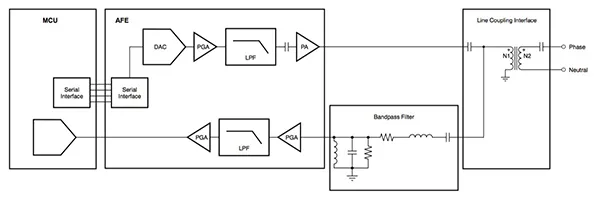
Figure 1: Besides coupling, bandpass, and circuit protection, a PLC modem combines an analog front end (AFE) for transmit and receive functions with an MCU that handles the communication stack. (Image: Texas Instruments)
Designers can implement PLC solutions using a discrete AFE, such as TI AFE030 and AFE031, paired with an external MCU like TI's C2000 C28x Piccolo MCU. This approach allows scaling modem performance by selecting higher-performance MCUs, for example a multicore MCU that combines a C2000 C28x core with an ARM Cortex-M3. More advanced modulation schemes, such as orthogonal frequency-division multiplexing (OFDM), may require higher-performance multicore processors to handle more complex stacks.
Alternatively, designers can use integrated PLC devices that incorporate much of the communication stack on a single chip. For example, Cypress Semiconductor's CY8CPLC10 integrates the PHY layer and lower-layer network protocol stack, while the CY8CPLC20 further integrates those functions with a PSoC core capable of executing a more complete PLC stack.
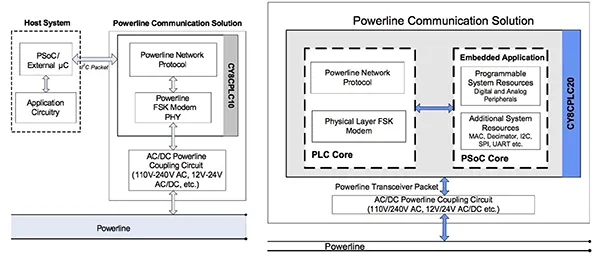
Figure 2: Vendors offer PLC solutions with varying levels of integration. For example, the Cypress CY8CPLC10 integrates the PHY and network protocol stack, while the CY8CPLC20 adds a PSoC core for complete stack processing. (Image: Cypress Semiconductor)
Frequency Bands
PLC devices must operate within frequency bands defined by regional regulations. In North America, the FCC Part 15 rules permit PLC operation from 10 kHz to 490 kHz. In Asia and Japan, ARIB specifies operation from 10 kHz to 450 kHz. In Europe, CENELEC EN50065 defines low-frequency bands including A (3 kHz to 95 kHz), B (95 kHz to 125 kHz), C (125 kHz to 140 kHz), and D (140 kHz to 148.5 kHz). In China, EPRI specifies a band of 3 kHz to 500 kHz.
Manufacturers support specific bands and modulation schemes across their device families. For example, TI AFE030 and AFE031 support CENELEC EN50065 bands A through D, while Cypress CY8CPLC10 and CY8CPLC20 support CENELEC EN50065 and FCC Part 15 operation. STMicroelectronics provides devices targeted to regional bands, for example ST7538Q and ST7540 for CENELEC EN50065, and ST7580 for ARIB, CENELEC EN50065, and FCC Part 15.
Power-Line Noise
Within the allocated bands, PLC systems must contend with a very noisy electrical environment. Power lines are subject to time-varying noise sources including impulse noise, motor noise, power-supply harmonics, and other interference caused when consumers switch appliances, tools, and equipment on and off.
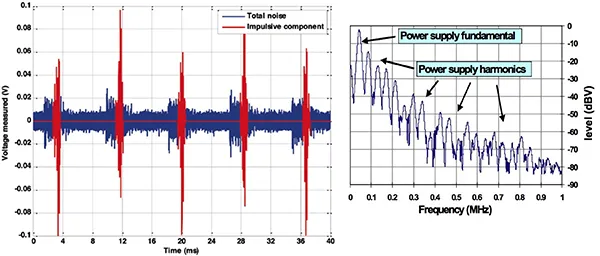
Figure 3: Low-voltage power lines are subject to impulse noise (A) and broadband noise from small appliances such as an electric toothbrush charger (B); these noise sources vary with consumer usage. (Image A: Texas Instruments; Image B: Echelon Corporation)
Noise levels on power lines vary widely: a frequency band may provide a clear communication channel for a period, only to be later overwhelmed by intermittent noise from household, office, or farm equipment. PLC receivers must often extract signals from sources with severely degraded signal-to-noise ratios.
Available PLC devices, including ST's ST7538Q, ST7540, and ST7580, provide binary frequency-shift keying (B-FSK), which offers robustness to amplitude fluctuations and nearby-band interference. While FSK can perform acceptably in low SNR environments, the broadband noise affecting many power lines demands more powerful communication schemes.
Noise-Resistant Modulation
To mitigate the impact of diverse power-line noise sources on PLC transmission, transceivers such as STMicroelectronics ST7570 implement spread FSK (S-FSK) as specified in IEC 61334, a standard for PLC in metering applications. For higher-performance requirements, designers can use OFDM support available in PLC devices like ST's ST7590 and TI's AFE030/031. OFDM employs multiple subchannels, which makes it particularly suitable for noisy media such as power lines.
Two major PLC standards, PRIME and G3, specify the use of OFDM to improve communications over noisy power lines. G3 provides an adaptive approach that allows compliant PLC devices to disable communications within severely impaired subbands. Its resilience in noisy environments makes G3 suitable not only for low-voltage consumer delivery but also for communications across transformers to data concentrators on medium-voltage lines that link transformers to utility substations.
Because of the complexity of these protocols, standards-compliant PLC modems require more capable devices. For example, the TI AFE031 PLC IC supports PRIME and G3, but TI recommends pairing it with a high-performance processor, such as a dual-core Concerto MCU, to execute the associated stack.
Among integrated PLC devices, Atmel's ATPL230A and ATPL250A implement PRIME and G3 modems respectively and are designed to work with high-performance MCUs such as the Atmel SAM4C series. For designers seeking a single-chip solution, the Atmel SAM4CP16B dual-core ARM Cortex-M4 PLC MCU integrates the PHY and Atmel's PLC stack in a single IC and supports both PRIME and G3.
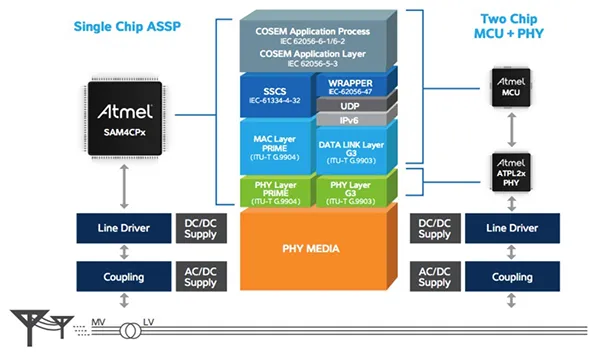
Figure 4: For PRIME and G3 PLC designs, engineers can build on a dual-chip platform that includes Atmel ATPL2x PLC devices and a SAM4C MCU, or on the SAM4CP16B single-chip solution that provides equivalent functionality. (Image: Atmel)
Development Kits
To simplify PLC design complexity, developers can use a range of development kits that combine key PLC ICs, processors, and software. Cypress Semiconductor's CY3274 development kit provides a quick start for developers using the CY8CPLC20 integrated PLC device.
STMicroelectronics offers the STEVAL-IPP004V1 development kit, which provides a complete PRIME-compliant module based on the ST7590 PLC device and an STM32F103 MCU.
Together with its PLC software suite, the TI TMDSP-LCKIT-V3 C2000 power-line modem development kit combines the AFE031, TMS320F28069 C28x Piccolo MCU, and support for S-FSK and OFDM to develop PRIME- and G3-compliant PLC solutions.
Conclusion
For rural areas, PLC can provide an effective method to connect smart meters, appliances, and devices to the smart grid. However, regulatory constraints, international standards, and the characteristics of power lines present significant design challenges. By leveraging commercially available PLC ICs and MCUs, designers can implement robust PLC solutions that operate on low-voltage lines and bridge transformers to connect to medium-voltage networks.