ALLPCB


Wearable technology refers to intelligent systems that can be worn on the body. These systems are used for behavior modeling, health monitoring, information and media services. Wearable computing is especially useful for applications that require computer support while the user is actively using their hands, voice, arms, or other parts of the body.
Research Areas and Related Fields
Wearable computing has been an active research area in user interface design, augmented reality, pattern recognition, assistive wearable devices for special applications or disability support, electronic textiles, and fashion design. Many issues overlap with mobile computing, ubiquitous computing, and ambient intelligence, including energy management and thermal dissipation, wireless software development, and personal area networking.
Core Characteristics
The primary characteristic of wearable computing is continuity of interaction between the computer and the user, without the need to explicitly turn the device on or off. Another feature is multitasking capability, allowing the device to augment the user's ongoing activities rather than interrupt them. These devices can integrate with the user in a manner similar to prosthetics, acting as extensions of the user's mind and body.
Product Types
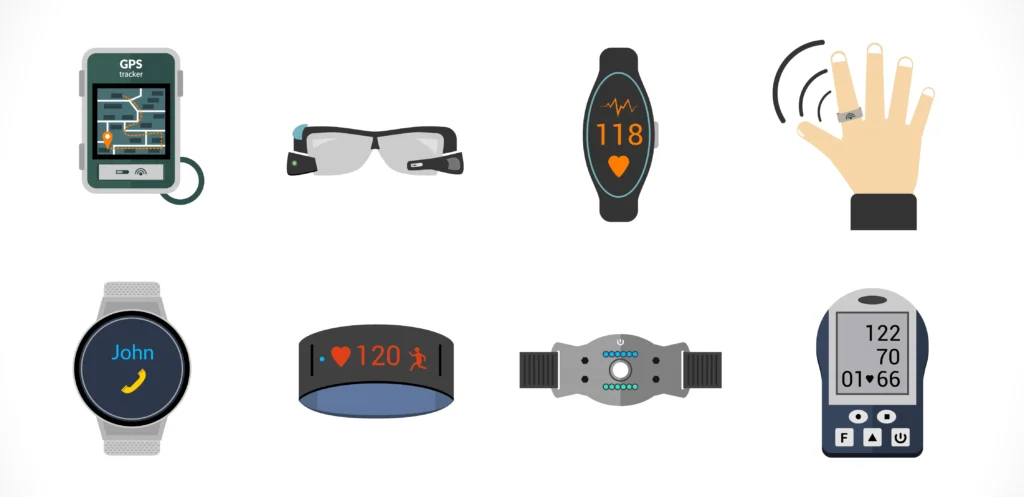
Wearable products are diverse. Common examples include smartwatches, head-mounted displays (HMDs), wearable cameras, fitness bands, smart clothing, heart-rate chest straps, sports watches, Bluetooth headsets, and other wearable devices. Market acceptance and product maturity vary across categories. Key application areas include:
Biometric Authentication
Biometric authentication has become mainstream thanks to fingerprint sensors in smartphones. Because wearables are worn close to the body and new sensors can capture more complex and tamper-resistant biometric signatures, biometric authentication is expected to be more widely applied to wearables. A major use case is supporting mobile payments: wearables with biometric authentication can enable payments through smartphone-hosted mobile payment solutions. Some wearables also incorporate dedicated payment functionality. Analysts predicted that by 2020 a significant share of sold smartwatches would be capable of mobile payments without requiring a paired smartphone.
Mobile Health Monitoring
Wearable health monitoring devices can collect and monitor physiological indicators such as weight, blood pressure, blood glucose, heart rhythm, sleep, and electrodermal activity, then upload the data to mobile apps and cloud services for monitoring, analysis, and feedback. When devices meet medical certification and user agreements, the collected data can be shared with clinicians to support patient monitoring and care improvement. This field can enable new telemedicine solutions, improve care for chronic conditions, and support medical research. Mobile health monitoring combined with biometric wearables can generate new service revenue through consultations and personalized advice, while reducing costs and improving resource utilization. Emerging markets have strong demand for these technologies due to limited access to medical resources in remote areas.
Energy Harvesting
Energy harvesting aims to capture ambient energy to supplement battery power and extend time between charges. Sources include radio-frequency waves, temperature differentials, solar energy, and mechanical vibration. This approach can generate extra power to extend wearable battery life, lower operating costs, and improve user experience. One common reason users abandon fitness devices is the need to recharge them frequently. Extending the interval between charges can change usage patterns.
Smart Coaching
Smart coaching is closely associated with fitness wearables. Analysts categorize these devices into bands, smart clothing, chest straps, sports watches, and other health monitors. Smart coaching functions collect multiple biometric data streams and use intelligent software and analytics to provide real-time fitness recommendations, feedback, and alerts. Users can follow coaching guidance for specific training tasks, receive smart fitness tips to improve effectiveness, or reduce the risk of injury. This function enhances the value proposition of fitness wearables.
Virtual Personal Assistants
Smartwatches and bands often have small or no screens, which presents user interface challenges. Virtual personal assistants can help overcome these limitations by delivering context-aware recommendations through wearables, including navigation, guidance, schedule management, to-do management, and message prioritization. Wearable sensing will evolve to combine different biometric data streams, such as heart rate and electrodermal activity, to infer user context and provide recommendations based on emotional or affective state. Wearables will also supply additional biometric data points to smartphones, potentially augmenting emotion detection beyond facial recognition. These developments are important to strengthen the value proposition of smartwatches and fitness bands and to increase their adoption.
Embedded Security
The proliferation of wearables introduces a new generation of devices into consumer and enterprise environments. Security concerns that once focused on smartphones are now emerging for wearables. Security measures can be implemented across software and hardware layers, and embedded security implemented at the hardware (chip) level is likely to see widespread adoption.
Conformal Electronics
Conformal electronics refers to tracking and electronic component technologies embedded in flexible and elastic polymer materials. This enables comfortable skin-mounted biosensors, electronic skin, electronic tattoos, smart clothing, bands, sports watches, and smartwatches. Conformal electronics combine polymer printing and etching with real miniature conductive wires, integrating printed and etched traces with tiny conductive elements made for electronics. In wearables, these technologies allow soft conformal computing elements to wrap or adhere comfortably to different body locations for noninvasive precise measurement or palpation.
Wearable Processors
Wearable processors are application-specific standard products (ASSP) or ASICs designed for the wearable market, including chip-scale systems or system-in-package (SiP) solutions. Unlike the general-purpose microcontrollers (MCUs) traditionally used in fitness devices, wearable processors integrate processing and other required functions at higher cost than discrete solutions. These processors support advanced operating systems such as Android Wear or Apple Watch OS, enable app downloads and execution, and manage complex displays, multimedia, sensor interfaces, and communications, thereby providing a higher value proposition for wearables.
Virtual Reality and Augmented Reality (VR and AR)
VR and AR can be effectively used with smartphones and tablets, but as wearable technologies they belong to immersive interfaces focused on human sensory experience. Head-mounted displays deliver immersive sensory experiences that require real-time interaction and feedback between rich virtual or real-world information and the user, demanding high computational performance. Consumer VR designs often use a smartphone combined with a headset and an app, while higher-end headsets require a powerful PC. Commercial VR/AR applications typically require custom content or special specifications. In the future, VR and AR will be paired with a variety of wearables to enhance immersion.
Accurate Motion Recognition
Motion tracking in wearables is based on inertial sensors such as gyroscopes, accelerometers, and magnetometers, often combined with sensor-fusion algorithms to identify and differentiate action types. Most current fitness devices provide simple, high-accuracy step counting. More sophisticated sensors and sensor-fusion algorithms can reduce error to 2%–5%, enabling wearables to offer capabilities far beyond basic step tracking.